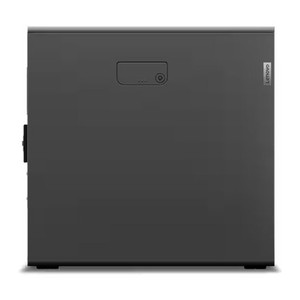
Lenovo 30GA008EUS ThinkStation P5 Professional Workstation
Overview
The Lenovo ThinkStation P5 (30GA008EUS) is a tower workstation built for compute-intensive professional workloads — surveillance analytics at scale, AI-assisted video review, 3D rendering, simulation, and multi-stream media production. It pairs an Intel Xeon W w7-2495X 24-core processor running at 2.5 GHz base (up to 4.8 GHz boost) with 64 GB of DDR5-SDRAM and an NVIDIA RTX 4000 Ada Generation GPU carrying 20 GB of VRAM. The result is a platform that can run concurrent high-demand applications without hitting memory bandwidth or compute ceilings that stall lighter workstations.
For integrators deploying enterprise video management systems, real-time analytics engines, or large-scale forensic workstations, the ThinkStation P5 sits in a class that handles multi-channel decode, deep learning inference, and VMS server duties simultaneously — tasks that push consumer-grade hardware into swap and stall within minutes.
Key Features
- Intel Xeon W w7-2495X — 24 Cores / 48 Threads: The 24-core, 48-thread configuration on the LGA 4677 socket means the OS scheduler has real headroom for parallel workloads. A VMS platform running 64 channels of H.265 decode alongside motion analytics and live client streaming won't saturate the CPU the way it would on a 12-core desktop chip. The 45 MB Smart Cache further reduces memory round-trips on large working sets.
- 2.5 GHz Base / 4.8 GHz Boost Frequency: Single-threaded workloads — codec licensing checks, database queries, UI rendering — benefit from the 4.8 GHz turbo headroom. The 225 W base TDP (270 W maximum turbo) tells you this is a processor that can sustain high performance without immediately throttling under load, provided rack or desktop cooling is adequate.
- 64 GB DDR5-SDRAM (4 × 16 GB, upgradeable to 512 GB): DDR5 brings higher bandwidth than DDR4 at equivalent capacity, which matters when multiple GPU and CPU processes are competing for memory throughput. The 4-slot population at 4 × 16 GB leaves slots open for expansion — a platform that can scale to 512 GB total means this chassis won't need to be retired when workloads grow.
- 1 × 2 TB M.2 2280 PCIe Gen4 TLC Opal SSD: PCIe Gen4 sequential read speeds roughly double PCIe Gen3, which compresses load times for large model files, video scrubbing through multi-terabyte recordings, and VM boot sequences. The Opal self-encrypting drive specification means hardware-level disk encryption is available without CPU overhead penalties — relevant for deployments with data-at-rest compliance requirements.
- NVIDIA RTX 4000 Ada Generation — 20 GB VRAM: The 20 GB VRAM capacity is the spec that directly addresses large-model inference. Running a deep learning video analytics model alongside a multi-monitor display workload, or batch-processing forensic video with AI-assisted object detection, benefits substantially from not spilling GPU memory to system RAM. For VMS deployments using GPU-accelerated codec decode (NVDEC), the Ada architecture handles concurrent streams with lower latency than prior-generation options.
- PCIe Gen 4.0 and Gen 5.0 Slots: Dual PCIe generations mean the platform can accept current Gen4 expansion cards today (additional GPUs, capture cards, high-speed NICs) while remaining compatible with Gen5 hardware as it enters the market. This matters for a workstation with a 5–7 year deployment horizon.
- Intel AX211vPro Wi-Fi + Bluetooth 5.1: Integrated Wi-Fi 6E and Bluetooth 5.1 cover wireless connectivity without an add-in card, useful in environments where wired Ethernet runs to the workstation aren't practical. For fixed workstation deployments, these remain as fallback or management interfaces.
- Windows 11 Pro for Workstations (64-bit): The Workstations edition of Windows 11 Pro adds ReFS file system support, persistent memory support, and SMB Direct — relevant if this machine is operating as a local storage node or connects to NAS/SAN infrastructure. It also carries higher RAM ceilings than standard Windows 11 Pro, which matters when scaling toward the 512 GB maximum.
- 3-Year Premier Next Business Day Warranty: Premier NBD coverage means on-site technician response by the next business day on a verified failure. For a production workstation running VMS, analytics, or live monitoring duties, this service tier reduces exposure to extended downtime compared to depot or mail-in support options.
Integration and Compatibility
The 30GA008EUS connects via PCIe, USB, and Ethernet interfaces. The Xeon W platform's ECC memory support (characteristic of the Xeon W family and LGA 4677 socket) reduces silent data corruption risk in long-running server-mode deployments. The system ships with Windows 11 Pro for Workstations, which has broad driver support across professional software stacks including most major VMS platforms, GPU compute frameworks (CUDA, OpenCL), and enterprise endpoint management tools.
For surveillance integrators evaluating this as a dedicated analytics or VMS server, the combination of a 24-core Xeon W, 20 GB RTX 4000 Ada, and PCIe Gen4/5 expansion provides sufficient headroom to run GPU-accelerated video decode, AI analytics inference, and NVR recording duties concurrently — workloads that typically require separate hardware on lighter platforms.
Frequently Asked Questions
Q: What processor does the Lenovo ThinkStation P5 30GA008EUS use?
A: It uses the Intel Xeon W w7-2495X, a 24-core, 48-thread processor on the LGA 4677 (Socket E) platform running at 2.5 GHz base and up to 4.8 GHz boost, with 45 MB of Smart Cache and a 225 W base TDP.
Q: How much memory does the 30GA008EUS ship with, and can it be upgraded?
A: It ships with 64 GB of DDR5-SDRAM configured as 4 × 16 GB. The platform supports a maximum of 512 GB, so there is significant room to expand without replacing the chassis.
Q: What GPU is included, and is the VRAM sufficient for AI video analytics workloads?
A: The system includes an NVIDIA RTX 4000 Ada Generation GPU with 20 GB of VRAM. That capacity supports large deep learning inference models alongside concurrent multi-monitor and video decode workloads without spilling to system memory.
Q: What storage does the ThinkStation P5 30GA008EUS include?
A: It ships with a single 2 TB M.2 2280 PCIe Gen4 Performance TLC Opal SSD. The Opal specification enables hardware-level self-encrypting drive capability for data-at-rest compliance without CPU performance overhead.
Q: Does the 30GA008EUS support PCIe Gen 5 expansion?
A: Yes. The platform includes both PCIe Gen 4.0 and Gen 5.0 slots, allowing current Gen4 cards and future Gen5 hardware to be installed as needed.
Q: What warranty does the ThinkStation P5 30GA008EUS carry?
A: It includes a 3-Year Premier Next Business Day on-site warranty, which provides next-business-day technician response on verified hardware failures.
The ThinkStation P5 30GA008EUS is one of the few workstations I'd confidently recommend as a combined VMS server and GPU analytics node without immediately adding a second machine. The 20 GB VRAM on the RTX 4000 Ada is the reason — most 16 GB GPU workstations hit ceiling when you try to run a real-time deep learning analytics engine alongside multi-channel H.265 decode, and then you're buying a second GPU or a second server. At 20 GB, you have practical breathing room to keep both workloads resident on the GPU without eviction.
Technical Highlights:
- 24-Core Xeon W w7-2495X at 4.8 GHz Turbo: Parallel decode threads, analytics scheduling, and VMS database I/O all compete for CPU resources in a large-channel deployment. 48 threads at up to 4.8 GHz means these workloads genuinely share the processor rather than serializing — a configuration running 64+ channels should see meaningful headroom above the CPU saturation point common on 8–12 core platforms.
- DDR5-SDRAM, 512 GB Maximum: The DDR5 memory bus feeds both the CPU compute pipeline and GPU transfers faster than DDR4. Shipping at 64 GB with room to reach 512 GB means this workstation can grow into a heavier role — whether that's expanding VMS channel count or adding in-memory database workloads — without a chassis swap.
- PCIe Gen4 Opal SSD (2 TB) + Gen4/Gen5 Expansion Slots: The Opal SED capability handles data-at-rest encryption requirements in regulated environments (healthcare surveillance, government facilities) without any measurable CPU overhead. The dual PCIe generations future-proof the expansion bus through the next hardware cycle.
Deployment Considerations:
- The Xeon W w7-2495X has a 225 W base TDP and a 270 W maximum turbo power draw — sustained compute workloads will approach that ceiling. Rack or desktop placement needs adequate airflow; this is not a machine to slot into a closed credenza or network closet without thermal planning.
- The system ships with a single 2 TB NVMe SSD. For VMS deployments recording to local storage at high bitrates, 2 TB fills quickly — plan supplemental storage (additional M.2, PCIe RAID card, or external NAS) before deployment rather than after the drive fills mid-recording.
This configuration makes the most sense as a dedicated analytics and VMS workstation in a physical security operations center, a forensic review station, or a broadcast-adjacent environment where GPU memory ceiling and multi-threaded CPU performance are both constraints — not just one of them.