Lenovo 30J5005SUS ThinkStation P3 Ultra Small Form Factor Workstation
Overview
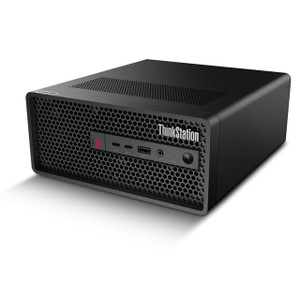
The Lenovo 30J5005SUS is a second-generation ThinkStation P3 Ultra in a Small Form Factor (SFF) chassis, built around Intel's Core Ultra 9 285K vPro processor. At 9 lb and sized to fit under a monitor or in a rack-adjacent shelf, it targets deployments where workstation-class compute needs to live at the edge — VMS servers, video analytics nodes, command centers, and surveillance operator stations where a tower footprint is simply not acceptable.
The 285K is a 24-core vPro part with E-cores topping out at 4.60 GHz, which means the 30J5005SUS can sustain simultaneous decode, analytics inference, and operator UI workloads without the thermal throttling that plagues slimmer mini-PC alternatives. vPro hardware manageability (Intel AMT) is baked in — relevant for IT teams running remote provisioning across distributed physical security infrastructure.
Key Features
- Intel Core Ultra 9 285K vPro, 24 Cores: The 285K's hybrid architecture separates performance-critical threads (VMS decode, analytics) from background tasks (OS, telemetry) at the hardware level. 24 threads available means multi-stream decoding and concurrent analytics pipelines won't fight each other for scheduler headroom. vPro adds out-of-band remote management — useful when this unit is deployed in a server closet or unmanned security booth.
- DDR5-6400MHz Memory, Up to 128GB: Ships with 16GB in a single SO-DIMM, leaving the second slot open. Populating both slots enables dual-channel DDR5 at 6400MHz — at current DDR5 pricing, upgrading to 32GB or 64GB is straightforward. The 128GB ceiling is meaningful for VMS deployments running high-channel counts with in-memory frame buffering or AI inference models loaded into RAM.
- 512GB PCIe 5.0 SSD: PCIe 5.0 storage delivers sequential throughput roughly double that of PCIe 4.0 drives — practically speaking, faster VMS database writes, quicker boot-to-operational state after a power event, and headroom for concurrent read/write during live recording. The 512GB base is adequate for OS and application; bulk video storage should be offloaded to a NAS or NVR.
- Small Form Factor Chassis, 9 lb: The SFF enclosure fits on a desk, mounts behind a monitor arm, or slides into a shallow equipment shelf. At 9 lb, a single technician can relocate or swap units without assistance — relevant for distributed retail or multi-site deployments where on-site service calls need to be fast.
- 2x SO-DIMM Slots: The dual-slot layout gives integrators a clear upgrade path. Ship the unit with 16GB for standard operator workstation builds; field-upgrade to 32GB or beyond for sites where the same unit will also run analytics or VMS server processes. No board swap required.
- Single Installed SSD, Expandable Storage Architecture: One SSD installed leaves internal expansion available. For surveillance use cases requiring local retention, the expansion bay allows adding a second SSD without touching the primary OS drive — cleaner than external USB storage from a reliability and cable-management standpoint.
Integration and Compatibility
The Core Ultra 9 285K is compatible with current-generation VMS platforms that publish system requirements for Intel Core i9/Ultra 9 processors. The vPro platform supports Intel AMT for remote KVM and provisioning — integrators managing distributed security infrastructure can provision, reimage, or reboot the 30J5005SUS out-of-band without requiring physical access. DDR5 at 6400MHz is the current standard for 14th/15th-gen Intel platforms; confirm your VMS vendor's validated hardware list if using GPU-accelerated analytics, as GPU selection (not included in base config) will drive those requirements independently.
For deployments pairing this workstation with IP cameras, review your IP camera channel counts against VMS decode requirements before finalizing RAM and CPU allocation. Integrators running network video recorders alongside operator workstations should evaluate whether a dedicated NVR or a software-defined VMS on this platform better fits the site's redundancy model. A PoE network switch upstream of this unit will handle camera power and data independently of the workstation's network interface. For storage planning on multi-camera deployments, consult a video surveillance storage guide to size retention correctly before committing to a single-SSD base configuration.
Frequently Asked Questions
Q: What is the maximum RAM the 30J5005SUS supports?
A: The 30J5005SUS supports up to 128GB of DDR5-SDRAM across two SO-DIMM slots. The base configuration ships with a single 16GB module, leaving one slot open for upgrade.
Q: Does the 30J5005SUS include an operating system?
A: Operating system inclusion is not confirmed in the available specification data. Verify OS licensing with your reseller at time of purchase.
Q: What storage interface does the SSD use in the 30J5005SUS?
A: The installed 512GB SSD uses a PCIe 5.0 interface — the current-generation standard that provides roughly twice the sequential throughput of PCIe 4.0 drives.
Q: Is the 30J5005SUS suitable as a VMS server for multi-camera surveillance deployments?
A: The Core Ultra 9 285K with 24 cores and up to 128GB DDR5 RAM provides sufficient compute for multi-stream VMS workloads. The 512GB base SSD is adequate for OS and VMS application files; video storage should be offloaded to dedicated NAS or NVR storage. Validate against your VMS vendor's hardware requirements for the specific channel count and analytics load.
Q: How much does the 30J5005SUS weigh, and can it be mounted?
A: The unit weighs 9.00 lb. The Small Form Factor chassis is designed for desk, shelf, or behind-monitor placement. Confirm mount compatibility with Lenovo's mounting accessory specifications for this chassis generation.
The 30J5005SUS sits in an interesting spot for physical security integrators: it's a genuine workstation — not a ruggedized mini-PC or a repurposed consumer NUC — in a chassis that weighs 9 lb and fits on a shelf. The Core Ultra 9 285K's 24-core count combined with DDR5-6400MHz memory at up to 128GB is a meaningful differentiator over lighter SFF systems when you're running a software VMS with concurrent stream decode and on-host analytics.
Technical Highlights:
- Core Ultra 9 285K, 24 Cores: vPro manageability means IT can reach this box remotely via Intel AMT without requiring a functioning OS — critical for unmanned security closets where a crashed VMS needs a remote power cycle or KVM session to recover without rolling a truck.
- DDR5-6400MHz, Single-Channel Base: Ships 16GB in one SO-DIMM slot. Single-channel DDR5 at 6400MHz is fast, but dual-channel provides roughly 30–40% additional memory bandwidth — for multi-stream decode workloads, populating both slots before deployment is worth doing at the bench, not in the field.
- PCIe 5.0 SSD: 512GB on PCIe 5.0 handles OS, VMS application, and index files without storage becoming a bottleneck. The interface headroom matters less for surveillance write patterns (sequential) than for VMS database random reads during playback and export.
Deployment Considerations:
- Size the RAM upgrade before deployment: single-channel 16GB is viable for light operator workstation use, but any VMS server role running more than a handful of analytics streams warrants 32GB minimum in dual-channel configuration — order the second SO-DIMM with the unit.
- The 512GB SSD is not large enough for local video retention on any meaningful channel count. Plan NAS, NVR, or SAN storage separately and treat this unit's SSD as OS-and-application only.
The 30J5005SUS is well-positioned as the operator workstation or edge VMS node in a mid-size physical security deployment — command centers, retail loss prevention rooms, or distributed enterprise sites where compute needs to be workstation-class but rack space and weight are constraints.