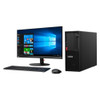
Lenovo 30J50033US ThinkStation P3 Ultra SFF G2 Workstation
Overview
The Lenovo 30J50033US is a compact Small Form Factor (SFF) workstation built around Intel's Core Ultra 9 285K vPro processor — a 24-core (8P+16E) chip that handles the parallel decode and analytics processing demands of large-scale surveillance workstations without the rack footprint of a tower. At 13.2 lb and 12 × 19 × 8 inches, it fits under a desk, on a shelf, or inside a compact equipment closet where a full tower simply won't go. With 80 GB of RAM, a 1 TB PCIe Gen5 NVMe SSD, NVIDIA RTX A1000 8GB, and Intel BE200 vPro Wi-Fi 7, this is a machine specced for real workloads — not light office use.
For security integrators and VMS architects, the P3 Ultra SFF G2 (30J50033US) sits at the intersection of compute density and physical footprint: enough GPU and CPU headroom to run multi-stream video decoding, deep learning analytics inference, and live operator display simultaneously, without requiring a dedicated server room.
Key Features
- Intel Core Ultra 9 285K vPro (24 cores, 36 MB cache, up to 5.6 GHz boost): The hybrid 8P+16E architecture means the processor can assign performance-intensive tasks — video decoding, analytics inference — to the 8 P-cores running up to 5.4 GHz, while background OS and management tasks run on the 16 E-cores at up to 4.6 GHz. This division of labor keeps latency low on live streams even when the machine is simultaneously indexing footage or running scheduled exports. The 36 MB Smart Cache reduces memory fetch latency on workloads that repeatedly access the same decoded frame buffers.
- NVIDIA RTX A1000 8GB: Purpose-built professional GPU with 8 GB of VRAM — enough to drive multi-monitor operator consoles (typical VMS deployments run 2–4 displays) and offload GPU-accelerated video decode from the CPU simultaneously. Unlike consumer GeForce cards, the RTX A1000 carries ECC memory support and professional driver stability, which matters in always-on security operations centers where a driver crash means a blind operator.
- 80 GB RAM: Most enterprise VMS platforms (Milestone XProtect, Genetec Security Center, Axis Camera Station Pro) recommend 32–64 GB for installations above 32 concurrent streams. 80 GB gives you meaningful headroom for larger deployments or for running VMS, access control, and video analytics on the same machine without thrashing swap.
- 1 TB PCIe Gen5 TLC Opal SSD (M.2 2280): Gen5 NVMe sequential reads reach roughly 12–14 GB/s on qualifying drives — fast enough to handle simultaneous high-bitrate write (recording) and read (live review or export) without the I/O bottleneck that plagues SATA-based systems. The Opal self-encrypting drive (SED) capability supports TCG Opal 2.0 hardware encryption, so footage at rest can be encrypted without CPU overhead — important for healthcare, finance, and government deployments with data-at-rest compliance requirements.
- Intel BE200 vPro (Wi-Fi 7 / 802.11be) + BT 5.1: Wi-Fi 7 supports multi-link operation (MLO), which means the adapter can bond 2.4 GHz, 5 GHz, and 6 GHz bands simultaneously for lower latency and higher aggregate throughput. In a security operations center with a congested 5 GHz environment, this reduces the chance of a wireless hop becoming a bottleneck on remote management or secondary network paths. Ethernet remains the primary recommendation for VMS traffic; Wi-Fi 7 is the right fallback or out-of-band management path.
- PCIe, USB, and Ethernet interfaces: PCIe expansion allows adding capture cards, additional NIC ports, or hardware security modules as the deployment grows. USB supports local peripherals and out-of-band enrollment devices. The combination gives integrators flexibility to adapt the machine to site-specific requirements without replacing the base unit.
- Windows 11 Pro 64-bit pre-installed: Ships ready for domain join and GPO management. vPro platform support enables Intel AMT (Active Management Technology) for out-of-band remote access — useful when the workstation is deployed in a remote or unmanned location and needs firmware-level recovery without a local technician.
- Small Form Factor, 13.2 lb: The SFF chassis fits in spaces where a tower won't — under a reception desk, in a shallow AV cabinet, or on a shelf in a wiring closet. At 13.2 lb, a single technician can rack, mount, or relocate it without assistance. The compact footprint does constrain internal expansion compared to a full tower; plan storage and I/O additions at procurement time.
Integration and Compatibility
The Lenovo ThinkStation platform is broadly compatible with enterprise VMS software. The PCIe Gen5 SSD and RTX A1000 GPU combination supports hardware-accelerated decode in Milestone XProtect, Genetec Security Center, and most ONVIF-compliant platforms that leverage NVIDIA NVDEC. The vPro platform integrates with Intel EMA (Endpoint Management Assistant) and Microsoft Endpoint Manager for fleet management in enterprise deployments.
For larger NVR and recording server builds where the 1 TB onboard SSD is insufficient for long-term retention, plan an external DAS or NAS solution — the SFF chassis limits internal drive expansion. The RTX A1000 supports up to 4 simultaneous display outputs, which covers most control room configurations. If your deployment requires more than 4 operator displays, a second GPU or a dedicated display wall controller will be needed.
The Intel BE200 adapter also supports Bluetooth 5.1, which can be used for proximity-based access or device pairing in integrated physical security scenarios. For primary VMS traffic, wire the Ethernet port to your surveillance VLAN — keep Wi-Fi for management only.
Explore the full surveillance server and workstation lineup to compare channel capacity and GPU options across the range. If your deployment has strict VMS hardware sizing requirements, match stream count and analytics load to available GPU VRAM and CPU core count before specifying.
Frequently Asked Questions
Q: How many concurrent camera streams can the 30J50033US handle in a typical VMS deployment?
A: Stream capacity depends on resolution, codec, and analytics load, but the Core Ultra 9 285K (24 cores, 5.6 GHz boost) paired with the RTX A1000 8GB GPU provides substantial headroom. Most enterprise VMS platforms support GPU-accelerated decode via NVIDIA NVDEC, which offloads stream decoding from the CPU. For a practical ceiling, consult your VMS vendor's hardware sizing calculator with your specific stream resolutions and analytics requirements.
Q: Does the 30J50033US support hardware encryption for stored footage?
A: Yes. The included 1 TB M.2 NVMe SSD is a TCG Opal self-encrypting drive (SED), which supports hardware-based at-rest encryption without CPU overhead. This meets data-at-rest requirements common in healthcare, finance, and government security deployments.
Q: Is the 30J50033US compatible with remote out-of-band management?
A: Yes. The vPro platform includes Intel AMT (Active Management Technology), which provides firmware-level remote access independent of the operating system. This is particularly useful for unmanned or remote deployments where a failed OS boot would otherwise require a local technician.
Q: Can the 30J50033US drive multiple operator monitors?
A: The NVIDIA RTX A1000 supports up to 4 simultaneous display outputs, covering most control room and security operations center configurations. If more than 4 displays are required, a second GPU or dedicated display controller will be needed — the SFF chassis limits internal expansion options.
Q: What is the storage expansion path if 1 TB is insufficient for video retention?
A: The SFF form factor limits internal drive bays, so long-term video retention beyond the onboard 1 TB SSD will require an external DAS, NAS, or SAN solution connected via USB or network. Plan storage architecture at procurement time rather than retrofitting later.
Q: Does the 30J50033US ship with an operating system?
A: Yes, it ships with Windows 11 Pro 64-bit pre-installed, ready for domain join and enterprise GPO management.
The 30J50033US stands out in the SFF workstation category specifically because of the RTX A1000 8GB pairing with the Core Ultra 9 285K — that GPU-to-CPU balance is what separates a machine that runs a VMS from one that runs a VMS well under load. Most SFF platforms in this class ship with integrated or entry-level discrete graphics that can't sustain hardware decode across 32+ simultaneous high-resolution streams. The A1000's NVDEC engine changes that calculus meaningfully.
Technical Highlights:
- Core Ultra 9 285K — 8P + 16E cores, 5.6 GHz boost: The P-core/E-core split means analytics inference and stream decode get dedicated high-frequency cores while OS scheduling, logging, and background services run on the E-cores at 1.9–4.6 GHz. Under a sustained 64-stream load, this architecture prevents background tasks from stealing cycles from live video.
- PCIe Gen5 NVMe SSD (1 TB, TLC Opal): Gen5 sequential throughput eliminates the I/O bottleneck that shows up in multi-camera simultaneous write-and-read scenarios. The Opal SED capability means hardware encryption is available at zero CPU cost — relevant for any deployment with data-at-rest compliance obligations.
- Intel vPro + AMT (BE200 adapter): Out-of-band management via AMT means you can remotely power cycle, mount a recovery ISO, or access BIOS from a remote site without dispatching a technician. In distributed deployments with workstations at unmanned branch locations, this is operational insurance worth having.
Deployment Considerations:
- The SFF chassis is the primary constraint: internal storage tops out at one M.2 drive. Any deployment requiring more than 1 TB of local retention needs an external storage plan — DAS via USB or a network-attached recording server — specified before installation, not after.
- The 182W maximum turbo power draw is worth noting for UPS sizing. Under sustained analytics + multi-stream decode load, this machine can approach that ceiling. Size your UPS for at least 250W per unit with runtime margin; don't use a shared branch-circuit UPS that was sized for standard office PCs.
The 30J50033US is the right workstation for a distributed physical security deployment where each site needs a compact, self-contained VMS node — a retail branch, a small campus building, or a manufacturing floor control room — where full tower or rack hardware is impractical but genuine multi-stream performance and professional GPU stability are non-negotiable.