Lenovo 30HT004WUS ThinkStation P3 Tower Gen2 Commercial Workstation
Overview
The Lenovo ThinkStation P3 Tower Gen2, model 30HT004WUS, is a commercial-grade tower workstation built around Intel's Core Ultra 7 265 processor — a 20-core, 20-thread chip designed for multi-application workloads that stall on conventional quad- or hex-core desktops. Whether you're running security camera VMS software alongside analytics engines, driving CAD/BIM workflows, or provisioning a high-performance IT administration workstation, the P3 Tower Gen2 positions itself as a deployable, serviceable platform rather than a consumer-tier machine dressed up for the office.
The 265 lands in Intel's Core Ultra 7 family — a generation that separates compute tiles from I/O fabric, giving sustained multi-threaded throughput without the thermal throttle you'd see in a monolithic die under sustained load. For integrators standing up network video recorders or VMS server roles on tower hardware, that distinction matters when the CPU is simultaneously decoding streams, running motion indexing, and serving the management interface.
Key Features
- Intel Core Ultra 7 265 — 20 Cores / 20 Threads: Unlike consumer processors with mixed efficiency/performance core ratios optimized for bursty desktop tasks, the 265's 20-thread configuration sustains parallel workloads without the scheduling latency you get when threads bounce between P-cores and E-cores. For VMS workloads running concurrent stream decode and analytics, that consistency matters more than peak single-thread speed.
- 16 GB DDR5-5600 MHz (1 x 16 GB DIMM): DDR5 at 5600 MHz roughly doubles the memory bandwidth of DDR4-3200, which translates directly to faster frame buffer throughput when driving high-resolution displays or feeding GPU compute tasks. The single-DIMM configuration means you're running single-channel today — adding a matched second DIMM uses one of the three remaining slots and enables dual-channel, a meaningful upgrade if workload profiling shows memory-bandwidth saturation.
- Up to 256 GB Maximum RAM (4x DIMM Slots): The four DIMM slots and 256 GB ceiling give this platform runway for memory-heavy workloads — ECC-capable configurations for database roles, large in-memory analytics jobs, or dense VM hosting — without requiring a workstation-class chassis swap mid-lifecycle.
- 512 GB PCIe 5.0 NVMe SSD: PCIe Gen 5 storage doubles the theoretical bandwidth ceiling of Gen 4 — sequential reads in the 10–14 GB/s range versus 5–7 GB/s. In practice, the gap narrows under real workloads, but the interface headroom matters for sustained large-file I/O: video editing scratch, database temp files, or VM image read/write without storage becoming the bottleneck.
- DVD±RW Optical Drive: An increasingly rare inclusion on commercial towers. Useful for regulated environments that distribute software on physical media, for imaging systems from original OEM discs, or for reading legacy data archives. If your deployment has no optical requirement, the bay is recoverable for additional storage.
- Windows 11 Pro: Ships with the Pro license — not Home — which means domain join, BitLocker, Remote Desktop host, Hyper-V, and Group Policy are all accessible out of the box. For managed IT environments running Active Directory or endpoint management platforms like SCCM/Intune, the Pro SKU is required; re-licensing from Home post-deployment is an avoidable cost and complexity.
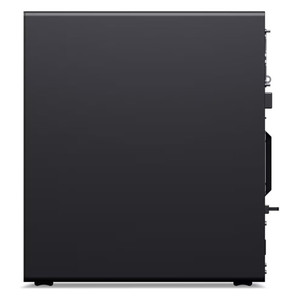
- Commercial Tower Form Factor (~9 lb): At approximately 9 lb, the P3 Tower is a traditional desktop chassis — floor- or desk-placed, with accessible internal bays and standard PCIe slot expansion. That means adding a discrete GPU for VMS decode offload, a capture card, or additional NIC is a standard slot-in operation rather than a proprietary upgrade path.
Integration and Compatibility
The ThinkStation P3 Tower Gen2 runs Windows 11 Pro natively, making it compatible with the full range of VMS platforms — Milestone XProtect, Genetec Security Center, Avigilon Control Center, and others — without OS compatibility workarounds. The Core Ultra 7 265 supports Intel vPro platform features on qualified configurations, enabling out-of-band management for remote IT departments that need to reach machines regardless of OS state. Integrators pairing this workstation with PoE network switches and IP camera infrastructure will find the platform well-suited to serve as a dedicated VMS server or analytics processing node in medium-density deployments. For a detailed look at how workstation selection affects camera system performance, see the security camera system planning guide.
The 4-slot DDR5 architecture gives IT architects flexibility for future memory expansion without a platform change. The PCIe 5.0 SSD interface also supports NVMe namespaces required by some enterprise storage configurations. For environments considering RAID or multi-drive setups, verify the specific motherboard storage controller capabilities against your target configuration before specifying additional drives.
Frequently Asked Questions
Q: How many memory slots does the 30HT004WUS have, and what is the maximum supported RAM?
A: The 30HT004WUS has four DIMM slots supporting DDR5-SDRAM. The maximum supported internal memory is 256 GB. The unit ships with a single 16 GB module installed, leaving three slots open for expansion.
Q: What type of storage does the 30HT004WUS use, and can I add more drives?
A: It ships with a single 512 GB PCIe 5.0 NVMe SSD. The tower form factor provides internal bays for additional storage; verify available M.2 and SATA ports on the specific motherboard configuration before specifying additional drives.
Q: Does the 30HT004WUS ship with a Windows license?
A: Yes. The 30HT004WUS includes Windows 11 Pro, which supports domain join, BitLocker encryption, Remote Desktop host, Hyper-V, and Group Policy — features required in most managed enterprise environments.
Q: Is the 30HT004WUS suitable for use as a VMS server for IP security camera systems?
A: The Core Ultra 7 265's 20-core/20-thread configuration and DDR5 memory bandwidth make it capable of handling multi-stream VMS decode and analytics workloads. Specific channel capacity depends on the VMS platform, codec, resolution, and whether GPU offload is added via PCIe expansion. Consult your VMS vendor's server sizing guide for your target stream count.
Q: What is the processor in the 30HT004WUS?
A: The 30HT004WUS is equipped with the Intel Core Ultra 7 265 — a 20-core, 20-thread processor from Intel's Core Ultra 7 family, running with DDR5-5600 memory support.
Q: Does the 30HT004WUS include an optical drive?
A: Yes, it includes a DVD±RW optical drive — useful for environments that distribute or archive software on physical media.
The 30HT004WUS stands out in the commercial tower segment specifically because of the DDR5-5600 memory bus paired with the Core Ultra 7 265 — when I'm sizing workstations for VMS roles, memory bandwidth is consistently the first bottleneck I hit on multi-stream decode, and DDR5 at 5600 MHz gives you roughly double the throughput of the DDR4-3200 configs that still populate a lot of tower workstation offerings at this price point.
Technical Highlights:
- Core Ultra 7 265 — 20 Cores, 20 Threads: No hyperthreading asymmetry to manage around — all 20 threads are available as full compute threads. On sustained parallel workloads like concurrent stream decode plus indexing plus VMS UI, that evenness in scheduling prevents the thread-starvation patterns I've seen on mixed P/E-core consumer chips under sustained load.
- PCIe 5.0 NVMe SSD (512 GB): Gen 5 storage interface means you have headroom for video scratch, database temp files, and rapid VM image operations without the SSD becoming a sustained-write bottleneck. At a 10–14 GB/s sequential ceiling, this is the right interface for any role involving large-file I/O under concurrent access.
- 4x DIMM / 256 GB Maximum: Ships single-channel (1x 16 GB), which is worth noting during initial spec review — a matched second DIMM converts the memory subsystem to dual-channel and is the single highest-ROI upgrade on day one for memory-bound workloads.
Deployment Considerations:
- The single 16 GB DIMM means the workstation ships in single-channel memory mode. If the deployment involves concurrent VMS decode, analytics, and OS overhead, budget a matching second 16 GB DDR5-5600 DIMM at deployment to enable dual-channel — it's a straightforward DIMM slot install with the remaining three open slots.
- The PCIe expansion slots (type and count not specified in available documentation) are the path to GPU decode offload for high-channel-count VMS deployments — verify slot configuration against your GPU shortlist before finalizing the workstation spec for large-scale installs.
For a mid-tier VMS server role in a 32–64 camera enterprise deployment — where you need a serviceable tower platform, Windows 11 Pro domain integration, fast storage, and room to grow memory — the 30HT004WUS is a defensible pick. I'd specifically call it out for physical security operations centers that need a dedicated analytics processing node and want to avoid the rack and cooling overhead of a 1U/2U server deployment.