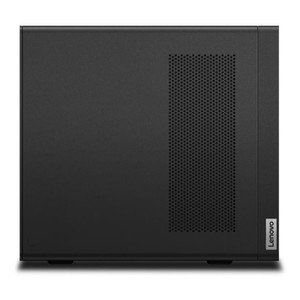
Lenovo 30HA00AQUS ThinkStation P3 Ultra Compact Workstation
Overview
The Lenovo ThinkStation P3 Ultra 30HA00AQUS is a compact, high-density professional workstation built around Intel's 20-core Core i7-14700 vPro processor, 64GB of DDR5-4800 RAM, a 2TB PCIe Gen 4 NVMe SSD, and the NVIDIA RTX 2000 Ada Generation GPU with 16GB of dedicated VRAM. It is positioned for deployment environments where desktop-class compute performance must fit within a constrained physical footprint — security operations centers, video analytics servers, engineering workstations, and multi-display surveillance review stations. Weighing in at 9 lbs with an M.2 form factor chassis, the 30HA00AQUS packs a 300W power supply into a package that can be rack-adjacent or tucked directly at a workstation desk without dominating the space.
Key Features
- Intel Core i7-14700 vPro (20 cores / 28 threads): The 20-core hybrid architecture — mixing performance and efficiency cores with a boost clock up to 5.3 GHz and a base of 2.1 GHz — handles simultaneous tasks like live VMS decoding, AI analytics processing, and operator UI without saturating. vPro adds out-of-band manageability, which matters for IT departments that need to patch, reboot, or diagnose a workstation remotely without standing in front of it.
- 64GB DDR5-4800 (2 x 32GB SO-DIMM, expandable to 192GB): DDR5-4800 delivers roughly 40% more bandwidth than DDR4 at equivalent frequency — relevant when the system is decoding multiple high-resolution video streams in parallel. Two of the four SO-DIMM slots are populated, leaving headroom to double or triple RAM as the workload scales. 192GB maximum means this platform can grow with a deployment rather than requiring a hardware swap.
- 2TB PCIe Gen 4 NVMe SSD (M.2 2280, TLC Opal): PCIe Gen 4 delivers sequential reads typically exceeding 7,000 MB/s — fast enough that loading a multi-week archive of 4K surveillance footage for forensic review doesn't bottleneck the analyst. Opal self-encrypting drive support means at-rest encryption can be enforced without software overhead, a requirement in many government and healthcare deployments.
- NVIDIA RTX 2000 Ada Generation, 16GB GDDR6: The Ada Lovelace architecture brings hardware-accelerated AV1 decode alongside H.264/H.265, which is directly applicable to modern IP camera streams and VMS platforms that have adopted AV1. 16GB of VRAM accommodates large AI inference models — object detection, license plate recognition, behavioral analytics — running simultaneously alongside the display workload.
- Intel AX211 Wi-Fi 6E + Bluetooth 5.1, Gigabit Ethernet: Tri-band Wi-Fi 6E (6 GHz band) provides a low-latency wireless fallback for lab or staging environments, while the wired Gigabit Ethernet handles primary production network connectivity. PCIe, USB, and Ethernet interfaces are available for peripheral and external device expansion.
- 300W Power Supply: The 300W internal PSU is sized to sustain the RTX 2000 Ada under GPU compute load alongside the i7-14700 without throttling. No external power brick — the supply is internal to the chassis, keeping the cable run clean at the workstation.
- Windows 11 Pro 64-bit (English): Ships with a full retail-grade OS license — no separate Windows activation cost to budget, and the Pro SKU includes BitLocker, Hyper-V, and Group Policy support for enterprise domain join and MDM enrollment.
- 3-Year Premier Support: Premier Support provides direct access to advanced-level technicians rather than tiered consumer call centers — relevant for deployments where workstation downtime has an operational cost.
Integration and Compatibility
The 30HA00AQUS connects via standard PCIe, USB, and Ethernet interfaces, making it compatible with the broad ecosystem of IP camera NVRs, VMS software clients (Milestone XProtect, Genetec Security Center, Avigilon Control Center, and similar), and GPU-accelerated analytics platforms that run on Windows 11 Pro. The RTX 2000 Ada supports NVIDIA's video codec SDK (NVDEC/NVENC), which VMS platforms like Milestone and Genetec leverage for hardware-accelerated decode — reducing CPU load when monitoring high channel counts. vPro manageability integrates with Intel vPro Platform-compatible IT management tools (Intel EMA, Microsoft Endpoint Manager) for remote provisioning and out-of-band access. The Opal-compliant SSD is compatible with enterprise TCG Opal management solutions for centrally managed disk encryption policy enforcement.
For Lenovo workstation deployments in security operations or video analytics environments, this platform sits within the broader professional workstations category. Buyers evaluating storage expansion should consider pairing with a compatible NAS or network storage solution for long-term video archive offload. If GPU compute density is the primary driver, review the rack server category for multi-GPU configurations. For a complete workstation build, a multi-display monitor setup is a natural complement given the RTX 2000 Ada's multi-output capability.
Frequently Asked Questions
Q: How much RAM can the 30HA00AQUS support, and can I upgrade after purchase?
A: The 30HA00AQUS ships with 64GB (2 x 32GB) in two of its four SO-DIMM slots. Maximum supported memory is 192GB, so you can add or swap modules post-deployment to scale with workload. DDR5-4800 is the required memory type.
Q: Does the 30HA00AQUS support hardware-accelerated video decoding for surveillance VMS platforms?
A: Yes. The NVIDIA RTX 2000 Ada Generation GPU supports NVDEC hardware decode for H.264, H.265, and AV1, which is leveraged by major VMS platforms including Milestone XProtect and Genetec Security Center to offload stream decoding from the CPU — allowing higher concurrent camera channel counts without CPU saturation.
Q: Is the SSD in the 30HA00AQUS self-encrypting?
A: Yes. The 2TB M.2 2280 PCIe Gen 4 SSD is TCG Opal-compliant, meaning it supports hardware-based self-encryption. This can be managed via enterprise Opal management tools or Windows BitLocker with eDrive, satisfying at-rest encryption requirements without software-overhead penalties.
Q: What is the warranty on the 30HA00AQUS?
A: The 30HA00AQUS includes a 3-Year Premier Support warranty from Lenovo, which provides direct escalation to advanced-level technicians — not standard consumer tier-1 routing.
Q: What connectivity interfaces does the 30HA00AQUS provide?
A: The system includes PCIe expansion, USB ports, and Gigabit Ethernet for wired connectivity, plus Intel AX211 Wi-Fi 6E and Bluetooth 5.1 for wireless. This covers standard enterprise peripheral and network integration requirements.
Q: Is the 30HA00AQUS suitable for running AI-based video analytics locally?
A: The RTX 2000 Ada's 16GB GDDR6 VRAM and Ada Lovelace architecture (with dedicated Tensor cores) support local inference workloads including object detection, license plate recognition, and behavioral analytics. Combined with 64GB of DDR5 system RAM and the 20-core i7-14700, the platform can run inference alongside live video decode without offloading to a cloud or edge server.
The 30HA00AQUS stands out to me specifically because of the RTX 2000 Ada with 16GB GDDR6 — that VRAM headroom is the deciding factor when you're running a VMS client plus a local AI inference engine simultaneously. Most compact workstations in this class ship with 8GB GPU configurations that hit their ceiling as soon as you layer a second analytics model alongside live decode. This unit has room to grow into a heavier AI workload without a GPU swap.
Technical Highlights:
- 20-core i7-14700 at up to 5.3 GHz boost: The hybrid core layout (P-cores handling latency-sensitive decode, E-cores absorbing background analytics tasks) keeps the system responsive under multi-stream load — practical for a SOC operator running 30+ camera feeds plus a browser-based VMS interface.
- DDR5-4800 with 192GB max: At 64GB shipped across two of four slots, you have a clear upgrade path. For deployments that scale to AI inference requiring large model weights in memory, the 192GB ceiling matters — a 64GB-max platform would force a hardware refresh at that threshold.
- PCIe Gen 4 NVMe SSD (Opal): Forensic analysts pulling large video archive segments won't wait on storage — Gen 4 sequential throughput is roughly double Gen 3. The Opal compliance handles at-rest encryption policy without the CPU penalty of software-layer encryption.
Deployment Considerations:
- The 300W internal PSU is sized for sustained GPU compute — confirm your UPS or PDU circuit budget accounts for full RTX 2000 Ada load plus the i7-14700 TDP, particularly in a SOC rack environment with multiple units on the same circuit.
- The four SO-DIMM slots are a compact-workstation constraint — SO-DIMM DDR5 pricing runs higher than UDIMM. Factor that into the memory upgrade cost if the deployment calls for 128GB or 192GB at the outset; it may be more cost-effective to configure higher at time of order.
This platform is well-matched for a physical security operations center workstation where an analyst needs simultaneous VMS client, AI analytics dashboard, and incident documentation — the GPU VRAM and DDR5 bandwidth handle the concurrent load without degrading display or decode performance.