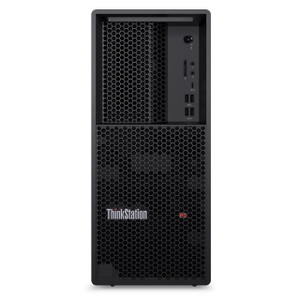
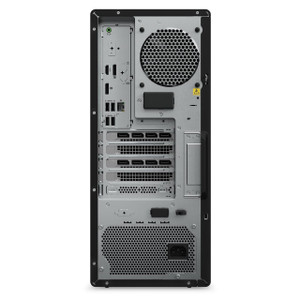
Lenovo 30GS00HUUS ThinkStation P3 Tower Workstation
Overview
The Lenovo ThinkStation P3 Tower 30GS00HUUS is a commercial-grade desktop workstation built around Intel's 14-core Core i5-14500 processor, 16 GB of DDR5-4400 memory, and a 512 GB NVMe SSD — a configuration that covers the compute and storage demands of physical security management software, IP surveillance recording platforms, and enterprise IT deployment environments equally well. Weighing in at 9 lb, the tower form factor gives integrators room to expand: four DIMM slots support up to 128 GB of RAM, meaning the unit can grow as VMS channel counts or concurrent workload requirements increase. This is a machine built to run production workloads continuously, not a consumer PC dressed in business clothing.
Key Features
- Intel Core i5-14500 (14-core / 20-thread): Six performance cores plus eight efficiency cores deliver 20 simultaneous threads, with boost clocks reaching 5 GHz. In practice this means the workstation handles multi-stream video decoding, concurrent VMS analytics processing, and OS-level background tasks without the frame-drop and UI lag you see on quad-core office machines. The 2.6 GHz base clock keeps thermal load predictable under sustained workloads.
- DDR5-4400 Memory at 16 GB (expandable to 128 GB): DDR5 at 4400 MHz delivers roughly double the peak bandwidth of DDR4-3200 — relevant when a VMS is simultaneously decoding high-resolution streams, writing to storage, and running motion-detection algorithms. The single 16 GB stick occupies one of four slots, leaving three open for expansion without pulling the existing module.
- 512 GB NVMe SSD (OS + Application Drive): A solid-state boot and application drive eliminates the latency spikes that plague spinning-disk workstations during VMS startup, database queries, and large configuration saves. 512 GB is sized for the OS, security applications, and short-term clip export — pair with a dedicated storage array or NVR for long-term video retention.
- Windows 11 Pro pre-installed: The Pro license matters in enterprise and government deployments — BitLocker encryption, domain join, Remote Desktop, and Group Policy are all available out of the box. No additional licensing cost for standard IT management workflows.
- Tower form factor (9 lb): The full-size tower chassis provides more PCIe expansion capacity than SFF or micro-form-factor alternatives, enabling integrators to add capture cards, GPU upgrades, or additional NIC cards without redesigning the deployment. The 9 lb weight is desk- and rack-shelf-friendly for control room installs.
- Up to 128 GB RAM ceiling: Security operations centers and multi-operator surveillance platforms routinely run multiple simultaneous VMS sessions, browser-based management consoles, and reporting tools. The 128 GB ceiling means this chassis can serve that use case for years without a hardware refresh.
Integration & Compatibility
The 30GS00HUUS ships with Windows 11 Pro, which maintains broad compatibility with enterprise physical security software platforms including video management systems, access control servers, and PSIM middleware. The i5-14500's hybrid core architecture is recognized by modern VMS schedulers that offload background analytics to efficiency cores, keeping performance cores free for active stream decoding. For deployments requiring a dedicated network video recorder, this workstation pairs cleanly as the management and operator console layer, offloading recording I/O to dedicated NVR hardware. Integrators evaluating the broader Lenovo workstation line will find the P3 Tower slots above entry-level ThinkCentre options and below the P5/P7 series for GPU-intensive rendering workloads — appropriate positioning for security operations rather than media production. Review the workstation category for alternative configurations if the channel count or analytics requirements scale beyond what a single i5-class processor can handle. For storage planning in multi-camera environments, the storage and retention planning guide covers NVMe + NAS pairing strategies for extended retention.
Frequently Asked Questions
Q: Can the 30GS00HUUS be upgraded beyond 16 GB of RAM?
A: Yes. The ThinkStation P3 Tower supports up to 128 GB of DDR5-SDRAM across its four DIMM slots. The base configuration ships with one 16 GB module, leaving three slots open for additional memory without removing the existing stick.
Q: Is Windows 11 Pro included, or does it require a separate license purchase?
A: Windows 11 Pro is pre-installed on the 30GS00HUUS. The Pro edition includes BitLocker, domain join, Remote Desktop, and Group Policy support — no separate OS license is needed.
Q: What is the processor boost frequency on the i5-14500?
A: The Intel Core i5-14500 has a base frequency of 2.6 GHz and a maximum turbo boost frequency of 5 GHz across its 14 cores and 20 threads.
Q: Does the 30GS00HUUS include an optical drive?
A: No. The ThinkStation P3 Tower 30GS00HUUS does not include an optical drive. Software deployment is handled via USB or network.
Q: How much internal storage does this workstation ship with?
A: The unit ships with a single 512 GB NVMe SSD. This drive is intended for the OS and applications; for video retention storage, a secondary internal drive or external NAS/SAN is recommended.
Q: What is the weight of the ThinkStation P3 Tower 30GS00HUUS?
A: The unit weighs 9.00 lb, making it straightforward to position on a desk shelf or within a control room equipment rack.
When I look at the 30GS00HUUS for physical security deployments, the spec that stands out immediately is the DDR5-4400 memory architecture combined with a 14-core processor — that combination meaningfully changes what you can ask a workstation to do as a VMS operator console or a locally-hosted access control server compared to a standard DDR4 office PC.
Technical Highlights:
- 14-core / 20-thread i5-14500 at 5 GHz boost: Enough headroom to run a multi-stream VMS decode session, a browser-based management UI, and background analytics simultaneously without throttling — the hybrid core design offloads low-priority threads to efficiency cores so performance cores stay available for active decoding.
- DDR5-4400 with 128 GB ceiling: The 4400 MHz memory bus is notably faster than DDR4-3200 found in previous-generation workstations of this class, and the four-slot / 128 GB ceiling means you can grow memory headroom as camera counts scale without changing chassis.
- 512 GB NVMe SSD: Eliminates the I/O latency spikes that slow down VMS application startup and database queries on spinning-disk machines — particularly noticeable when operators are pulling historical clips under active live-view load.
Deployment Considerations:
- The single 512 GB SSD is OS and application storage only — any deployment requiring on-box video retention will need a secondary internal drive or an external NAS configured in the VMS storage settings before go-live.
- No optical drive is included, so integrators deploying from physical media need to plan for USB-based software installation or network deployment; this is rarely a constraint in modern environments but worth flagging for older licensing workflows.
The 30GS00HUUS is the right pick for a security operations center console or a mid-size access control application server where the operator needs Windows 11 Pro manageability, DDR5 memory bandwidth for multi-stream workloads, and a chassis that can absorb a RAM upgrade two years down the road without a forklift swap.