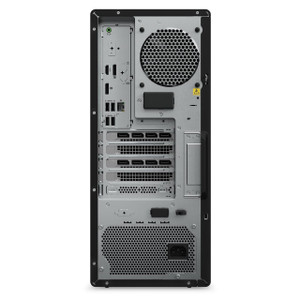
Lenovo 30GS00HQUS ThinkStation P3 Tower Workstation
Overview
The Lenovo ThinkStation P3 Tower 30GS00HQUS is a commercial-grade tower workstation built around Intel's 14-core Core i5-14500 processor, 32GB of DDR5-4400 memory, and a 1TB SSD — a configuration that handles demanding VMS workloads, multi-stream video decoding, and concurrent analytics processing without the thermal and reliability compromises of consumer-class hardware. At 9 lbs, it fits under a desk or on a rack shelf without a dedicated enclosure. If your deployment runs network video recorders or software-based VMS on general-purpose hardware, the P3 Tower is the kind of platform that holds up under 24/7 load.
Key Features
- Intel Core i5-14500 — 14 Cores, 20 Threads, 5 GHz Boost: The i5-14500's hybrid architecture (6 P-cores + 8 E-cores) lets it sustain background analytics and recording threads on the efficiency cores while burst decoding tasks hit the 5 GHz performance cores. For VMS workloads running continuous multi-stream decode, 20 threads means you're not starving background services when primary streams spike.
- 32GB DDR5-4400 in a Single DIMM (4 Slots Available): DDR5-4400 delivers roughly 50% more bandwidth than DDR4-3200 at equivalent capacity — meaningful when the processor is shuttling large frame buffers for high-resolution camera streams. Starting with 1 x 32GB leaves three slots open; you can scale to 128GB maximum without replacing existing memory, so the platform grows with your channel count.
- 1TB NVMe SSD — No Spinning Disk: An SSD as the primary drive eliminates the I/O bottleneck that plagues traditional spinning-disk workstations under simultaneous read/write loads. For VMS installations writing continuous streams while simultaneously serving playback requests, SSD throughput keeps seek times from compressing the available I/O window.
- 128GB Maximum Memory Ceiling: Four DIMM slots supporting up to 128GB total gives this platform headroom well beyond a typical 8–16 camera deployment. If you're running a software VMS with deep analytics pipelines or multiple concurrent operator sessions, that ceiling matters — you won't be forced into a platform migration as the deployment scales.
- Windows 11 Pro — Enterprise Management Ready: Win 11 Pro includes BitLocker, Hyper-V, Remote Desktop, and domain join out of the box. For integrators deploying VMS in corporate environments with Active Directory and group policy requirements, Pro licensing is the baseline expectation — Home edition is a non-starter in those environments.
- No Optical Drive: The absence of an optical drive is an intentional design choice for commercial workstation builds — it removes a mechanical failure point and frees internal bay space. Software deployment is expected over network or USB, which aligns with modern enterprise provisioning workflows.
- Commercial-Grade UNSPSC Classification (43211515): The UNSPSC code 43211515 classifies this as a commercial workstation, which matters for procurement systems that validate product categories against purchasing policy — especially in government, healthcare, and enterprise accounts that enforce commodity codes.
Integration and Compatibility
The ThinkStation P3 Tower platform is compatible with major VMS software deployments including Milestone XProtect, Genetec Security Center, and Avigilon Control Center — all of which publish minimum and recommended hardware specs that the i5-14500 / 32GB DDR5 configuration meets or exceeds for mid-scale deployments. The DDR5 memory subsystem and PCIe expansion slots support adding dedicated GPU cards for accelerated video analytics decoding, a common upgrade path as AI-based analytics workloads increase. For integrators sourcing PoE network switches and cameras alongside a VMS server, this platform pairs cleanly with the rest of a commercial security stack. Lenovo's commercial workstation line carries standard enterprise driver support and image deployment compatibility through tools like SCCM and Lenovo Vantage.
Frequently Asked Questions
Q: How many camera streams can the 30GS00HQUS handle simultaneously?
A: Stream capacity depends on your VMS software, camera resolution, codec, and analytics load. The i5-14500's 14 cores and 20 threads with 32GB DDR5 is sufficient for mid-scale deployments — typically 32–64 HD streams in software decode, more with GPU-assisted decoding. Consult your VMS vendor's hardware sizing guide for exact numbers.
Q: Can the memory be upgraded on the 30GS00HQUS?
A: Yes. The system ships with 1 x 32GB DDR5-4400 in one of four DIMM slots, leaving three slots open. Maximum supported memory is 128GB — you can add DIMMs without replacing the existing module.
Q: Does the 30GS00HQUS include an optical drive?
A: No. The ThinkStation P3 Tower 30GS00HQUS does not include an optical drive. Software installation is expected via USB or network deployment.
Q: What operating system does this workstation ship with?
A: It ships with Windows 11 Pro, which supports BitLocker encryption, Hyper-V virtualization, Remote Desktop, and Active Directory domain join — standard requirements for enterprise security deployments.
Q: Is the storage expandable beyond the included 1TB SSD?
A: The specification lists one 1TB SSD installed. The ThinkStation P3 Tower chassis supports additional storage expansion in available internal bays, though you should verify specific bay configuration and interface availability for this exact build before purchasing additional drives.
The 30GS00HQUS hits a practical sweet spot for software VMS deployments: the i5-14500's 14-core hybrid architecture handles the mixed workload of continuous stream recording plus on-demand playback without the cost premium of a Xeon platform, and DDR5-4400 gives the memory subsystem enough bandwidth to keep up when multiple operators are pulling archived footage simultaneously.
Technical Highlights:
- 14-Core / 20-Thread i5-14500 at 5 GHz Boost: The hybrid P-core + E-core layout is purpose-suited to VMS workloads — efficiency cores sustain background recording threads while performance cores handle burst decode requests. You won't see the thread starvation that shows up on older 6-core builds under peak load.
- DDR5-4400 with 128GB Ceiling: The single 32GB DIMM leaves three slots open. For a growing deployment, that means you can double or quadruple memory without a motherboard swap — just add matched DIMMs as camera count increases.
- 1TB SSD — No Spinning Disk in the Primary Drive: Concurrent write (live recording) and read (playback) operations on a spinning disk create measurable I/O contention above roughly 8–12 simultaneous streams. SSD eliminates that ceiling entirely for the OS and application layer; if you're adding bulk storage, that goes on secondary drives, not the boot volume.
Deployment Considerations:
- At 9 lbs, this tower drops cleanly under a desk or on a low shelf in a head-end closet — no rack ears needed, but verify your physical footprint before ordering if rack mounting is required.
- The single-DIMM starting configuration means memory runs in single-channel mode until a second DIMM is installed. For maximum DDR5 bandwidth on analytics-heavy workloads, populate a second slot with a matching 32GB module to enable dual-channel operation.
The 30GS00HQUS is the right call for a mid-scale software VMS server in a corporate or institutional security deployment — specifically where IT requires Windows 11 Pro domain join, the integrator expects to scale memory as the camera count grows, and the budget doesn't justify a full Xeon workstation.