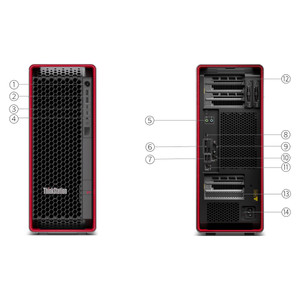
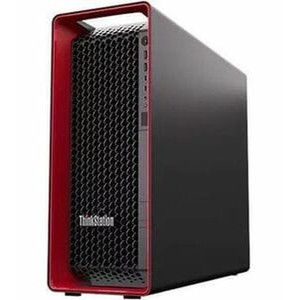
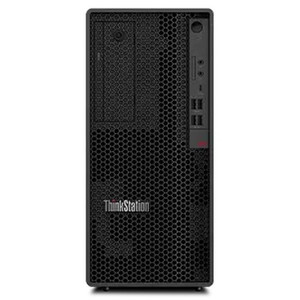
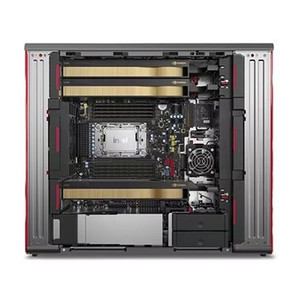
Lenovo 30F3005EUS ThinkStation P7 Tower Workstation
Overview
The Lenovo ThinkStation P7 30F3005EUS is a tower workstation built around the Intel Xeon w5-3425 processor — a 12-core, 24-thread LGA 4677 CPU with a 3.2 GHz base clock and 4.6 GHz maximum turbo frequency. With 30 MB of Smart Cache, 270 W base TDP (324 W maximum turbo), and support for up to 1 TB of DDR5-SDRAM, the P7 is positioned for compute-intensive workloads where sustained multi-threaded throughput matters more than raw single-core speed. It ships with 16 GB of DDR5 memory and Windows 11 Pro for Workstations.
For security integrators and enterprise architects deploying professional workstations at the edge or in command centers, the P7's combination of PCIe 5.0 bandwidth, a high-core-count Xeon W platform, and expandable memory architecture makes it a credible long-cycle investment rather than a commodity desktop refresh.
Key Features
- Intel Xeon w5-3425 — 12 cores, 24 threads: 24 simultaneous threads at up to 4.6 GHz turbo means VMS decode, analytics inference, and OS overhead can all run concurrently without starving each other. On a 32-camera NVR workstation running video management software, that headroom prevents the frame-drop artifacts that plague under-core consumer platforms.
- 270 W base / 324 W maximum turbo power envelope: This is a high-TDP platform — budget your rack PDU and UPS accordingly. The 54 W swing between base and turbo is normal for Xeon W under burst workloads; a quality 20A circuit is the minimum install requirement.
- 30 MB Smart Cache: The large L3 cache reduces main-memory round trips during repetitive analytical tasks — relevant for AI-accelerated video analytics pipelines that repeatedly access the same model weights or feature maps.
- 16 GB DDR5-SDRAM (standard) — expandable to 1 TB: The platform supports up to 1 TB of DDR5, which is meaningful in multi-channel surveillance deployments or workloads that buffer large datasets in-memory. The base 16 GB configuration is modest for a Xeon W system; most production security deployments will want at minimum 32–64 GB.
- PCIe 5.0 and 4.0 slot support: PCIe 5.0 slots double the bandwidth of PCIe 4.0 (up to 128 GB/s bidirectional on x16), which matters when adding high-performance NVMe storage or next-generation GPU accelerators. A high-throughput network card or dedicated capture card will saturate PCIe 4.0 long before PCIe 5.0.
- LGA 4677 (Socket E) platform: This is Intel's professional Xeon W socket — not a consumer derivative. The platform supports ECC memory (verify with Lenovo memory compatibility list), multi-channel memory controllers, and a larger validated ISV application list than mainstream desktop platforms.
- Windows 11 Pro for Workstations: Ships with a workstation-class OS license that supports ReFS, persistent memory, and elevated memory/CPU limits compared to standard Windows 11 Pro — relevant for VMS platforms that can leverage advanced file system features.
- 9 lb shipping weight, manufactured in Mexico: Compact for a full tower Xeon workstation. The MX country of origin is relevant for federal procurement teams evaluating domestic content requirements under TAA; confirm TAA compliance separately with the purchase documentation.
Integration and Compatibility
The ThinkStation P7 is a validated platform for major video management system vendors including Milestone XProtect, Genetec Security Center, and Avigilon Control Center — though confirm specific version compatibility with the VMS vendor for the w5-3425 configuration. The PCIe expansion slots accommodate video capture cards, 10GbE NICs, and NVMe RAID controllers. Memory expandability to 1 TB makes this platform viable as a standalone software-defined NVR for large-channel-count deployments where a dedicated appliance NVR is not preferred. The Xeon W platform is also validated for CAD, simulation, and rendering workloads if the workstation serves dual-use roles in an engineering environment. Pair with a UPS sized for the 324 W peak TDP plus display and peripheral load to protect against power events.
Frequently Asked Questions
Q: What is the maximum RAM this workstation supports?
A: The ThinkStation P7 30F3005EUS supports up to 1 TB of DDR5-SDRAM. It ships with 16 GB standard.
Q: Does the 30F3005EUS support ECC memory?
A: The Intel Xeon W platform (LGA 4677, Socket E) is architected to support ECC memory; verify the specific memory configuration and ECC support with Lenovo's compatibility documentation for this SKU.
Q: What PCIe generations are available in the ThinkStation P7?
A: The P7 includes both PCIe 5.0 and PCIe 4.0 slots, giving you access to maximum-bandwidth expansion for NVMe storage, GPU accelerators, and high-speed network cards.
Q: Is the 30F3005EUS suitable for running a multi-camera VMS like Milestone or Genetec?
A: Yes — the 12-core Xeon w5-3425 with 24 threads and up to 4.6 GHz turbo is well-suited for VMS decode and analytics workloads. Most production deployments should upgrade beyond the base 16 GB RAM to 32–64 GB for stable multi-stream performance.
Q: What operating system does this workstation ship with?
A: The 30F3005EUS ships with Windows 11 Pro for Workstations.
Q: What is the processor TDP and what power circuit does this workstation require?
A: The Intel Xeon w5-3425 has a 270 W base processor power and 324 W maximum turbo power. A dedicated 20A circuit is recommended; factor in GPU, storage, and display load on top of CPU TDP when sizing your UPS or PDU.
The 30F3005EUS is the entry configuration of Lenovo's ThinkStation P7 — and the spec that defines what this platform actually is sits in the CPU socket: the Intel Xeon w5-3425 on LGA 4677 (Socket E), running 12 performance cores at up to 4.6 GHz with a 324 W maximum turbo power draw. That is not a desktop chip in a workstation box — it is a genuine workstation-class processor with the memory bandwidth and PCIe topology to match.
Technical Highlights:
- 12-core / 24-thread Xeon w5-3425 at 4.6 GHz turbo: Enough parallel throughput to handle multi-stream H.265 decode, analytics inference, and OS scheduling simultaneously without CPU contention — the most common failure mode on under-specified VMS servers.
- PCIe 5.0 + 4.0 slot mix: PCIe 5.0 delivers up to 128 GB/s bidirectional on x16, which future-proofs GPU and NVMe add-in selection. You are not locked into today's card lineup — the slot will handle next-generation accelerators as the analytics stack evolves.
- 1 TB DDR5 memory ceiling: The base 16 GB ships thin, but the 1 TB ceiling means this chassis can scale to hold an entire camera stream buffer or large AI model inference dataset in RAM — a real advantage for software-defined NVR deployments over dedicated appliances with soldered memory.
Deployment Considerations:
- Plan your power circuit before installation: 270 W CPU base + GPU + NVMe storage + displays can easily push total system draw past 500 W. A 20A dedicated circuit is the minimum; size your UPS for the measured system load, not just the processor TDP.
- The 16 GB DDR5 base configuration is genuinely insufficient for production multi-camera VMS workloads — budget for a RAM upgrade to at least 32 GB (64 GB preferred for 30+ channel deployments) before commissioning.
The 30F3005EUS earns its place in a centralized security operations center or a high-channel-count video analytics node — specifically where a software VMS, AI inference engine, and operator interface need to share one platform without a CPU bottleneck.