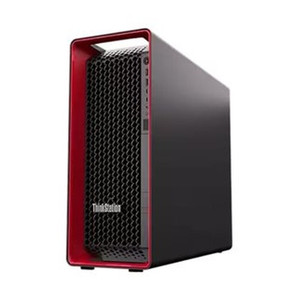
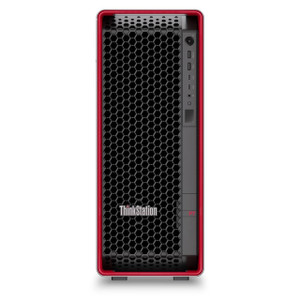
Lenovo 30F3003HUS ThinkStation P7 Tower Workstation
Overview
The Lenovo ThinkStation P7 (30F3003HUS) is a single-socket tower workstation built around Intel's flagship Xeon w9-3495X — a 56-core, 112-thread processor that targets the most compute-intensive professional workloads: multi-stream video analytics, large-scale VMS server duties, AI-assisted surveillance inference, 3D rendering, and simulation. With a 350W base processor power envelope and a 420W maximum turbo power draw, this is not a desktop dressed up as a workstation — it is purpose-engineered for sustained, heavy parallel throughput. If your deployment calls for decoding dozens of high-resolution streams simultaneously or running on-box deep learning inference without offloading to a GPU cluster, the 30F3003HUS deserves a close look.
Key Features
- 56-Core / 112-Thread Xeon w9-3495X: Intel's LGA 4677 (Socket E) Xeon W flagship delivers 56 performance cores with 112 threads and a 4.8 GHz maximum turbo frequency. In practice, that translates to workloads that would saturate a dual-socket server fitting comfortably inside a single-socket tower — relevant when you need VMS server throughput without rack space or dual-socket licensing overhead.
- 105 MB Smart Cache: The processor's 105 MB on-die Smart Cache is large enough to hold working sets for many parallel video decode and analytics pipelines in L3, reducing DRAM latency hits during sustained multi-stream operation. For AI inference workloads that repeatedly reference the same model weights, this cache size materially reduces per-frame latency.
- 1.9 GHz Base / 4.8 GHz Max Turbo Frequency: The base frequency is deliberately conservative — the Xeon w9-3495X sustains all-core throughput at 1.9 GHz when all 56 cores are fully loaded, then turbos individual cores to 4.8 GHz for single-threaded bursts. Understand this tradeoff: peak single-thread performance is strong, but plan thermal and power budgets around the all-core sustained scenario, not the turbo headline.
- 64 GB DDR5 Installed, Up to 1 TB Maximum: Ships with 64 GB of DDR5-SDRAM across four channels, providing the bandwidth headroom that Xeon W workloads demand. The platform supports scaling to 1 TB of RAM — practical for in-memory databases, large video frame buffers, or AI model loading without storage I/O bottlenecks. If your workload today is 64 GB but your roadmap includes larger datasets, this platform grows with you without a forklift upgrade.
- PCIe 4.0 and 5.0 Slot Availability: The ThinkStation P7 provides both PCIe 4.0 and PCIe 5.0 expansion slots, which matters for GPU selection. PCIe 5.0 doubles the per-lane bandwidth of PCIe 4.0 — a real differentiator when pairing with next-generation professional GPUs or high-throughput NVMe storage cards. This forward-compatibility means the platform supports current and near-future accelerator cards without bandwidth bottlenecking at the slot.
- 350W / 420W Processor TDP: The w9-3495X carries a 350W base processor power (PBP) and a 420W maximum turbo power (MTP). Size your UPS, PDU circuit, and rack cooling accordingly — this system under full load draws significantly more than a typical workstation. In a surveillance operations center or server room, that means dedicated 20A circuit planning and active rack cooling rather than passive airflow.
- Intel LGA 4677 (Socket E) Platform: The Socket E platform is Intel's highest-tier Xeon W socket, offering the memory bandwidth and I/O lane count that the w9-3495X's 56-core design requires. This is not a platform you upgrade the CPU on mid-lifecycle — the socket and platform are matched to the w9-3495X at this tier, so spec it correctly at procurement.
Integration and Compatibility
The ThinkStation P7 30F3003HUS is aimed at environments that need workstation-class compute without moving to a rack-mounted server. VMS platforms that support distributed server deployments — where the recording and analytics engine runs on a dedicated machine separate from operator consoles — fit this form factor well. The PCIe 5.0 slots accommodate professional NVIDIA RTX or AMD Radeon Pro GPUs for GPU-accelerated video transcoding, AI inference, and rendering pipelines. The DDR5 memory architecture provides the bandwidth required for multi-channel, high-resolution stream handling. Country of origin is Mexico; UNSPSC code 43211515 (workstations) applies for procurement classification.
For deployments pairing this workstation with a network video recorder appliance or using it as a dedicated video management software server, the 56-core Xeon W platform handles concurrent decode, analytics, and archival tasks that would require multiple lesser machines. Browse the full Lenovo workstation and compute line for complementary options, or review our workstation selection guide to confirm platform fit before committing to this power and thermal envelope. If you are pairing with dedicated network switching infrastructure, account for the 10GbE or higher uplink this platform warrants given its throughput capacity.
Frequently Asked Questions
Q: How many processor cores does the 30F3003HUS have, and does that matter for video analytics workloads?
A: The 30F3003HUS ships with the Intel Xeon w9-3495X, which provides 56 performance cores and 112 threads. For video analytics workloads — particularly those running simultaneous deep learning inference on multiple streams — core and thread count directly translate to how many parallel decode and analysis pipelines the system can sustain without queuing. 56 cores is at the top of the single-socket Xeon W hierarchy.
Q: What is the maximum RAM this system supports, and what type does it use?
A: The ThinkStation P7 30F3003HUS supports up to 1 TB of DDR5-SDRAM. It ships with 64 GB installed. DDR5 provides higher memory bandwidth than DDR4, which benefits multi-stream video workloads and large AI model inference where memory bandwidth is often the bottleneck rather than raw core count.
Q: What PCIe generations are available for GPU or storage expansion?
A: The platform provides both PCIe 4.0 and PCIe 5.0 expansion slots. PCIe 5.0 offers double the per-lane bandwidth of PCIe 4.0, making it relevant for high-throughput professional GPUs and next-generation NVMe storage accelerators.
Q: What are the power requirements for the 30F3003HUS?
A: The Intel Xeon w9-3495X processor alone has a 350W base processor power (PBP) and a 420W maximum turbo power (MTP). Total system power draw will exceed this when GPU, storage, and memory are factored in. Plan for a dedicated 20A circuit and verify UPS and PDU capacity before deployment.
Q: What is the processor's maximum turbo frequency?
A: The Xeon w9-3495X reaches 4.8 GHz maximum turbo frequency on performance cores. The base all-core frequency is 1.9 GHz — relevant for sustained, fully-loaded workloads where all 56 cores are active simultaneously.
Q: What is the processor cache size, and why does it matter for this workload class?
A: The w9-3495X includes 105 MB of Intel Smart Cache (L3). For workloads that repeatedly access the same data — AI inference model weights, video frame buffers, lookup tables — a large L3 cache reduces DRAM round-trips, lowering per-operation latency and improving sustained throughput on parallel pipelines.
The 30F3003HUS is one of those systems where the spec sheet looks almost implausible until you understand what the Xeon w9-3495X actually is: 56 performance cores, 112 threads, and 105 MB of L3 cache on a single LGA 4677 socket. I've looked at a lot of workstation configurations for surveillance and analytics deployments, and the core count alone puts this system in territory that previously required dual-socket servers — with all the cost, licensing, and management overhead that entails.
Technical Highlights:
- 56C / 112T at 4.8 GHz Turbo: The w9-3495X's 4.8 GHz max turbo isn't just a marketing stat — paired with 56 cores, it means single-threaded codec tasks and multi-threaded decode pipelines can coexist without one starving the other. That's directly applicable to VMS deployments where the server handles both live stream decode and background analytics simultaneously.
- DDR5 up to 1 TB: Shipping with 64 GB DDR5 is reasonable for initial deployment, but the platform's 1 TB ceiling means you can grow into in-memory analytics databases or large AI model preloading without touching the CPU or motherboard. DDR5's bandwidth increase over DDR4 also matters here — the w9-3495X's core count can actually saturate DDR4 in parallel workloads.
- PCIe 5.0 Expansion: PCIe 5.0 slots aren't just forward-looking — current-generation professional inference GPUs already benefit from the doubled bandwidth versus PCIe 4.0, particularly for models with large activation tensors that move between GPU and host memory frequently.
Deployment Considerations:
- The 350W processor base power (420W MTP) means total system draw under full load can exceed 800W when a professional GPU and multiple NVMe drives are factored in. Verify your circuit capacity and UPS sizing before the system arrives on-site — this is a 20A dedicated circuit deployment minimum.
- The 1.9 GHz all-core base frequency is the number to plan around for sustained workloads, not the 4.8 GHz turbo. If your VMS or analytics platform benchmarks are taken at turbo frequencies, they will not reflect sustained production throughput when all 56 cores are pegged.
This system is a strong fit for a centralized surveillance analytics node in a large enterprise or critical infrastructure deployment — specifically where you need to consolidate multi-stream AI inference, recording, and event management onto a single machine with room to scale RAM and GPU without a platform replacement.