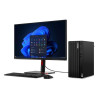
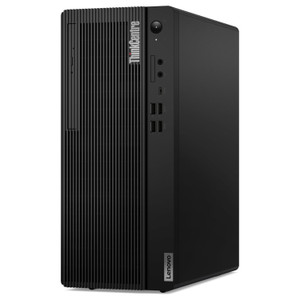
Lenovo 12U00010US ThinkCentre M70t Gen 5 Tower Desktop
Overview
The Lenovo ThinkCentre M70t Gen 5 (12U00010US) is a commercial-grade tower desktop built around Intel's 14th-generation Core i7-14700 vPro processor and an NVIDIA GeForce RTX 3050 6GB discrete GPU — a pairing that makes it a capable on-premise workstation for VMS operators, security control rooms, and enterprise IT deployments that need local GPU compute without the footprint of a full workstation. With 32GB of DDR5 RAM and a 512GB PCIe Gen4 NVMe SSD, it handles multi-stream video decode, concurrent application workloads, and fast OS boot cycles without resource contention. If your deployment requires a dedicated local machine for running video management software, access control head-end software, or enterprise management consoles, the 12U00010US is sized to carry those loads without requiring a rack-mounted server.
Key Features
- Intel Core i7-14700 vPro (20 cores / 28 threads): The hybrid 8P+12E core architecture separates performance-critical threads (up to 5.3 GHz P-core turbo) from background OS and monitoring tasks (E-cores at up to 4.2 GHz), so your VMS decode pipeline doesn't compete with Windows Update or endpoint security agents. The 65W base TDP keeps steady-state power draw low; 219W turbo headroom is available for burst workloads like video export or indexing. vPro enables Intel AMT for out-of-band remote management — useful when the machine is in a wiring closet or unmanned security office.
- NVIDIA GeForce RTX 3050 6GB: 6GB of dedicated VRAM handles GPU-accelerated video decode for multi-camera VMS playback and supports CUDA-based analytics offloading. For operators running Milestone, Genetec, or similar platforms that leverage GPU decode, this removes the CPU bottleneck on high-channel-count live views without requiring a workstation-class card.
- 32GB RAM: 32GB is the practical floor for running a Windows 11 Pro host alongside a VMS server process, a database, and several concurrent operator clients. You won't hit memory pressure with a moderate-scale deployment. Expandability depends on platform limits — verify slot count against Lenovo's configurator if you anticipate future growth.
- 512GB PCIe Gen4 NVMe SSD (M.2 2280, TLC, Opal): PCIe Gen4 sequential reads reduce application load times and database query latency versus Gen3. The TLC NAND is appropriate for OS and application workloads; surveillance video retention should route to a separate NAS, NVR, or external storage rather than this drive. The Opal self-encrypting drive (SED) capability supports hardware-based full-disk encryption — relevant for deployments with data-at-rest compliance requirements.
- Intel AX211 Wi-Fi 6E + Bluetooth 5.1: Wi-Fi 6E (6 GHz band support) provides a high-throughput wireless fallback or primary connection for environments where running Ethernet to a desktop isn't practical. BT 5.1 supports wireless peripherals without a USB dongle. In wired deployments, the onboard Ethernet remains the preferred path for VMS traffic.
- Slim DVD RAMBO optical drive: Read/write optical support is increasingly uncommon in commercial desktops. Useful for deploying software from physical media, writing evidence archives to disc, or importing legacy configuration backups — scenarios that still appear in physical security and government deployments.
- Windows 11 Pro 64-bit: Pro licensing includes BitLocker, Remote Desktop host, domain join, and Hyper-V — all relevant for enterprise IT management and remote operator access. If your VMS vendor certifies on Windows 10, verify Win11 compatibility before deploying at scale.
- Intel vPro platform: AMT (Active Management Technology) allows BIOS-level remote access, remote power cycling, and hardware inventory reporting independent of the OS state. For distributed deployments with machines in unmanned locations, vPro reduces the need for physical site visits during troubleshooting or reimaging.
Integration and Compatibility
The 12U00010US connects via PCIe, USB, and Ethernet as documented in the source data, covering the standard interface set for peripherals, capture cards, and network integration. The NVIDIA RTX 3050 is supported by major VMS platforms that leverage GPU-accelerated decode (verify your specific VMS version's GPU compatibility matrix). Intel AMT requires network access on the management VLAN and compatible RMM software (Intel EMA, LANDesk, SCCM with AMT extensions) to be useful. The Opal SED capability requires a compatible pre-boot authentication solution (Windows BitLocker with TPM, or a third-party SED manager) to activate encryption — the drive does not self-encrypt by default without a management layer.
Frequently Asked Questions
Q: Can the Lenovo ThinkCentre M70t Gen 5 12U00010US run a VMS server and operator client simultaneously?
A: Yes. The 20-core i7-14700 and 32GB of RAM provide sufficient headroom to host a VMS server process alongside one or more operator client sessions. For large-scale deployments (100+ cameras), a dedicated server is more appropriate, but mid-range deployments running Milestone, Genetec, or Hanwha Wave on this machine are well within its compute envelope.
Q: Does the 12U00010US support hardware-based full-disk encryption?
A: The 512GB M.2 SSD is an Opal self-encrypting drive (SED), which supports hardware-based encryption. To activate it, you need a compatible management layer such as Windows BitLocker with TPM or a third-party SED management tool. The drive does not encrypt by default without enabling a pre-boot authentication solution.
Q: What is Intel vPro and why does it matter for a security deployment?
A: Intel vPro enables Active Management Technology (AMT), which allows IT administrators to remotely access and manage the machine at the hardware level — including powering it on/off, accessing the BIOS, and reimaging the OS — independent of whether Windows is running. For machines deployed in unmanned security offices or wiring closets, this eliminates the need for physical site visits during troubleshooting.
Q: Is the included SSD large enough to store surveillance video?
A: The 512GB NVMe SSD is sized for the OS, applications, and databases — not for primary video retention. Surveillance video storage should be handled by a dedicated NVR, NAS, or external storage array. Using the OS drive for video retention would shorten its lifespan and create resource contention.
Q: Does the GPU in the 12U00010US accelerate VMS video playback?
A: The NVIDIA GeForce RTX 3050 6GB supports GPU-accelerated video decode (NVDEC), which major VMS platforms including Milestone XProtect and Genetec Security Center can leverage. This offloads H.264/H.265 decode from the CPU, allowing higher concurrent camera counts on the live view without saturating CPU threads.
Q: What wireless connectivity does the 12U00010US include?
A: It ships with an Intel AX211 Wi-Fi 6E adapter (supporting the 6 GHz band for reduced interference in dense environments) and Bluetooth 5.1. For production VMS traffic, wired Ethernet remains the recommended path; wireless is best suited as a fallback or for peripheral connectivity.
The 12U00010US sits at an interesting intersection: it's a business desktop spec'd well above what most office deployments need, which makes it worth a second look for physical security integrators building out on-premise VMS workstations. The i7-14700 vPro's 219W turbo power ceiling means it can sustain burst decode loads that would cause frame drops on lower-TDP alternatives — and the vPro AMT capability is a genuine operational asset when the machine is in a closet nobody wants to walk to at 2 AM.
Technical Highlights:
- i7-14700 20-core / 28-thread vPro: 8 performance cores turbo to 5.3 GHz for decode-heavy threads; 12 efficiency cores handle background OS tasks. 65W base TDP keeps idle power draw low; 219W turbo headroom is available for export or indexing bursts without throttling.
- RTX 3050 6GB VRAM: Enough dedicated VRAM to handle GPU-accelerated H.265 decode on 20–30 concurrent streams in Milestone or Genetec without pulling CPU threads into decode duty. 6GB is the practical floor for multi-monitor VMS operator stations.
- PCIe Gen4 NVMe SSD with Opal SED: Gen4 sequential throughput reduces VMS database query latency versus Gen3 drives. The Opal SED is hardware-encryption-ready for deployments with data-at-rest compliance requirements — activate via BitLocker or a compatible SED manager, not out of the box.
Deployment Considerations:
- The 512GB SSD is an OS/application drive — route all video retention to a dedicated NVR or NAS. Mixing video writes with the OS volume creates I/O contention and will degrade SSD lifespan faster than rated.
- vPro AMT requires a management VLAN and compatible RMM tooling to be operationally useful. If your IT environment doesn't already have AMT infrastructure, the vPro benefit is effectively unused — factor that into the model selection decision versus a non-vPro variant.
For a mid-size physical security control room running 30–80 camera streams across two monitors with a local VMS server process, this machine hits the right balance of compute, GPU capacity, and remote manageability without the cost or rack space of a 1U server.