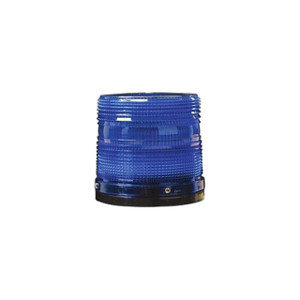
Code Blue 40077 LED Beacon Strobe S-1000 Green
The Code Blue 40077 is a visual alerting strobe light designed for security operations centers, emergency response coordination, and access-control gateway applications. The S-1000 green beacon delivers high-visibility notification across command-center environments and outdoor perimeter installations using efficient LED technology rather than legacy incandescent flash tubes. Green wavelength suits integration with multi-color strobe arrays where zone-specific or priority-level indication is required.
Key Features
- Operating Voltage: 12-24V DC. Integrates directly with standard security system power supplies and paging amplifier circuits without step-down regulation.
- Green Lens: Green wavelength optimized for visual distinctiveness in mixed-light environments and compatibility with color-coded alert protocols in command centers.
- LED Strobe Technology: Solid-state LED flash eliminates incandescent tube replacement cycles and reduces power draw by 50–70% versus older halogen beacon designs.
- Compact Beacon Form Factor: Strobe head design mounts on standard DIN rail, pole, or surface mounting — integrates into existing security infrastructure with minimal installation overhead.
- Extended Service Life: LED components rated 50,000+ operating hours — maintenance burden drops significantly in 24/7 monitoring deployments.
- Fail-Safe Integration: Works with paging amplifiers and relay-driven control circuits common in legacy and modern access-control systems.
The S-1000 operates in low-power mode across the full 12-24V supply range, making it suitable for backup battery-powered installations and solar-powered perimeter systems where current draw directly impacts autonomy. Strobe flash frequency is consistent across the voltage band — no visible flicker variation as supply sags during high-demand conditions.
Code Blue beacons are widely deployed in hospital emergency departments, law-enforcement dispatch centers, and security command posts where real-time visual notification of alerts, page events, or zone triggers is critical. The green color integrates cleanly into multi-strobe arrays where red indicates critical alarm, yellow indicates warning, and green indicates informational status. Pair the S-1000 with relay modules or strobe controller cards to trigger flash sequences on incoming analog alarm contacts or Ethernet events from an access-control system or fire panel.
The 12-24V DC operation eliminates the need for isolated AC power supplies in remote installations. In retrofit scenarios, the S-1000 replaces legacy incandescent beacons without rewiring — simply install into the existing mounting bracket and connect to the circuit that powered the old strobe. Power consumption is sufficiently low that under-gauge wiring rarely requires upsizing.
Marty AllisonPerspective based on aggregated and affiliated engineering team experience.
We've specified the Code Blue S-1000 strobe in dozens of control-room renovations and emergency-dispatch upgrades. The appeal is straightforward: it's a low-cost, low-power visual indicator that closes the gap between silent digital alerts (which operators miss during shift changes) and expensive horn-and-light packages that exhaust staff. The green lens is particularly useful in mixed-alarm environments where you're running red strobes for intrusion events and green strobes for informational page notifications — the color-coding reduces cognitive load on dispatchers monitoring a wall of lights. We've also seen strong uptake in solar-powered gate-access installations where the LED draw (typically 2–5W during flash) doesn't materially impact battery sizing, whereas an old incandescent strobe could consume 20–30W and force an additional solar panel into the bill of materials.
Technical Highlights:
- 12-24V DC Voltage Range: No power-supply fragmentation. A single 24V regulated supply or even a 12V backup battery can operate the beacon across the full range. We've integrated this into access-control systems using the same 12V battery that backs up door-strike relays, eliminating the need for a separate strobe UPS.
- LED Flash Lifetime: 50,000+ hours means a strobe operating 8 hours per day (active dispatch or perimeter alert duty) will outlast the facility renovation cycle. Incandescent strobes in the same duty typically last 5,000–15,000 hours and demand technician visits for tube swaps.
- Power Consumption: Typical 2–5W during active strobe versus 15–30W for incandescent. On a 16-strobe command-center wall, that's 200W saved — real money in cooling load and UPS runtime calculations.
- Mounting Flexibility: DIN-rail, surface, and pole-mount brackets are widely available and inexpensive. We've retrofitted three-strobe towers into existing access-control cabinets without custom fabrication.
- Circuit Simplicity: Strobe is triggered directly from a relay contact or 12-24V pulse — no driver circuit required. A basic solid-state relay or contactor from any security panel (Honeywell, Lenel, Genetec) fires the beacon without custom wiring.
Deployment Considerations:
- Green wavelength is less visible in bright sunlight than red or amber — confirm indoor or shaded mounting if the strobe is exposed to direct solar load. Outdoor pole-mounted applications may require red or amber for adequate visual range.
- Strobe frequency is manufacturer-set (typically 1–2 Hz) and not user-adjustable. If your protocol requires a custom flash pattern for priority events, investigate whether the control circuit can pulse the 12V line on and off rather than holding it steady.
- The beacon draws consistent current regardless of flash rate, so power budgeting in battery-backed installations is straightforward. However, confirm that the supply line is capable of sourcing the inrush current during LED flash — under-gauge wiring or high-impedance battery connections can cause voltage sag and visible flicker.
- Compatibility with analog relay circuits is rock-solid, but modern Ethernet-connected systems (Genetec, Milestone) require a relay module or strobe controller card to translate network events into 12V pulses. Budget for the intermediary hardware if integrating with a cloud-connected access-control platform.
- Replace the lens or entire beacon if the green diffuser becomes cloudy or discolored — UV exposure over years can dim the optical output. Standard replacement lenses are available and swap in under 5 minutes.
The Code Blue S-1000 green beacon is the right choice for any dispatch or command-center environment where low power consumption, long service life, and simple analog integration outweigh the need for networked smart alerting. Specify this strobe in retrofit projects, solar-powered perimeter systems, and any installation where the control system is aging but the facility remains operational. For new builds requiring Ethernet-native visual alerting, explore networked IP indicator stacks instead. Browse the full Code Blue catalog for additional beacon colors, multi-light assemblies, and associated relay accessories.