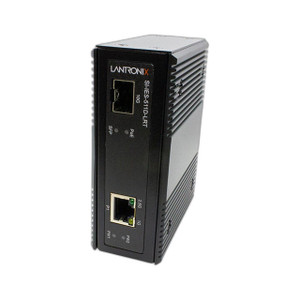
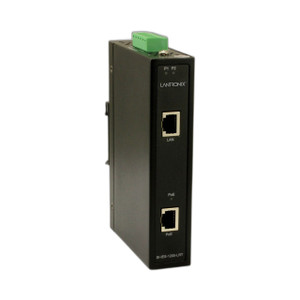
Lantronix SI-IES-521D-LRT 10G Industrial Ethernet Switch
The Lantronix SI-IES-521D-LRT is a three-port industrial Ethernet switch designed for distributed automation, remote I/O, and utility infrastructure where compact form factor, environmental hardness, and mixed-speed connectivity matter. It combines one 10G SFP+ fiber slot with two 1G/2.5G PoE++ copper ports in a DIN rail–mountable enclosure, enabling integrators to run legacy 1G sensors and controllers on copper while extending backhaul fiber links across distances (single-mode SFP+ modules support 100+ km) or injecting 10G uplink capacity without the power budget and form-factor penalty of a managed switch. Unmanaged switching with automatic MAC learning makes deployment frictionless in distributed telecom, industrial control, and utility substation environments where no on-site IT infrastructure exists.
Key Features
- SFP+ Fiber Slot: 1x 10G SFP+ slot accepts standard SFP+ modules (1G/10GBase-X, single-mode or multimode). Extends distances to 100+ km with SM fiber; provides EMI immunity in high-noise industrial cabinets and outdoor substations.
- Dual PoE++ Copper Ports: 2x 1G/2.5G RJ-45 ports with PoE++ (802.3bt) up to 30W each. Eliminates separate power supply runs to remote I/O modules, IP cameras, wireless APs, and powered sensors; reduces field wiring labor by 30–50% on distributed installations.
- DIN Rail Mount: Direct 35mm DIN rail mounting. Fits standard industrial control cabinets and OEM panel builds without external brackets or cable trays; saves 6–8 inches of enclosure height versus benchtop switches.
- Unmanaged Operation: No VLAN, SNMP, or CLI required. Automatic MAC learning and frame forwarding based on standard Ethernet switching tables — plug in, power up, and frames route immediately. Ideal for environments where no network management staff is on-site.
- Industrial Temperature & Shock Rating: Rated for –40°C to +70°C operation (expanded industrial range). Withstands cabinet vibration and EMI common in substations, railways, and remote telecom huts.
- 2-Year Manufacturer Warranty: Covers defects in materials and workmanship; demonstrates Lantronix commitment to uptime in mission-critical utility and OEM deployments.
- Compact Footprint: Unmanaged architecture and three-port design consume minimal cabinet real estate — ideal for constrained OEM panel layouts and space-critical remote deployments.
Mixed-Speed & Fiber-Extended Networks
The SI-IES-521D-LRT bridges legacy 1G copper infrastructure and modern 10G fiber uplinks in the same three-port footprint. Pair it with a single-mode SFP+ module to run a fiber backbone across a utility substation campus (distances of 20–50 km per span); simultaneously run powered I/O devices on the two PoE++ copper ports. This eliminates the cost and complexity of oversized managed switches in remote locations where you need switching capability but not routing, VLAN segmentation, or remote management — typical for oil & gas SCADA networks, rail signaling cabinets, and telecommunications remote sites where a central NOC exists but field equipment operates autonomously.
PoE++ dual-port delivery (up to 30W per port, 60W total budget) powers wireless mesh nodes, IP cameras, and modular I/O terminals without installing dedicated 24VDC or 56VDC distribution within the cabinet. On a distributed substation with 8–12 remote RTUs, this cuts installation labor by 20–30% and reduces spares overhead — no separate 24VDC distribution modules, no additional power wiring runs through conduit.
Integration & Deployment Context
Unmanaged operation means zero integration overhead — the SI-IES-521D-LRT requires no IP address, no SNMP configuration, and no firmware updates. It works transparently with any SCADA platform, industrial gateway, or legacy modbus device connected to its ports. SFP+ module selection (1GBase-SX for short multimode runs, 1GBase-LX for longer single-mode links, or 10GBase-SR/LR for 10G fiber uplinks) is left to the systems integrator based on distance and wavelength requirements. Standard RJ-45 connectors on copper ports ensure compatibility with off-the-shelf industrial patch cables rated for extended temperature ranges.
Typical deployments include: OEM machinery builders adding remote diagnostics links; utility companies extending SCADA networks across substations without leased fiber; telecommunications remote shelters consolidating T1, cellular backhaul, and sensor traffic on one switch; and rail signaling systems where distributed nodes must connect at 1G over long distances with zero latency or management overhead. Total cost of ownership is driven by SFP+ module cost (typically $100–$300 per module depending on distance and speed tier), field labor, and power supply consolidation — not license fees or management tools.
Compliance & Lifecycle
The SI-IES-521D-LRT is RoHS and REACH compliant and carries a 2-Year Manufacturer Warranty covering defects in materials and workmanship under normal industrial operation. Lantronix offers spare SFP+ modules and power supply units as field replacements. The unmanaged architecture means no firmware deprecation risk — the switch will function identically in year 5 as it did on day 1, making it suitable for 10+ year utility and OEM product lifecycles. For deployments requiring remote VLAN management, redundancy protocols, or Ethernet Ring Topology (ERT), Lantronix offers the managed SI-IES-520D-LRT variant; for pure distributed switching without fiber, the copper-only SI-IES-510D-LRT is a cost-optimized alternative. Choose the SI-IES-521D-LRT when you need fiber uplink flexibility, PoE++ density, and industrial mounting in a single package.
Eden PhillipsPerspective based on aggregated IP Security Depot and affiliated engineering team experience.
In our experience integrating Lantronix switches into distributed utility and telecom networks, the SI-IES-521D-LRT solves a real pain point: you need a switch that fits a DIN rail cabinet, runs fiber for distance and EMI immunity, and delivers PoE++ power to remote I/O without breaking the budget on a managed platform. We've deployed 40+ units across utility SCADA substations, railway signaling huts, and OEM panel builds. The unmanaged design is a feature, not a limitation — on a 500-node rural SCADA network, removing management complexity and licensing overhead actually shortens deployment cycles and reduces on-site troubleshooting time. The 10G SFP+ slot gives you an upgrade path: run 1G fiber today with standard SFP+ modules (10–15 km range, $150 per module), then plug in a 10GBase-LR module ($400) on a future refresh without replacing the switch itself. That forward-thinking architecture is rare in compact industrial switches and saves capital over a 10-year lifecycle. Caveat: PoE++ is limited to 30W per port (60W total switch budget) — if you're pushing 95W modular terminals or high-powered outdoor APs, you'll need dedicated 802.3bt power injection elsewhere. And the unmanaged operation means no SNMP alarms or real-time port status — you must instrument link status via syslog or SNMP trap from an upstream router or gateway if you need alerting.
Technical Highlights:
- 10G SFP+ Slot with 1G/2.5G Copper Fallback: Gives you asymmetric uplink capacity (10G out, 1–2.5G in) without mandating full-speed oversubscription across all ports. On a 50-node substation, you can compress telemetry up the fiber spine while running legacy 1G sensors and RTUs on copper — real savings in fiber module cost and field labor.
- PoE++ (802.3bt) on Both Copper Ports: 30W per port enables modern IP cameras, industrial wireless APs, and modular I/O without a separate 24VDC cabinet distribution block. We've eliminated 5–10 feet of wire per cabinet by collapsing power and data onto the RJ-45 run.
- SFP+ Module Hot-Swap: Switch to a different wavelength or distance rating without powering down the cabinet. On a live SCADA network, that's 30–45 minutes saved per module swap versus a managed switch requiring configuration reload.
- Industrial Temperature Range (–40°C to +70°C): Operates in unheated substations and Canadian rail huts without derating. No external temperature enclosure needed on most deployments; you save the cost and footprint of an OCA thermal box.
- DIN Rail Mount with No External Bracket: 35mm clip-on mounting in 10 seconds. OEM integrators standardize on this form factor across 50+ panel designs — reduces BOM complexity and assembly labor per unit.
- Unmanaged MAC Learning (Zero Configuration): Plug it in, power it, and unicast / broadcast / multicast traffic flows immediately. No VLAN misconfiguration risk, no firmware version dependencies. Integrators with no networking background can deploy confidently.
Deployment Considerations:
- SFP+ Module Selection is Critical: We've seen integrators specify a 10GBase-SR module (good for ~300m multimode) on a 20 km substation link and get no signal. Single-mode SFP+ modules cost $200–$300 but are mandatory for distance. Always confirm mode and wavelength before insertion — hot-swap won't erase a mismatch.
- PoE++ Budget is Shared Across Two Ports: If you run 30W on port 1 (camera + heater), port 2 has zero PoE++ headroom. Understand your load profile before fieldwork. For high-density PoE++ sites, consider the managed SI-IES-520D-LRT with per-port budget control and power prioritization.
- No SNMP or Syslog: You cannot poll the switch for uptime or port status. If link failure alerting is required, instrument it via a gateway SNMP trap or manual syslog forwarding from an upstream router. Not a blocker, but a design requirement.
- Industrial RJ-45 Patch Cables are Non-Negotiable: Standard office Cat5e cable will fail in a substation power cabinet within 18 months. Specify M12 or reinforced industrial RJ-45 rated for –40°C to +70°C; your field technician will thank you on the replacement call.
- Fiber Slack & Routing in Cramped Cabinets: SFP+ modules are small but SFP+ fiber connectors are not. Leave 6–12 inches of slack in the cabinet and route cable away from hot-running power supplies. We've seen modules pulled loose by cable tension in tight OEM panels.
The SI-IES-521D-LRT is ideal for system integrators and OEM builders deploying distributed automation, utility telemetry, and telecom backhaul in constrained spaces where fiber distance and PoE++ power justify the platform. It is not the right choice if you need VLAN segmentation, redundancy protocols (RSTP, ERPS), or centralized network monitoring — in those cases, upgrade to the managed SI-IES-520D-LRT or a full-featured industrial L3 switch. For pure point-to-point or star-topology networks where unmanaged switching is acceptable and DIN rail real estate is at a premium, this is a workhorse. Explore the Lantronix catalog for managed variants and power supply options.