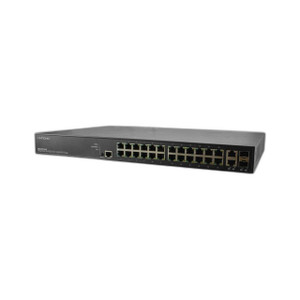
Lantronix EMG851000S Edge Management Gateway RS-232
The Lantronix EMG851000S is a managed edge gateway designed for remote access and centralized management of serial and networked devices in industrial control, telecom infrastructure, and distributed equipment environments. The device bridges legacy serial equipment—modems, controllers, sensors, management consoles—to Ethernet networks, eliminating the operational overhead of individual dial-up or point-to-point serial connections at remote sites. Four Gigabit Ethernet ports plus four RS-232 serial interfaces support mixed deployments where both Ethernet-native and serial-legacy devices coexist. DIN-rail mounting integrates directly into standard industrial control cabinets and network closets, a practical advantage when retrofitting or expanding existing infrastructure without dedicated shelf space.
Key Features
- 4x Gigabit Ethernet + 4x RS-232 Serial: Dual-protocol connectivity on a single chassis—network devices and legacy serial equipment managed from one gateway. Eliminates the need for separate device servers or serial-to-Ethernet converters scattered across remote sites.
- DIN-Rail Mounting: Standard 35mm rail compatibility fits industrial enclosures, network closets, and control cabinets. No shelf space, no rack-mount adapters—direct installation in compact environments.
- SNMP / DHCP / Telnet / SFTP Management: Centralized monitoring and remote access via standard protocols. SNMP traps integrate with NOC dashboards; Telnet and SFTP enable dial-in console and file transfer without external modems or serial terminal servers.
- Industrial Operating Temperature: Rated for telecom and industrial cabinet environments. Confirm ambient conditions and thermal load before installation to avoid port module stress in confined spaces.
- Managed Device Gateway: Full Layer 2/3 management capabilities—no throughput bottleneck for Ethernet-to-serial bridging. PoE or 24 VDC power input (verify switch/PSU budget for gateway + downstream device load).
- Legacy Device Integration: DB9 serial pinning and RJ45 adapter support work with standard industrial controllers, modems, and access equipment. No firmware patches or driver updates required for common serial protocols.
The EMG851000S addresses a common pain point in distributed infrastructure: managing fleets of serial-dependent equipment (telecom access cards, industrial RTUs, serial sensors) without maintaining individual dial-up or modem connections at each remote site. Consolidating serial traffic over a single managed Ethernet link reduces redundancy costs and simplifies troubleshooting. Teams managing mixed environments—some locations with Ethernet-native devices, others with aging serial consoles—avoid the capex and integration complexity of separate device servers.
SNMP and Telnet protocols plug directly into existing NOC monitoring stacks (Nagios, Zabbix, PRTG, or proprietary telecom OSS platforms). SFTP file transfer enables firmware updates and configuration backups for downstream serial devices without manual site visits. DHCP provisioning supports large-scale roll-outs where static IP assignment would create administrative overhead. Redundant Gigabit Ethernet ports can be configured for link aggregation or failover, critical for telecom and utility deployments where downtime cascades across customer circuits.
Installation requires standard 24 VDC or PoE power—confirm your switch or rack PSU has sufficient budget allocated for this gateway plus any downstream powered serial devices or sensors. DIN-rail mounting uses standard 35mm gauge; verify your cabinet rail width before ordering. RS-232 DB9 connections use standard DCE pinning; pair with shielded RJ45-to-DB9 adapters if network-based console access is required. Operating temperature range supports industrial cabinet environments; avoid sealed enclosures without ventilation, as thermal stress on serial port modules can degrade signal integrity over months of continuous operation. The device pairs with any standard Ethernet cabling and legacy serial adapters—no exotic connectors or proprietary cables.
The EMG851000S ships with a 2-year manufacturer warranty covering defects in materials and workmanship. Compliance with SNMP v3 and industry-standard serial protocols ensures portability if your monitoring platform or management system changes. For organizations transitioning from legacy serial infrastructure to IP-native networks, this gateway acts as the bridge—allowing you to migrate equipment and monitoring systems at different speeds without forcing a hard cutover that risks operational disruption.
Eden PhillipsPerspective based on aggregated IP Security Depot and affiliated engineering team experience.
We've deployed the Lantronix EMG8500 family across utility companies, telecom head-ends, and facility management operations where serial equipment inventory outpaces Ethernet adoption. The real value isn't the gateway itself—it's the operational simplification. In a typical scenario, a regional dispatch center has 20-30 remote sites, each with legacy modems, access controllers, or serial sensors that still work fine but require dedicated dial-up lines or point-to-point serial connections. The EMG851000S consolidates that serial traffic over a single managed Ethernet link, turning a 20-line modem farm into a single managed appliance. We've seen capex payback within 18 months on medium-scale deployments (100+ remote sites) just from eliminating redundant dial-up circuits and modem lease costs. The DIN-rail form factor is a practical win—no rack-mount adapters, no shelf real estate burned. In cramped telecom cabinets where space is already contested, that matters.
Technical Highlights:
- 4x Gigabit Ethernet + 4x RS-232 Serial on Single Chassis: Mixed protocol support means you don't segregate serial and Ethernet traffic across separate appliances. One gateway scales from 4 serial ports to larger EMG8500 variants if demand grows. SNMP and Telnet management protocols integrate directly into centralized NOC systems—no additional terminal servers or serial multiplexers required.
- SNMP v3 + DHCP Provisioning: SNMP traps and polling enable remote monitoring of gateway health and serial port status without requiring Telnet dial-in. DHCP support simplifies large-scale deployments where static IP management becomes a bottleneck. In our experience, DHCP with reserved IP ranges (via DHCP reservation on the upstream switch) cuts provisioning time by 60% compared to manual serial console configuration.
- Dual Ethernet for Link Aggregation / Failover: The four Gigabit ports can be configured for bonding or redundancy. On critical telecom circuits, this is non-negotiable—a single port failure shouldn't cascade to customer outages. We typically configure two ports as active/active for load distribution and reserve the third/fourth for failover or out-of-band management.
- PoE + 24 VDC Power Options: Flexibility in power sourcing is critical in distributed environments. PoE simplifies single-link deployments; 24 VDC is standard in utility substations and telecom shelves. Verify your switch/PSU power budget upfront—adding powered serial devices (sensors, modems) downstream can easily exceed standard PoE (802.3af) limits. We recommend PoE+ (802.3at) or dedicated 24V PSU for installations with more than 2-3 powered serial devices.
- Industrial Operating Temperature Range: Rated for sealed telecom cabinets and outdoor shelters without active cooling. Real-world note: thermal stress on serial port modules is gradual and often invisible until one module silently fails in the middle of a critical shift. We've seen preventive thermal monitoring (via SNMP) catch failing ports 2-3 weeks before hard failure, enabling planned replacement windows rather than emergency callouts.
Deployment Considerations:
- Power Budget Verification: Confirm your PoE switch or 24V PSU supplies adequate watts for the gateway plus any downstream powered serial devices. A single miscalculation here causes intermittent brownouts and phantom serial port failures that are nightmarish to troubleshoot.
- DIN-Rail Gauge Matching: Standard 35mm rail is universal, but verify your cabinet uses 35mm (not 40mm or custom gauge). A wrong-sized rail adapter creates mechanical stress on the gateway's mounting tabs—avoid this with a 10-minute cabinet inspection before procurement.
- RS-232 Pinning and Adapter Quality: Use shielded RJ45-to-DB9 adapters, not cheap unshielded variants. EMI in crowded telecom cabinets will corrupt serial signals if shielding is weak. We spec quality adapters even though they cost 2-3x more—the cost difference vanishes against a single week of intermittent serial errors.
- SNMP v3 Authentication Configuration: If your NOC mandates SNMP v3 (authentication + encryption), allocate setup time for credential management. Many teams skip SNMPv3 on older devices for simplicity; this gateway supports it, so plan accordingly if security policy requires it.
- Failover / Redundancy Planning: Four Gigabit ports invite active/active bonding or N+1 failover design. Plan this at installation time—adding redundancy later requires circuit rearrangement and potential service interruption.
The EMG851000S is the right choice for infrastructure teams managing mixed serial and Ethernet environments at scale—particularly telecom operators, utilities, and facility management groups where centralized console and modem access eliminates on-site travel and dial-up lease costs. If your deployment is pure Ethernet or pure serial (under 4 ports), this gateway adds unnecessary complexity; pick a simpler device. But if you're bridging legacy and modern infrastructure, this appliance earns its cost rapidly. Explore the full Lantronix catalog for additional gateway variants and serial-to-Ethernet solutions.