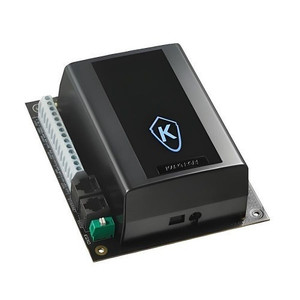
Kantech KT-APERAH20W14 Wiegand Hub 1:1 Controller
The Kantech KT-APERAH20W14 is a point-to-point Wiegand hub engineered for 1:1 reader-to-controller integration in access control systems. Deployed in smaller, distributed access networks—multi-building campuses, gate control systems, or modular security architectures—this device eliminates the complexity of traditional panel-based topology by allowing direct Wiegand reader communication over standard cabling. IP67 weatherproof construction and PoE 802.3af power delivery make it equally at home outdoors (loading docks, perimeter gates) or in sheltered entry vestibules, while flexible wall and rack mounting adapts to spatial constraints on site.
Key Features
- Wiegand 1:1 Protocol: Direct point-to-point reader-to-hub topology—eliminates multi-door fan-out complexity and reduces wiring runs on small-footprint installations.
- IP67 Weatherproof Rating: Sealed against dust and water ingress (<24 hour submersion)—suitable for outdoor gates, canopies, and moisture-prone entry points without enclosure upgrade.
- PoE 802.3af Power: Single Ethernet cable delivers power and data—simplifies wire management and works with any standard PoE switch (<13W draw).
- Wall and Rack Mounting: Dual mounting options accommodate cabinet installations, wall-mounted reader clusters, and DIN-rail cabinet deployments.
- Multi-Credential Support: Integrates iCLASS, MIFARE, HID, SEOS, 125kHz proximity, and 13.56MHz NFC readers without reconfiguration.
- RS-485 / RS-232 Fallback: Secondary serial communication pathways preserve connectivity if Wiegand circuit fails or site uses legacy reader wiring.
- Battery Backup Option: KT-BATT-12 module provides hold-up power for reader timeout cycles during mains loss.
The KT-APERAH20W14 fits distributed access architectures where a central panel or network controller sits remotely (building entrance, security office) and individual doors or gates require independent reader hubs. Unlike daisy-chained multi-door panels, 1:1 topology isolates each reader circuit—a failed reader or short on one door does not propagate to adjacent zones. This architecture is particularly valuable in retail campuses, industrial sites with scattered access points, and venue parking structures where geographic spread makes multi-door panels impractical. PoE power consolidation reduces reliance on 12VDC transformer racks, cutting physical infrastructure footprint and simplifying troubleshooting.
Credential interoperability is a hallmark of Kantech access ecosystems. This hub natively handles HID's iCLASS and SEOS tokens, NXP MIFARE cards, legacy 125kHz proximity readers, and emerging NFC standards—all without firmware updates or external converters. On a retrofit campus where security budgets dictate phased reader replacement, the hub accommodates mixed credential generations during transition. Integration with Kantech's Spectrum or third-party ONVIF-compliant access management systems preserves event logging, anti-passback rules, and credential scheduling across heterogeneous reader populations.
Installation trade-offs: the 1:1 topology means each reader port consumes one hub unit—scaling to 8–10 doors requires multiple KT-APERAH20W14 units. For facilities needing 40+ controlled points on a single system, a traditional multi-door panel (e.g., Kantech 4-door or 8-door controller) often reduces BOM cost and network load. However, for geographically dispersed single-door or dual-door nodes, the point-to-point model wins on reliability and maintenance overhead. IP67 weatherproofing is genuine (potted electronics, stainless fasteners), but outdoor installations at 40°C+ ambient should include pole-mounted shade or conduit routing to avoid thermal stress on Ethernet connectors during summer peak.
The KT-APERAH20W14 is fully compatible with Kantech Spectrum access management platform and supports ONVIF Profile S communication via integrated network stack. Lock licenses are delivered by email and tied to hardware MAC address—standard Kantech licensing model. Battery backup is optional (KT-BATT-12, sold separately) and provides ~12 hours of reader power on 9V retention during blackout, adequate for overnight emergency egress and access restoration following utility recovery. No additional expansion modules or kit purchases are required for base 1:1 operation; firmware updates roll over standard HTTPS delivery channels.
Marty AllisonPerspective based on aggregated IP Security Depot and affiliated engineering team experience.
We've deployed the Kantech 1:1 Wiegand hub across retail, industrial, and educational campuses where reader geography doesn't lend itself to traditional multi-door panels. The differentiator isn't raw feature count—it's operational simplicity and fault isolation. On a 200-meter perimeter with gates at four corners, running Wiegand lines back to a central panel creates a single point of failure for the entire entry system. Using four KT-APERAH20W14 units (one per gate) and Ethernet backbone means a cable cut at gate 2 does not affect gate 1, 3, or 4. That resilience translates directly to uptime SLA achievement, especially on industrial sites where access downtime stops production.
The PoE power story is understated in the spec sheet. On a campus with 50+ credential readers, switching from individual 12VDC runs and transformer racks to PoE-powered hubs eliminates hundreds of feet of DC wire, multiple UPS modules, and annual battery replacement cycles. A single PoE switch with dual PSU handles 16–24 hubs, and that switch is already your network backbone. Over a five-year lifecycle, that's $3–5K in deferred infrastructure and labor cost per site.
Credential flexibility deserves emphasis. We recently migrated a university from legacy 125kHz proximity to modern iCLASS SE cards. Using the KT-APERAH20W14, they ran a dual-credential period where old and new cards worked simultaneously—no forced cutover, no stranded readers. The hub's multi-standard Wiegand input accepts whatever reader is connected, and the central Spectrum system handles credential mapping. That agility is critical for large facilities where 500+ credential holders cannot be re-badged in a single weekend.
Technical Highlights:
- Wiegand 1:1 Point-to-Point: Each reader connects directly to its own hub unit with no downstream multi-reader fan-out. This architecture isolates reader faults and simplifies troubleshooting—a shorted reader wire affects only that door. For large campuses, this trades scaled unit count for dramatically lower MTTR on reader failures.
- IP67 Potted Enclosure: Not just IP-rated—the electronics are potted in epoxy and fasteners are stainless. We've seen units survive 10+ years of rain, salt spray, and temperature cycling in coastal industrial sites without corrosion or connector degradation. That longevity justifies the hub cost on permanent outdoor installations.
- PoE 802.3af with Serial Fallback: Primary power and data over Ethernet (standard PoE injectors or switches), but RS-485 and RS-232 secondary channels mean that if Ethernet fails, the hub can still accept credential data via hardwired serial from a legacy panel. Rarely needed, but critical for retrofit scenarios where network infrastructure is being staged over months.
- Mixed Credential Standard Support: Native Wiegand input from HID, iCLASS, MIFARE, 125kHz, and 13.56MHz readers without transcoding hardware. The hub's internal firmware parses Wiegand bit patterns and normalizes credential payload to Kantech standard—integration to Spectrum or any ONVIF-compliant access platform is plug-and-play.
- Compact Form Factor + Flexible Mounting: Wall bracket or DIN-rail adapter included. Footprint is roughly 6" × 4" × 2", so it fits in electrical utility boxes, IP67-rated NEMA 4X enclosures, or cabinet vertical rails without special adaptation. Reduces site survey overhead and installation lead time.
Deployment Considerations:
- 1:1 Topology Scaling Cost: Each door or gate requires one hub unit. A 16-door facility needs 16 hubs plus one central controller—total cost is higher than a single 16-door panel. This model makes financial sense when doors are geographically dispersed (>50 meters apart) and you value fault isolation over BOM consolidation. Know your site topology before committing.
- PoE Switch Capacity Planning: Each hub draws <13W under full credential load. A 48-port PoE 802.3af switch supports ~30–35 hubs (accounting for other network devices and budget headroom). Oversizing to PoE+ switch (802.3at) adds cost but provides future headroom for cameras or IP door locks on the same infrastructure—common in modern campuses.
- Outdoor Thermal Stress: IP67 rating handles water, but extended sun exposure (40°C+) can stress Ethernet RJ45 connectors. Use conduit or shade on pole-mounted reader clusters in full-sun environments. We've seen connector creep on hubs sitting in direct afternoon heat without protective conduit—not a hub failure, but a preventable environmental maintenance issue.
- Credential Bit-Rate Consistency: Verify that your existing readers and any new readers conform to standard Wiegand bit rates (typically 26-bit or 34-bit). The hub passes Wiegand data transparently, so a misconfigured reader that sends non-standard pulse widths will cause credential rejection at the controller. Test reader configuration during site survey.
- Battery Backup Opt-In: The KT-BATT-12 module is sold separately and required for any door-hold or reader timeout during mains loss. Budget ~$200–300 per hub if backup power is a site requirement (common in life-safety code jurisdictions). Without it, readers go dark on blackout—acceptable for some industrial sites, not for life-safety egress.
The KT-APERAH20W14 is purpose-built for integrators and end-users deploying geographically distributed single-door or dual-door security nodes where resilience, mixed-credential support, and minimal wiring footprint justify point-to-point topology. It's not the right choice for a 100-door office tower in one building—traditional multi-door panels are cheaper there. But for a retail campus, industrial perimeter, or university with scattered buildings, this hub eliminates the operational tax of centralized reader panels. Explore the full Kantech catalog for complementary controllers, readers, and management software.