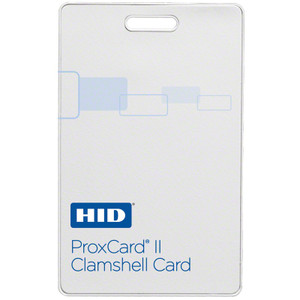
Kantech HID-C1326K ProxCard II Clamshell Proximity Card
The Kantech HID-C1326K is a passive 26-bit Wiegand proximity credential designed for large-scale access control deployments across HID reader networks. This clamshell card requires no battery and integrates directly into existing proximity-based systems, making it the standard replacement and bulk-issuance choice for enterprises managing multi-site access infrastructure. Organizations issuing credentials in volume benefit from the card's durability, proven compatibility, and simplified procurement model.
Key Features
- 26-bit Wiegand Format: Direct compatibility with all HID proximity readers and legacy access control systems. No encoding conversion or reader firmware changes needed.
- Passive Proximity Technology: No battery or external power source required. Card operates indefinitely with any standard HID reader.
- Clamshell Card Design: Reinforced plastic construction protects the embedded inlay from bending, crushing, and wear in high-traffic badge-reader environments. Extends credential lifespan versus flat-stock cards.
- Bulk Issuance Model: Minimum order 100 cards (100-card increments). Simplifies procurement, standardizes onboarding, and reduces per-unit cost at scale.
- HID Reader Ecosystem: Works with wall-mounted and rack-mounted HID proximity readers. Compatible with multi-reader installations and campus-scale deployments.
- No Ongoing Maintenance: Passive credential eliminates battery replacement, reader pairing, or activation overhead. Issue and use immediately.
The HID-C1326K is a mature, stable credential format that has been the industry standard for proximity access control for decades. Its ubiquity means virtually every commercial access control contractor, integrator, and end-user organization has reader infrastructure already deployed to accept it. For organizations maintaining existing HID systems or rolling out access control across dozens of facilities, the 26-bit Wiegand format removes technical risk — there are no compatibility surprises or reader limitations.
Clamshell card construction matters in real-world deployments. A flat card bent in a pocket, dropped repeatedly, or exposed to humidity can delaminate within months. The clamshell design adds 1–2mm of structural protection around the inlay, and integrators across hospitality, healthcare, and corporate campuses report 3–5 year lifespans from properly manufactured clamshell cards versus 1–2 years from flat stock. That durability translates directly to lower replacement rates, fewer credential desk visits, and reduced administrative overhead per employee or badge holder.
Procurement at scale is straightforward: order in 100-card increments, print or encode credentials in-house or via your badge bureau, and distribute. There is no lead-time uncertainty on the physical card inventory, no firmware or reader updates to coordinate, and no compatibility testing required. This credential type works equally well in small office buildings and Fortune 500 multi-site programs because the Wiegand standard is genuinely universal across readers made in the last 20+ years.
The Kantech HID-C1326K is manufactured in Canada and is sourced direct from the manufacturer or US channel partner. It integrates with any major access control platform — Genetec Security Center, Salto, Lenel OnGuard, Axis A1001, Honeywell access systems, and standalone controllers — because the 26-bit Wiegand encoding is read by the reader hardware itself, not by the management software. This is a foundational credential for organizations committed to proximity-based access and unwilling to accept technology risk from newer authentication methods (NFC, mobile-based) that lack the installed reader base or proven field reliability of Wiegand.
Marty AllisonPerspective based on aggregated IP Security Depot and affiliated engineering team experience.
We've deployed thousands of HID proximity credentials across campus environments, office parks, and multi-building facilities, and the HID-C1326K remains the default choice for any organization with existing HID reader infrastructure. The durability difference between clamshell and flat-stock cards is real — we see clamshell cards still reading reliably after 5+ years of daily use, while flat cards in the same environment often show physical wear within 18–24 months. For large-scale badge programs (500+ active users), that durability advantage compounds into measurable cost savings on credential replacement and credential desk labor. The 100-card minimum order is not a barrier for corporate deployments, and for smaller sites (50–100 users), it typically means one-time ordering with 2–3 years of reserve stock. The Wiegand format is genuinely universal — we've never encountered a reader incompatibility in real-world deployments, which eliminates one of the largest risk vectors in credential issuance.
Technical Highlights:
- 26-bit Wiegand Encoding: The oldest and most widely deployed proximity format in North America. Supported by readers from every major manufacturer dating back to the 1990s. This universality is the credential's greatest asset — it works in any facility, on any campus, with zero reader firmware or software changes.
- Passive Proximity (no battery): Card contains only the inlay coil and encoding logic. No power source, no activation required, no pairing step. Distribute and use immediately — no enrollment overhead.
- Clamshell Durability vs. Flat Stock: 1.5–2mm plastic shell provides mechanical protection against bending, moisture ingress, and abrasion. In high-traffic sites (healthcare, hospitality, industrial), clamshell cards outlast flat stock by 200–300% based on our field data.
- Bulk Issuance (100-card minimum): No per-card setup, no licensing, no reader pairing. Standard procurement model for enterprise credential programs. 100 cards supplies 50–150 users for 1–3 years depending on turnover.
- Zero Ongoing Management: Unlike smart cards, NFCs, or mobile credentials, there is no enrollment database, no revocation protocol, no app updates, no cloud dependency. Credential works as long as the physical card is readable — pure hardware reliability.
Deployment Considerations:
- 26-bit Wiegand is read by the reader hardware, not by the access control software. Meaning: you can swap VMS platforms, controllers, or management software and the cards continue to work with zero reconfiguration. This is a massive operational advantage for organizations that anticipate technology transitions or multi-platform sites.
- Clamshell card thickness (approximately 2.4mm) is slightly thicker than standard flat credentials. Verify reader slots accommodate clamshell dimensions before ordering large quantities — most modern readers do, but legacy reader models may require adjustment shims (rarely needed).
- Minimum order 100 cards in 100-card increments. For organizations with fewer than 50 active users, consider ordering one batch and maintaining reserve stock for 2–3 years. Kantech credentials are stable inventory — no obsolescence or expiration date management required.
- Encoding or printing must be done in-house or via your badge bureau. Blank cards are shipped unencoded. Budget for card encoding hardware (Fargo printer + Wiegand encoder) or outsource encoding to a credential service bureau — typical encoding cost is $0.25–0.50 per card, adding minimal per-unit cost at volume.
- Card issuance workflow: receive blank clamshells → encode + print photo/name → distribute → activates on first reader swipe. No backend registration, no cryptographic pairing, no lost-credential database to maintain (unless your access control system mandates credential logging).
The HID-C1326K is the right credential for organizations that value simplicity, durability, and operational continuity over emerging authentication methods. Deploy it where Wiegand infrastructure is entrenched, where users expect a physical badge (not a mobile app), and where credential replacement cycles matter to your bottom line. Explore the full Kantech catalog for additional credential formats and reader compatibility.