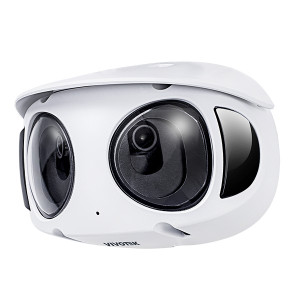
What is the main advantage of multi-sensor IP cameras over single-sensor models?
Multi-sensor cameras deliver wider coverage (often 180°–360°) in a single mount point, reducing the number of cable runs, switch ports, PoE injectors, and ceiling penetrations. This simplifies installation in large open areas and minimizes blind spots, though you must account for higher per-camera bitrate and power consumption.
How much bandwidth does a multi-sensor camera consume?
Dual-sensor cameras typically consume 6–15 Mbps per sensor (12–30 Mbps total), while quad-sensor models range from 8–40 Mbps depending on resolution, frame rate, and codec. Always plan for the combined bitrate of all imagers active simultaneously; bitrate and storage retention calculators help size your NVR and switch.
Do multi-sensor cameras work with standard PoE switches, or do they require PoE++?
Dual-sensor models often work with PoE+ (30W), but quad-sensor cameras and those with active cooling typically need PoE++ (60W) or higher. Check the camera datasheet for power rating, then verify your switch model supports the required power class on each port; PoE switch capacity planning is critical at scale.
Can I stitch multi-sensor feeds into a single panoramic view?
Yes, many cameras embed firmware stitching, while others require NVR or third-party software to blend sensor streams. Verify compatibility between your camera brand (e.g., Axis, Hikvision) and NVR software before deploying; not all combinations support seamless panoramic output.
Are multi-sensor cameras suitable for outdoor use?
Yes. Outdoor-rated turret and bullet multi-sensor models from Hanwha, i-PRO, and Axis handle extreme temperatures, rain, and UV. Verify IP rating (IP66 or higher) and operating temperature range; thermal-fusion models excel at perimeter detection in low-light conditions.
How do I choose between dual-sensor and quad-sensor cameras?
Dual-sensor models cost less and consume half the bandwidth/power of quad-sensor equivalents, suitable for hallways and linear spaces. Quad-sensor cameras justify higher cost and bitrate in large open areas (warehouses, parking structures) where 360° coverage and fewer mount points are critical. Consider your identification distance requirements and available infrastructure capacity.