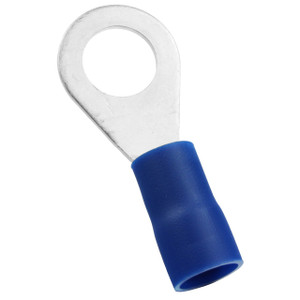
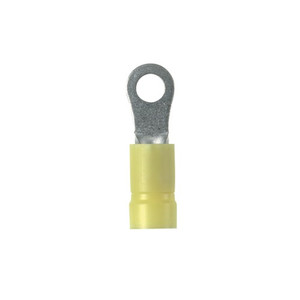
Panduit EV6-38R-Q StrongHold Ring Terminal
Panduit EV6-38R-Q is a vinyl-insulated ring terminal rated for 6 AWG wire and 3/8" stud connections. StrongHold construction features seamless-barrel crimping for maximum pull strength, making it the specified choice for UPS battery banks, switchgear grounding, and critical-power installations where terminal failure isn't an option. Tin-plated copper barrel ensures low-resistance connections in corrosive environments. UL 587H listed and CSA certified for use in inspected electrical systems. Ships in 25-count packs.
Key Features
- 6 AWG wire capacity with 3/8" stud hole for standard #8 hardware
- Vinyl insulation barrel — red color-coding for instant wire-size verification during inspection
- Tin-plated seamless copper barrel for corrosion resistance and maximum conductivity
- StrongHold seamless-barrel design — no split seams that can catch wire strands or create stress points
- UL Listed 587H (file E52164) and CSA certified (LR31212) for code-compliant installations
- 1.76" overall length, 0.63" tongue width — compact profile for tight panel enclosures
The EV6-38R-Q addresses the most common failure mode in power terminations: inadequate crimp retention under thermal cycling. Standard butt-splice-style lugs use split barrels that can lose contact pressure as copper expands and contracts through load cycles. StrongHold's seamless barrel construction maintains constant radial compression on the wire bundle, verified through UL's temperature-rise and pull-force testing protocols. In battery-bank installations — where terminal resistance directly impacts runtime and lifespan — this translates to measurably lower voltage drop across the connection.
Vinyl insulation serves three functions beyond basic electrical isolation. First, the funnel-shaped insulation barrel guides stripped wire into the crimp zone and prevents stray strands from escaping during crimping — critical when working with finely-stranded welding cable or DLO wire common in solar and battery applications. Second, the vinyl creates a moisture seal at the wire entry point, preventing wicking corrosion in outdoor or high-humidity enclosures. Third, red color-coding provides instant visual verification of wire gauge during multi-circuit inspections, reducing the risk of undersized wire terminations that can pass visual inspection but fail under load.
Tin plating on the copper barrel matters in two scenarios: dissimilar-metal contact and long-term storage. When connecting to aluminum bus bars or tin-plated studs (common in switchgear and industrial panels), bare copper creates a galvanic cell that accelerates corrosion. Tin plating eliminates the potential difference. For integrators stocking terminations for field service, tin plating prevents the copper-oxide layer that forms on bare copper lugs after 6-12 months of shelf storage — oxide buildup increases contact resistance and can cause crimp tools to slip during compression.
The 3/8" stud hole pairs with standard #8 hardware (3/8" bolts, 5/16" studs with 3/8" washers). This is the dominant size for battery terminal posts (Group 24, 27, 31 AGM/gel-cell batteries), UPS input/output terminal blocks, and grounding bus bars in 19" rack PDUs. The 0.63" tongue width provides sufficient surface area for star washers and split-ring lock washers without overhang, preventing the lever-arm bending that occurs when oversized lugs are torqued down on small studs.
Crimping requires a ratcheting hex-crimp tool (Panduit CT-920 or equivalent) with the proper die size for 6 AWG insulated terminals. Non-ratcheting pliers-style crimpers and hammer-crimp tools do not apply sufficient radial force to meet UL's pull-test requirements and will void the listing. The seamless barrel requires a single crimp cycle positioned 0.2" from the wire entry point — over-crimping or double-crimping work-hardens the copper and creates fracture points. For high-vibration applications (generator sets, motor control centers), apply dielectric grease to the stud threads before torquing to prevent the vinyl insulation from rotating under vibration, which can loosen the nut over time.
UL 587H listing covers use in 600V circuits up to 105°C ambient temperature. CSA certification extends to Canadian Electrical Code installations. Both listings require the terminal to pass 1,000-hour salt-spray testing, 500-cycle thermal shock (-40°C to +105°C), and pull-force testing at 150% of the wire's rated tensile strength. These ratings make the EV6-38R-Q compliant for NEC Article 690 solar installations, Article 645 datacenters, and Article 700/701 emergency/standby power systems where terminal failure can disable life-safety circuits.