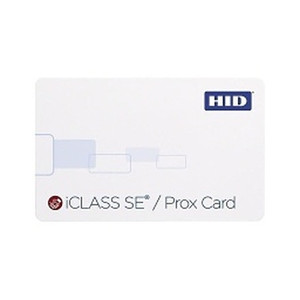
HID 3151RGGMNN iCLASS Prox Programmable Credential
When you're managing mixed-format access control deployments with both legacy 125 kHz prox and 13.56 MHz iCLASS readers, issuing separate credentials creates overhead and user friction. The HID 3151RGGMNN solves this by combining iCLASS SE platform security with embedded prox technology in a single programmable credential, letting you migrate systems without replacing every card or forcing users to carry multiple badges.
Key Features
- Dual-technology credential supports both iCLASS 13.56 MHz and legacy 125 kHz prox readers
- Programmable format allows encoding custom facility codes and card ranges to match existing systems
- iCLASS SE platform provides mutual authentication and encrypted credential data
- Standard CR80 credit card form factor ensures compatibility with existing badge holders and lanyards
- Graphical printable surface accepts dye-sublimation and direct-to-card printing for photo IDs
- Compatible with HID's iCLASS SE readers and infrastructure for future-ready deployments
- Works with existing HID prox readers during migration periods without reader replacement
This credential type is engineered for phased access control upgrades where you need to maintain compatibility with installed prox infrastructure while deploying higher-security iCLASS SE readers in sensitive areas. Program the iCLASS application space with encrypted credentials for new high-security zones, while the embedded prox technology grants access through legacy readers in lower-risk areas. This approach lets you allocate security investment where it matters most without forklift upgrades.
The programmable format structure means you can encode site-specific facility codes and card numbering that align with your existing database and access management software. Whether you're running an enterprise campus with thousands of credentials or a multi-tenant facility managing separate access groups, the flexibility to define format parameters during encoding ensures seamless integration with your current provisioning workflows and eliminates the need to reconfigure reader wiring or controller programming during the transition.