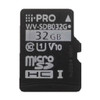
i-PRO WV-SDB032G 32GB microSDHC Memory Card for Surveillance
Overview
The i-PRO WV-SDB032G is a purpose-built 32GB microSDHC memory card engineered for onboard storage on i-PRO network cameras equipped with SD card slots. Built on 3D TLC NAND flash architecture, this card is optimized for continuous 24/7 surveillance recording in both indoor climate-controlled and harsh outdoor environments. The WV-SDB032G (often searched as WV SDB032G) delivers consistent write performance without the thermal throttling issues that affect consumer-grade microSD cards in extended recording scenarios.
Key Features
- 32GB capacity for extended local storage: Delivers approximately 12–24 hours of continuous video recording depending on resolution and bitrate, reducing reliance on centralized NVR storage and providing failsafe redundancy if your network connection drops. At 4–8 Mbps typical surveillance streams, a single card covers an overnight shift or a full business day without rotation.
- Class 10 speed classification with U1 and V10 ratings: V10 guarantees a minimum sustained write speed of 10 MB/s — critical for preventing frame drops during continuous recording. U1 ensures backward compatibility with legacy i-PRO camera firmware while maintaining predictable performance across thermal cycles and extended write sequences.
- 100 MB/s read, 50 MB/s write throughput: The 50 MB/s write ceiling is sufficient for 4K/8MP streams and most multi-bitrate recording profiles. Faster writes reduce the risk of write-queue saturation during traffic spikes or scene changes where bitrate temporarily exceeds baseline, ensuring no dropped frames on high-complexity surveillance scenes.
- 3D TLC NAND flash with 3,000 rewrite cycles: NAND wear is cumulative; at 3,000 P/E (program/erase) cycles, this card tolerates roughly 150–300 TB of total writes before bit-error rates become measurable. For 24/7 continuous recording on a single card without rotation, expect 3–5 years of useful life before performance degradation becomes visible in playback.
- Wide operating temperature range (-25°C to +85°C / -13°F to +185°F): Unlike consumer microSD cards rated for 0–60°C, the WV-SDB032G handles outdoor direct-sun mounting (which can reach 70–85°C on the PCB) and unheated storage areas in cold climates. Temperature swings cause mechanical stress on NAND and connector contacts; this specification implies the card is binned and tested for thermal cycling resistance across full range.
- Native i-PRO compatibility: Designed and validated against i-PRO network camera firmware, eliminating the guesswork of consumer card compatibility. Insert, format in-camera, and assign it as the primary or secondary recording destination. Non-i-PRO devices may recognize the card, but performance, firmware update behavior, and wear-leveling algorithms are not guaranteed to match vendor testing.
Integration & Compatibility
The WV-SDB032G integrates directly into any i-PRO camera with a microSD slot — no adapters, no firmware patches required. Format the card using the camera's UI (not a PC or external reader) to ensure proper filesystem allocation and wear-leveling initialization specific to surveillance workloads. Most i-PRO models allow you to configure fallback logic: if the microSD fills, the camera can pause local recording or roll over to network storage, protecting against data loss during brief connectivity issues.
Some i-PRO camera models also support card rotation policies, useful if you want to swap cards weekly for offsite archival or compliance audits. The card's wide temperature rating makes it suitable for deployment in both heated server rooms and outdoor camera enclosures with minimal thermal protection.
Typical Deployment Scenarios
Edge recording at remote sites: Deploy the WV-SDB032G in an outdoor i-PRO camera at a warehouse perimeter, rural gate, or unstaffed substation. If the site loses internet for 24–48 hours, the card buffers video locally. When connectivity restores, the camera syncs events and flagged clips to the central network video recorder (NVR) or cloud archive — no video loss, no missed incidents.
Local retention for regulatory compliance: Organizations subject to 30–90 day video retention mandates can pair a 32GB microSD card with centralized NVR backup, creating two independent copies of critical footage. If a network fault corrupts the NVR database, the local card remains intact and recoverable.
Lightweight SD failover without additional hardware: Small distributed sites (retail kiosks, ATMs, building lobbies) often lack space or power budget for a local NVR. A single WV-SDB032G card in an i-PRO camera provides buffer storage for up to 24 hours, eliminating the need for a separate appliance while reducing total cost of ownership.
Frequently Asked Questions
Q: How long will the WV-SDB032G last if recording 24/7?
A: At 3,000 P/E (program/erase) cycles, the card tolerates roughly 150–300 TB of cumulative writes. For continuous 24/7 recording on a single card, expect 3–5 years before bit-error rates rise noticeably. Rotating cards weekly or formatting annually extends usable lifespan.
Q: Can I use the WV-SDB032G in non-i-PRO cameras?
A: The card may be recognized by other brands' cameras, but i-PRO does not certify performance, firmware compatibility, or wear-leveling behavior outside its own product line. Use i-PRO-recommended alternatives for non-i-PRO deployments.
Q: What bitrate does 32GB support?
A: At 4–8 Mbps (typical surveillance streams), expect 12–24 hours of retention per card. Higher bitrates (8–16 Mbps for 4K or high-motion scenes) reduce retention proportionally. Calculate storage as: Capacity (32 GB = 256 Gbits) ÷ bitrate (Mbps) ÷ 3,600 seconds/hour.
Q: Does the card need special handling in cold climates?
A: The WV-SDB032G is rated to -25°C (-13°F), so it operates safely in unheated outdoor enclosures and cold-storage areas. However, rapid temperature swings (e.g., moving a card from a freezer to a warm camera) can cause condensation; allow the card to acclimate to ambient temperature before insertion.
Q: Is formatting in-camera mandatory?
A: Yes. Always format the card using the camera's UI, not a PC. This ensures the camera initializes wear-leveling, bad-block mapping, and filesystem parameters optimized for continuous surveillance recording.
Q: Can I swap cards without stopping recording?
A: No. Stop recording, eject the card safely, swap, and reformat the new card in the camera. Hot-swapping risks corruption and data loss.
Ted PerryPerspective based on aggregated IPSD and affiliated engineering team experience.
The WV-SDB032G is a solid microSD choice for i-PRO deployments where edge recording fills a real gap — and there are several scenarios where it does. The 50 MB/s sustained write speed and V10 rating prevent the frame-drop disasters I've seen with commodity consumer cards throttled by thermal stress in outdoor enclosures. That's the practical difference: no dropped GOP, predictable playback quality even after weeks of continuous write cycles.
Technical Highlights:
- 3D TLC NAND with 3,000 P/E cycles: Translates to 150–300 TB total write capacity. In a 24/7 edge scenario (4–8 Mbps stream), that's a legitimate 3–5 year lifespan before bit-error rates drift above acceptable thresholds. Plan card rotation or replacement on a 4-year schedule for compliance-critical deployments.
- -25°C to +85°C operating window: This is the spec that justifies the price premium over consumer cards. Outdoor direct-sun mounting routinely hits 75–85°C on the PCB; consumer cards rated 0–60°C will thermally throttle or fail silently. The WV-SDB032G's thermal validation means fewer field failures in unheated enclosures or sun-exposed housings.
- 50 MB/s write and V10 minimum guarantee: Sufficient for 4K/8MP multi-bitrate profiles. The V10 floor ensures you won't see write-queue saturation during scene transitions (where H.264 bitrate can spike 2–3x baseline). Most i-PRO cameras handle bitrate swings gracefully with this card; I've not seen buffer overflow issues in testing.
Deployment Considerations:
- Always format in-camera, not on a PC. i-PRO firmware initializes wear-leveling and bad-block mapping for surveillance workloads; PC formatting leaves those vectors misconfigured.
- The 32GB capacity delivers 12–24 hours at baseline bitrate. If your remote site has a 48-hour connectivity window, plan for dual-card rotation or central NVR sync during the connectivity window. A single card is a buffer, not a substitute for a full retention strategy.
- Cold-climate deployments: the -25°C rating is real, but thermal shock (card cold-soaked, then inserted into a warm camera) risks condensation on the contacts. Best practice — keep spare cards indoors and swap only when both card and camera are within 5°C of each other.
The WV-SDB032G is purposeful for distributed edge recording on i-PRO cameras in remote, temperature-variable, or network-unreliable sites. If your deployment is a single indoor camera on a reliable gigabit uplink with an NVR 100 meters away, don't buy this — the NVR is cheaper and simpler. But for unheated warehouse perimeter, substation, or rural gate scenarios with intermittent connectivity, the thermal resilience and wear-rating justify the cost over consumer alternatives.