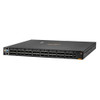
HPE R8Z96A Aruba 9300-32D 32-Port 400G Data Center Switch
The HPE Aruba 9300-32D is a high-density core switching platform — the R8Z96A variant configures 32 ports at 400G alongside 2 ports at 10G, making it a fit for spine or aggregation layers in data centers and high-performance campus cores where 400G fabric connectivity is the next step beyond 100G buildouts.
Overview
Positioned within the HPE Aruba switching portfolio, the 9300-32D targets environments demanding non-blocking 400G forwarding — think HPC clusters, AI/ML training fabrics, hyperconverged infrastructure interconnects, and large-scale enterprise core deployments. The 32x 400G port density allows a single chassis to serve as a leaf or spine node in a folded-Clos architecture without requiring external line cards or chassis expansion. The pair of 10G ports provides out-of-band management or legacy uplink connectivity without consuming 400G capacity.
Port Configuration
The R8Z96A delivers 32 ports of 400G and 2 ports of 10G in a fixed-form-factor platform. In a data center spine role, 32x 400G downlinks to leaf switches supports substantial east-west bandwidth — a consideration when deploying GPU clusters or NVMe-over-Fabric storage networks where bisectional bandwidth defines application throughput ceilings. The 10G ports serve management plane separation or slower-tier aggregation without requiring a separate management switch.
Deployment Context
As part of the broader network switching category, the 9300-32D competes in a segment where port density, forwarding ASIC architecture, and software stack maturity determine total cost of ownership. HPE's Aruba CX OS, common across the 8000 and 9000 series, enables consistent automation tooling — Ansible, REST API, and telemetry streaming — across both campus and data center tiers. Buyers evaluating this platform alongside alternatives in the HPE Aruba data center switching line should verify specific ASIC forwarding rates, buffer depth, and supported optics from the current HPE Aruba 9300 series datasheet before finalizing BOM.
Note: Full technical specifications — forwarding rate, buffer size, power consumption, supported optics, OS version requirements, and warranty terms — should be confirmed against the current HPE Aruba 9300 series product bulletin. Contact pre-sales engineering for configuration assistance.
Frequently Asked Questions
Q: What does the R8Z96A part number correspond to in the HPE Aruba lineup?
A: The R8Z96A is the HPE Aruba 9300-32D switch, configured with 32 ports at 400G and 2 ports at 10G. It is positioned as a high-density fixed-form-factor platform for data center spine or aggregation roles.
Q: Is the HPE Aruba 9300-32D suitable for a spine role in a Clos fabric?
A: The 32x 400G port count is consistent with spine-layer deployment in a folded-Clos architecture, providing high east-west bandwidth for leaf-spine interconnects. Confirm non-blocking forwarding capacity and buffer specifications in the HPE Aruba 9300 datasheet for your specific traffic profile.
Q: What is the country of origin for the R8Z96A?
A: The R8Z96A is manufactured in Taiwan (TW).
Q: Does the 9300-32D run HPE Aruba CX OS?
A: The Aruba 9300 series is part of the Aruba CX platform. Verify the specific supported CX OS version and feature set against the current HPE product bulletin for this SKU before deployment.
The R8Z96A lands in a specific design point: 32 ports of 400G in a fixed chassis, which is the configuration you reach for when building a leaf-spine fabric that has outgrown 100G downlinks and needs to move bulk AI/ML or NVMe storage traffic without a chassis-based solution eating half a rack. At this port speed and density, the optics BOM (QSFP-DD 400G SR8, FR4, LR4) is a bigger line item than the switch itself — verify your reach and fiber plant before quoting.
Technical Highlights:
- 32x 400G Ports: enough spine bandwidth for a mid-scale leaf-spine (16 leaves with dual-homed uplinks), without the operational complexity of a modular chassis
- 2x 10G Ports: dedicated management or out-of-band connectivity that keeps control plane traffic physically separated from production fabric — a clean practice in high-throughput environments
- Taiwan Manufacture (COO: TW): relevant for procurement teams with TAA or supply-chain documentation requirements — confirm TAA compliance status with HPE for this specific SKU if it's a federal or regulated-sector purchase
Deployment Considerations:
- At 400G port speeds, validate that your cabling plant (MPO-12/MPO-16, single-mode vs. OM4/OM5) matches the optics you intend to deploy — mismatched fiber type is the most common commissioning delay on 400G rollouts
- Full forwarding rate, power draw, and supported optics must be verified against the current HPE Aruba 9300 series datasheet — do not size power circuits or cooling capacity from the product name alone
Best fit: a data center spine layer in an AI/ML compute cluster or hyperconverged infrastructure deployment where 100G leaf uplinks are the current bottleneck and the team is ready to manage 400G optics and cabling at scale.