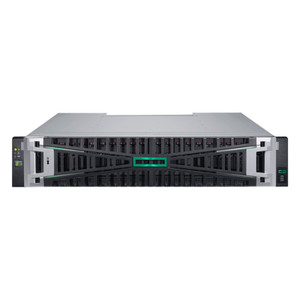
HPE S1H44A MSA 2070 10/25GbE iSCSI SFF Storage Array
Overview
The HPE MSA 2070 (S1H44A) is a 2U rack-mount shared storage array built around dual 10/25 GbE iSCSI controllers and 24 small form-factor (SFF) drive bays. It is sized for mid-range enterprise and departmental workloads — virtualization clusters, database tiers, and video surveillance repositories — where you need proven block-level storage with a clear expansion path but do not require the complexity or cost of an all-NVMe array. If your infrastructure already runs 10GbE or 25GbE switching, the MSA 2070 drops in without adding a dedicated storage network fabric, which keeps both capital and operational costs contained.
Key Features
- Dual 10/25GbE iSCSI Controllers (4-port each): Both controllers are active simultaneously, so workload traffic distributes across both paths rather than sitting idle on a standby node. Each controller carries four ports, giving you eight total host-facing connections — enough to wire redundant multipath links to every host in a moderate-sized VMware or Hyper-V cluster without port contention.
- 24 SFF Drive Bays — HDD and SSD mix: Small form-factor bays accept both spinning HDDs and SSDs in any combination. In practice, this lets you tier within a single enclosure: flash for your OLTP or VM metadata LUNs, high-density HDDs for bulk data or surveillance footage. You're not forced into an all-SSD cost profile to get flash acceleration where it matters.
- Up to 7.37 PB Raw Capacity with Expansion: The base 2U enclosure scales to 7.37 petabytes by chaining expansion shelves. For video surveillance NVR deployments with long retention requirements or large-scale file archiving, that ceiling removes the need to evaluate a larger, more expensive platform before the project actually demands it.
- 2U Rack-Mount Form Factor: Two rack units is a meaningful constraint in dense data centers. The MSA 2070 fits alongside compute nodes in a standard 42U rack without consuming the space a 4U or modular chassis would — relevant when rack space is billed or physically limited in a colo or branch IDF.
- Broad OS and Hypervisor Compatibility: Validated against Windows Server, VMware vSphere, Red Hat Enterprise Linux, and SUSE SLES. For mixed environments — Windows workloads sharing storage with Linux application servers or VMware clusters — this means a single array serves multiple OS stacks over iSCSI without custom driver work or compatibility waivers.
- 3-Year Limited Warranty with Next-Business-Day Parts Exchange: The included service level commits to next-business-day parts delivery, not just next-business-day response. For most enterprise sites without deep spare-parts inventory, this distinction matters: a failed controller or drive can be replaced the following morning without carrying your own hot-spares on the shelf.
- Flexible Drive Mix Supports Tiered Storage: Because the 24 SFF bays accept both HDDs and SSDs natively, you can implement read or write caching without a separate cache appliance or additional licensing. Configure SSD-heavy pools for latency-sensitive applications and HDD pools for high-capacity, lower-IOPS workloads — all managed through a single controller pair.
Integration and Compatibility
The S1H44A connects over standard 10GbE or 25GbE Ethernet using iSCSI — no Fibre Channel HBAs, no InfiniBand, no specialized switching required. Any host with a standard NIC and an iSCSI initiator (built into Windows Server, VMware ESXi, and major Linux distributions natively) can provision storage. This matters for organizations that want SAN-class shared storage without committing to a parallel FC fabric. For teams managing VMware vSphere environments, HPE MSA arrays integrate with VMware vSphere Storage APIs, enabling hardware-accelerated operations like VAAI offload — reducing CPU load on ESXi hosts during storage-intensive tasks like cloning and zeroing. The array is also supported under Red Hat and SUSE enterprise Linux, making it a viable shared block device for clustered database deployments such as Oracle RAC or SQL Server failover cluster instances on Linux.
Frequently Asked Questions
Q: What is the maximum raw capacity of the HPE MSA 2070 S1H44A?
A: With expansion shelves attached, the MSA 2070 S1H44A supports up to 7.37 PB of raw capacity. The base 2U enclosure holds 24 SFF drives; expansion shelves extend that ceiling substantially for long-retention or high-density use cases.
Q: Does the S1H44A require a Fibre Channel switch or HBA?
A: No. The MSA 2070 S1H44A uses 10/25 GbE iSCSI exclusively. Standard Ethernet switching and software iSCSI initiators — built into Windows Server, VMware ESXi, and major Linux distributions — are sufficient. No FC HBAs or specialized SAN switching is required.
Q: Can the MSA 2070 S1H44A mix HDDs and SSDs in the same enclosure?
A: Yes. All 24 SFF bays support both HDDs and SSDs in any combination. This allows tiered storage configurations — flash for latency-sensitive LUNs, HDDs for bulk capacity — within a single enclosure, without separate cache appliances.
Q: What hypervisors and operating systems are validated with the S1H44A?
A: HPE validates the MSA 2070 with VMware vSphere, Windows Server, Red Hat Enterprise Linux, and SUSE SLES. Mixed OS environments sharing the same array over iSCSI are a supported configuration.
Q: What warranty and service level is included with the S1H44A?
A: The S1H44A includes a 3-year limited warranty with next-business-day parts exchange. This means replacement parts are delivered the following business day — not just a technician dispatched — which is the relevant metric for storage hardware recovery time.
Q: How many host connections does the MSA 2070 S1H44A support?
A: The dual-controller configuration provides eight total host-facing iSCSI ports (four per controller). This supports redundant multipath connections to multiple hosts simultaneously, which is the standard requirement for VMware or Windows Server failover cluster deployments.
The MSA 2070 S1H44A is a straightforward answer to a problem I see constantly in mid-size enterprise environments: teams that need shared block storage for virtualization clusters but cannot justify a Fibre Channel fabric or an all-flash array's price tag. The dual 10/25GbE iSCSI controllers are the key spec here — both active simultaneously, four ports each, which gives you eight host paths before you've added a single expansion shelf. That's enough for a fully redundant multipath configuration across a 10-to-20 host VMware cluster with bandwidth headroom to spare.
Technical Highlights:
- Dual Active Controllers, 8 Total iSCSI Ports: Active-active controller operation eliminates the dead failover path you get with active-passive designs — all eight ports carry production traffic under normal conditions, and the surviving controller absorbs full load transparently if one fails.
- 24 SFF Bays, Mixed HDD/SSD: The ability to mix drive types within a single 2U enclosure means you can address tiered storage requirements — sub-millisecond latency for VM swap and database logs on SSDs, cost-effective bulk capacity on HDDs — without purchasing a separate caching appliance or tier-2 array.
- 7.37 PB Expansion Ceiling: For video surveillance deployments with 90-day or longer retention mandates across dozens of camera feeds, the expansion path to 7.37 PB removes the need to size for a more expensive platform upfront. Start with the base enclosure, expand as retention requirements grow.
Deployment Considerations:
- Validate your Ethernet switching infrastructure before deployment: 25GbE requires SFP28 ports and compatible cabling. If your existing switches are 10GbE-only, the array will negotiate down — functional, but you'll leave throughput on the table until switching is upgraded.
- iSCSI multipathing requires configuration on the host side (MPIO on Windows, NMP on ESXi, DM-Multipath on Linux) — this is not automatic. Confirm your storage admin has multipath policy configured before going to production, or you'll have single-path connections that look redundant but aren't.
This array fits best in VMware vSphere environments running 10 to 30 hosts where iSCSI is already the storage protocol of record and the team needs to add shared capacity without retraining staff on a new protocol stack or adding FC infrastructure complexity.