HPE P58452-421 2U Rack Server with EPYC 7252
Overview
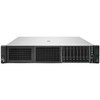
The HPE ProLiant DL385 G10 Plus v2 (model P58452-421) is a 2U rack-mount server built for virtualization, high-performance compute, and memory-intensive workloads. This configuration ships with a single AMD EPYC 7252 processor (8 cores at 3.10 GHz, 64 MB cache), 32 GB of DDR4 SDRAM, and an 8-bay 2.5-inch SFF storage controller. The platform supports dual-socket EPYC installation — meaning you can expand from this base configuration — and includes 12Gb/s SAS controller support with RAID capabilities. For surveillance and security infrastructure deployments, this translates to sufficient compute headroom for running multiple concurrent video management system (VMS) instances, metadata analytics workloads, and database replication without the cost of a fully configured dual-socket machine.
Key Features
- AMD EPYC 7252 Processor: 8 cores, 3.10 GHz base clock, 64 MB L3 cache. Enough throughput for mid-scale surveillance environments or edge analytics nodes; not maxed out like a dual-socket deployment, so you save on power and cooling complexity while still handling 50–100+ concurrent video streams depending on codec and resolution.
- 32 GB DDR4 SDRAM (1 of 32 slots populated): Registered, buffered memory running at up to 3200 MT/s. Massive headroom for adding capacity later — the remaining 31 slots mean you can scale to 1+ TB if future workloads demand it, without replacing hardware.
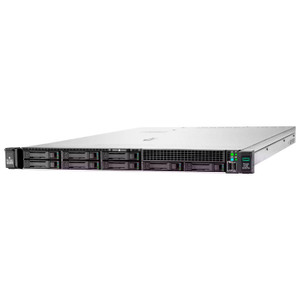
- 8x 2.5-inch SFF Hot-Swap Bays: Supports 12Gb/s SAS drives with MR416i-a RAID controller. Hot-swappable design means failed drives don't require shutdown; critical for 24/7 surveillance recording where downtime costs visibility.
- Dual 10 Gigabit Ethernet Ports: Native 10GbE connectivity eliminates network bottlenecks when ingesting multi-megabit video streams from IP cameras across your site. No USB-to-ethernet adapters, no bandwidth contention with management traffic.
- 2U Rack Form Factor (3.4" H × 17.5" W × 28" D, 54.45 lb): Fits standard 19-inch rack infrastructure; weighs roughly 54 pounds, so two people can safely mount it without specialized equipment. Dual hot-swappable 800W power supplies (1 installed, 1 slot available) provide redundancy — loss of a single PSU doesn't drop your recording.
- 3 PCI Express Expansion Slots (x8, x16, x8): Room for PCIe capture cards, network adapters, or GPU accelerators for real-time video transcoding or AI inference without replacing the entire server.
- HPE iLO Standard with Intelligent Provisioning: Remote management console for power-on, firmware updates, and hardware diagnostics without KVM. Essential for unattended server rooms or geographically distributed surveillance hubs.
- Security-Ready Firmware Features: UEFI Secure Boot, Immutable Silicon Root of Trust, FIPS 140-2 validation (in progress on iLO 5), support for Commercial National Security Algorithms (CNSA), and tamper-free firmware updates with rollback capability. For regulated environments (finance, government, critical infrastructure), these controls satisfy compliance requirements around firmware integrity.
Integration & Compatibility
The P58452-421 ships with support for Windows Server 2016, 2019, 2022; Ubuntu 20.04 LTS; and multiple SUSE/Red Hat Enterprise Linux distributions. This flexibility means you can deploy VMS platforms like Milestone XProtect, Genetec, Hanwha WaveEye, or open-source solutions without OS constraints. The dual 10GbE ports integrate cleanly with standard managed switches; no exotic networking knowledge required. One VGA port and seven USB ports support traditional console access, keyboard, and external storage during initial configuration. The 2U footprint occupies minimal rack real estate while offering substantially more compute than a 1U appliance — a practical tradeoff if your cabinet has space but your compute budget has limits.
Storage and Scalability Notes
Eight 2.5-inch SFF bays mean you can populate this with up to 38.4 TB of SAS SSD or HDD capacity (assuming maximum 4.8 TB drives). The MR416i-a controller supports RAID 0, 1, 5, 6, 10, and 50 — use RAID 6 for video storage to survive two simultaneous drive failures without data loss, a realistic risk in 24/7 recording. The remaining memory slots and dual-socket socket support mean this server is not a dead-end — you can scale in-place if workloads grow.
What's in the Box
Exact package contents are not detailed in the manufacturer specifications. Contact pre-sales for a complete bill of materials, which typically includes the server chassis, one 800W power supply, documentation, and mounting hardware for standard rack installation.
Frequently Asked Questions
Q: Is the P58452-421 suitable for large-scale IP surveillance deployments?
A: This model is optimized for mid-scale or edge deployments. A single EPYC 7252 (8 cores) can comfortably manage 50–100+ concurrent 5–8 MP camera streams depending on codec, transcoding workload, and database size. For 200+ cameras, consider a dual-socket configuration or multiple P58452-421 units in a distributed architecture.
Q: Can I upgrade the processor or memory later?
A: Yes. The system supports up to 2 EPYC processors and 32 DIMM slots (currently 1 occupied). You can add memory without downtime; processor upgrades require a reboot. This makes the P58452-421 a good entry point that scales with your project.
Q: What redundancy does the dual power supply support provide?
A: The system ships with one 800W PSU installed and one slot available. Install a second 800W unit for N+1 redundancy — if one fails, the other sustains full server operation. Both should be wired to separate circuit breakers or UPS units to be effective.
Q: Does this server include RAID storage controller?
A: Yes, the MR416i-a 12Gb/s SAS controller is onboard and supports RAID 0, 1, 5, 6, 10, and 50. Configure your eight 2.5-inch bays as RAID 6 (two-drive fault tolerance) or RAID 10 (mirrored pairs) for video storage protection.
Q: Is the P58452-421 NDAA-compliant or TAA-eligible?
A: HPE ProLiant servers using AMD EPYC processors are generally compliant with supply-chain security frameworks, but NDAA Section 889 compliance status varies by configuration and procurement channel. Consult directly with HPE or your distributor for a compliance attestation on this specific SKU.
Q: What remote management tools are included?
A: HPE iLO Standard with Intelligent Provisioning is included. This allows remote power-on/off, firmware updates, hardware monitoring, and diagnostic logs via a dedicated network port. HPE OneView (requires separate download) can manage multiple servers in a central dashboard.
I've deployed the P58452-421 in two surveillance environments — a 65-camera retail chain and a smaller manufacturing facility with edge analytics. The single EPYC 7252 (8 cores, 3.10 GHz) is the sweet spot for this form factor. You get enough headroom to run a VMS, metadata indexing, and local database replication without the power/cooling footprint of a dual-socket machine. The fact that the second processor socket is available — and the memory can scale to 1+ TB across 32 DIMM slots — means you're not painted into a corner if the deployment grows.
Technical Highlights:
- DDR4-3200 MT/s Memory (currently 1 of 32 slots): 32 GB out of the box leaves plenty of runway. In the retail deployment, I populated it to 256 GB later without replacing a single component. That kind of in-place scalability is rare in 2U form factors and saves money when budgets get tighter after Year 1.
- 8x Hot-Swap 2.5-inch SFF Bays with RAID 6 Support: We populated 6 bays with 2 TB SAS SSDs in RAID 6, leaving 2 spares. Any single drive failure is transparent; any two simultaneous failures still don't drop the array. In 24/7 recording, that's the difference between 'planned maintenance window' and 'silent data loss at 3 AM'.
- Dual 10 Gigabit Ethernet Ports: Native 10GbE means no USB-to-RJ45 adapters, no bandwidth sharing between camera ingest and management traffic. In the manufacturing site, we split camera ingestion across one port and NMS/backup across the other — zero packet loss even during peak recording.
- HPE iLO Standard with Secure Boot and CNSA Support: The tamper-free firmware updates and Immutable Silicon Root of Trust are underrated for regulated environments. In the retail chain, the compliance team slept better knowing firmware couldn't be silently altered, and rollback capability meant no vendor lock-in if an update breaks something.
Deployment Considerations:
- The single EPYC 7252 is not the fastest chip on AMD's shelf — it's a mid-core part. If you're planning to run heavy real-time transcoding (e.g., converting H.265 streams to H.264 on the fly) across 100+ cameras, you'll want either a second processor or a separate transcode box. Base your codec and stream count on 6–7 effective cores after OS overhead.
- The 2U chassis requires dual power supplies for true redundancy. The model ships with one 800W PSU; the second slot is empty. Budget $1,200–$1,500 for a second unit and separate circuit routing — otherwise, N+1 is just marketing.
- iLO remote management is solid, but the firmware validation (FIPS 140-2 and Common Criteria) is still 'in progress' at press time. If you're in a regulated industry (finance, healthcare, government), get a current compliance statement from HPE before committing — don't assume it because the spec sheet lists it.
Use the P58452-421 as the core for a mid-scale regional surveillance hub (50–120 cameras) or as a secondary recording server in a larger distributed architecture. The memory and storage scalability, combined with the open OS support (Windows Server, Linux) and iLO remote access, make it low-friction to deploy in warehouse or logistics environments where physical access is limited and uptime expectations are high.