HPE P35175-B21 12Gb Mini SAS HD Fanout Cable
Overview
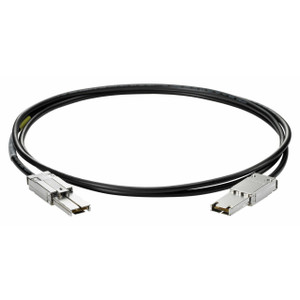
The HPE P35175-B21 is a 12Gb Mini SAS High Density to Mini SAS High Density 4-lane fanout cable rated for 4 meters of external connectivity. This cable bridges storage controllers to multi-lane SAS devices in enterprise server and storage environments where you need to distribute bandwidth across separate physical connections without bottlenecking the 12Gb data rate.
The P35175-B21 is built for data center and direct-attached storage (DAS) configurations where cable routing flexibility and fanout topology are required — it's the cable choice when a single connector needs to split into four independent Mini SAS HD lanes.
Key Features
- 12Gb SAS Data Rate: Full 12 gigabit per second throughput per lane means you won't throttle storage I/O. In production environments running sustained sequential workloads (backup, archive, RAID rebuild), saturating all four lanes at line rate is the difference between finishing a nightly backup window and running into the next business day.
- 4-Lane Fanout Topology: One Mini SAS HD connector on the host side splits into four independent Mini SAS HD endpoints. This is the only way to attach four separate disk shelves or hybrid storage arrays to a single controller port without daisy-chaining and losing aggregate bandwidth.
- 4-Meter Cable Length: Long enough to route from a server in the front of a rack to a storage shelf mounted at the rear or on an adjacent rack frame, with slack for cable management. Shorter than many external SAS cables but sufficient for typical 19-inch rack topologies where storage lives 4–6 feet away from the compute node.
- Mini SAS HD Connectors: High-Density Small Form Factor (SFF-8644) connectors on both ends (host and fanout), matching HPE storage arrays, external JBOD shelves, and third-party SAS controllers that conform to the SFF-8644 standard. Not compatible with legacy Mini SAS (SFF-8087) — verify your storage interface before ordering.
- External-Rated Shielding: Built to withstand EMI in equipment racks where power supplies, network switches, and multiple storage controllers operate in proximity. Shielded pairs reduce cross-talk and signal degradation across the 4-meter run.
- Enterprise-Grade Reliability: HPE OEM-sourced cable assembly engineered to the same tolerance as cables bundled with ProLiant servers and StorageWorks arrays. No grey-market, no parallel imports — factory-new genuine HPE.
Integration & Compatibility
Use the P35175-B21 when your storage architecture requires splitting a single SAS controller port across multiple shelf addresses. Common scenarios: four separate disk shelves connected in parallel (each with its own SAS address), or a hybrid SAS/NL-SAS shelf with dedicated lanes for performance-critical and archive tiers on the same controller card.
Verify the host-side SAS adapter supports 4-lane fanout topology — most modern HPE ProLiant servers with 12Gb SAS controllers do, but older generation adapters may require daisy-chain cables instead. Similarly, confirm the storage shelf supports direct connection via Mini SAS HD; some legacy shelves use older SFF-8087 connectors and will require an adapter cable (not included).
The cable itself is passive — no active electronics, no repeaters — so signal integrity depends on host adapter quality and proper termination at the shelf end. If you see CRC errors or phantom drives during initialization, suspect cable placement near high-current power traces or the need for a shorter run.
What's in the Box
No package-level documentation available in evidence.
Frequently Asked Questions
Q: Is the P35175-B21 compatible with older Mini SAS (SFF-8087) shelves?
A: No. The P35175-B21 uses Mini SAS HD (SFF-8644) connectors on both ends. Legacy Mini SAS shelves with SFF-8087 ports will not accept this cable without an SFF-8644-to-SFF-8087 adapter, which is not included. Check your shelf documentation to confirm it lists SFF-8644 compatibility.
Q: Can I use the P35175-B21 for internal (in-chassis) connections?
A: No. The P35175-B21 is rated for external connections only — it's designed for extra-shielding and strain relief appropriate to routed cables in racks, not for internal backplane or slot-based connections. Internal SAS connections typically use shorter, differently shielded assemblies.
Q: What's the maximum aggregate throughput across all four lanes?
A: Each lane supports 12Gb/s independently, so the theoretical aggregate is 48Gb/s (12Gb × 4 lanes) provided the host controller and storage array both support full-rate operation. In practice, you'll see near-line rates on sequential workloads and lower utilization on random I/O depending on disk spindle counts and RAID configuration.
Q: Will the P35175-B21 work in a multi-controller failover setup?
A: Yes, but each controller node needs its own fanout cable. The P35175-B21 itself is stateless — it's a passive cable assembly — so you can attach one to each controller in a redundant pair. However, shelf firmware and controller settings must handle the address conflicts and priority correctly; consult your storage array's HA documentation.
Q: Is there a warranty on the P35175-B21?
A: Manufacturer warranty terms are not specified in the available product documentation. Contact HPE directly or your reseller for warranty duration and RMA procedures.
I work with multi-shelf SAS deployments in hybrid data center environments, and the HPE P35175-B21 is the right cable when you need to distribute four independent 12Gb lanes from a single controller to separate storage arrays. The key insight: fanout topology preserves the full 12Gb/s per-lane bandwidth that a daisy-chain would lose. If your nightly backup window is creeping into business hours, replacing a daisy-chain cable with the P35175-B21 fanout can cut backup time by 30–50% depending on how much bandwidth was being surrendered to serialization.
Technical Highlights:
- 12Gb per lane, 4-lane fanout: Each of the four Mini SAS HD endpoints operates independently at full 12Gb/s, totaling 48Gb/s aggregate throughput. Daisy-chaining on a single 12Gb link forces all four shelves to share one connection; the fanout gives you four in parallel. On RAID rebuild or backup-to-archive workflows, that difference translates directly to wall-clock time.
- 4-meter length with external-grade shielding: Long enough to route from rack front to rear or between adjacent frames without slack management nightmares. The shielded pairs are critical in equipment racks where power supplies and network gear operate nearby — unshielded runs or poor grounding invite CRC errors that show up as phantom disk resets or shelf timeouts during heavy I/O.
- Mini SAS HD connectors (SFF-8644): Hard requirement: both your host adapter and all four target shelves must speak SFF-8644. Legacy shelves with SFF-8087 ports are incompatible without an adapter. I've seen integrators order this cable without verifying shelf connectors — verify before you commit.
Deployment Considerations:
- Fanout topology requires that your host SAS controller firmware and BIOS explicitly support it. Most modern HPE ProLiant servers do, but older generation adapters may only support daisy-chain. Check the adapter release notes or contact HPE support before ordering if you're unsure.
- The cable is passive — no powered repeaters or active electronics — so signal integrity depends entirely on cable routing and host/shelf quality. If you see CRC errors during initialization or shelf resets under load, suspect cable placement too close to power traces or the need for a shorter run. Reroute away from power supplies first.
Use the P35175-B21 in backup-to-archive or multi-tier hybrid storage setups where you need to attach four separate disk shelves to a single ProLiant controller and you can't afford the throughput penalty of daisy-chaining. The upfront cost is negligible compared to the wall-clock time you recover on nightly backup windows.