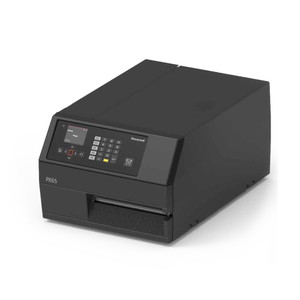
Honeywell PX940A00100060202 Industrial Label Printer 203 DPI
The Honeywell PX940A00100060202 is a wired thermal transfer printer engineered for high-volume barcode and shipping label production in warehouse, manufacturing, and logistics operations. Built around a dual-core ARM Cortex-A9 processor running at 1 GHz with 1 GB DDR3 SDRAM, this printer delivers consistent 203 DPI output at speeds up to 350 mm/s, enabling rapid label production across variable-data and multi-barcode workflows without sacrificing precision or throughput.
Key Features
- Print Speed 25–350 mm/s at 203 DPI: Variable speed capability means you can trade throughput for quality or vice versa depending on the job — run simple barcodes at full speed or slow to 25 mm/s for detailed graphics and QR codes without changing hardware.
- 203 DPI Resolution: Hits the practical sweet spot for supply chain applications — crisp enough for barcode scanners and readable graphics, but not so dense that ribbon costs balloon or media width becomes a constraint.
- ±0.2 mm Print Precision: Tight tolerance ensures label placement is repeatable across runs, critical if you're running fixed-position labels through automated conveyors or need compliance-label alignment to exact specifications.
- Dual-core ARM Cortex-A9 with 1 GB DDR3 SDRAM and 256 MB Flash: Processor and memory headroom means the PX940 can handle complex template rendering, variable data substitution, and multi-barcode layouts without job queue backup or processing delays that would idle production.
- ZPL II, ZSim2, DP, FP, and IPL Emulation: Multi-protocol support eliminates the need to redesign label templates when replacing older printer fleets — migration risk drops significantly because label files often port without modification.
- Ink-In/Out Ribbon System: Thermal transfer architecture keeps media costs lower than direct thermal (no expensive heat-sensitive label stock) and supports a wider range of materials — plastic, synthetic, and coated labels all work without media-specific ribbon pairing.
- 3.5-inch Color Touch LCD Display: Operator-facing interface reduces training overhead and enables job monitoring, status checks, and error diagnosis without requiring a PC connection at the printer location.
- Ethernet, USB 2.0, RS-232, Bluetooth, and NFC Connectivity: Wired Ethernet and USB provide production-floor reliability, while Bluetooth and NFC enable mobile device job submission and diagnostics — useful for distributed labeling or emergency print requests from warehouse staff.
Integration and Deployment
Ethernet connectivity integrates cleanly into warehouse management systems (WMS) and enterprise resource planning (ERP) platforms via standard network printing protocols. The PX940 operates reliably across 5–40°C, matching typical indoor industrial environments; storage range extends from -20 to 70°C, so the printer tolerates shipment and warehousing in uncontrolled spaces. Compact dimensions (261 × 506 × 398.7 mm, 22 kg) fit standard workbench or wall-mount installations without consuming excessive floor space — important in confined warehouse areas. Multi-protocol emulation support means you can phase out legacy printer fleets without wholesale label template redesign, reducing IT overhead during technology migrations across multiple business units or locations.
Typical Applications
- Barcode and QR code label production for inventory tracking and goods receipt
- Shipping and pallet labeling for logistics operations and parcel carriers
- Product identification and serial-number labeling for traceability
- GHS hazard, regulatory, and compliance label printing
- Multi-location enterprise label production with centralized template management
When to Choose a Different Model
If your label volumes or speeds exceed 350 mm/s or you require 300+ DPI for ultra-fine graphics and micro QR codes, evaluate higher-resolution variants in the Honeywell industrial printer line. If you need portable, battery-powered mobile printing, a mobile thermal printer is a better fit than a stationary desktop model. For direct thermal (no ribbon) simplicity and lower consumable costs in low-volume environments, consider direct thermal alternatives — though they're not suitable for long-term archive labels or outdoor exposure.
Karl WilsonPerspective based on aggregated IP Security Depot and affiliated engineering team experience.
The PX940A00100060202 is a solid workhorse for centralized or semi-centralized label operations where print volume and format variety justify dedicated hardware. The combination of dual-core processing, 1 GB RAM, and multi-protocol emulation makes this printer genuinely versatile — you can migrate label fleets from competing thermal printers without redesigning templates, a real cost-saver during technology refreshes.
Technical Highlights:
- 203 DPI at up to 350 mm/s: You get speed and quality in one unit. For most supply chain applications — barcodes, shipping labels, GHS warnings — 203 DPI is more than sufficient, and the variable-speed capability means you don't sacrifice throughput for print quality on simpler jobs.
- ±0.2 mm Precision with 1 GB DDR3 memory: Tight tolerance plus processor overhead means label placement is repeatable and template rendering doesn't stall, even with variable-data substitution and multi-barcode layouts running continuously.
- ZPL II and three competing emulation languages: Drop-in compatibility with Zebra ZPL workflows (the de facto standard) plus fallback support for older DP and FP systems means you're not locked into a single ecosystem — real flexibility in mixed-fleet environments.
Deployment Considerations:
- Thermal transfer requires consumable ribbon: Factor ribbon costs into your label cost model — not just media. Ink-in/out ribbon is economical, but you'll need supply-chain discipline to avoid stockouts on high-volume days.
- Wired-only operation: Despite Bluetooth and NFC support, print jobs still flow over Ethernet. Mobile job submission is convenience, not core architecture. Expect print performance to depend on network reliability.
- 5–40°C operating window: This is standard industrial range, but if your warehouse swings below 5°C or above 40°C (cold storage, furnace-adjacent operations), test thermal response before deployment.
The PX940A00100060202 is best positioned for WMS-integrated label printing in multi-location enterprises where printer standardization reduces support overhead and protocol compatibility matters. It's not the right choice for high-frequency portable printing, ultra-fine graphics, or environments requiring sub-zero operation.
Frequently Asked Questions
Q: What emulation languages does the PX940A00100060202 support?
A: The PX940 supports ZPL II, ZSim2, DP, FP, and IPL. ZPL II is the most common — it's the Zebra standard used across most supply chain software. The additional protocols ensure compatibility if you're migrating from older competing thermal printers.
Q: Can the PX940A00100060202 print directly on plastic or synthetic labels?
A: Yes. The ink-in/out thermal transfer ribbon system works with plastic, synthetic, and coated label stock, not just paper. Direct thermal printers (which use heat-sensitive media) are more restricted in material choice.
Q: What is the operating temperature range for the PX940A00100060202?
A: Operating range is 5–40°C. Storage range extends to -20 to 70°C. If your facility regularly falls outside 5–40°C, test the printer before full deployment or consider environmental controls.
Q: Does the PX940A00100060202 integrate with warehouse management systems (WMS)?
A: Yes. Standard Ethernet connectivity enables integration with WMS and ERP platforms via network printing protocols. Network setup and printer-to-system configuration is typically handled by IT or your system integrator.
Q: What is the maximum print speed of the PX940A00100060202?
A: Maximum print speed is 350 mm/s at 203 DPI. Actual throughput depends on label length, complexity, and network latency between your system and the printer.
Q: Does the PX940A00100060202 require a separate power supply?
A: Yes. The printer requires standard AC power (US power cord included). It does not operate on PoE or battery power.