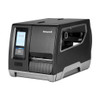
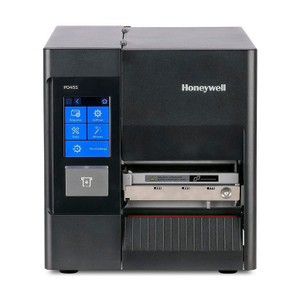
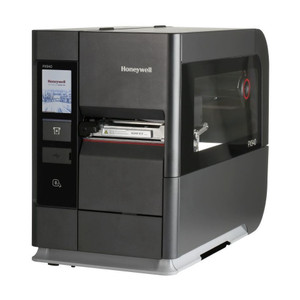
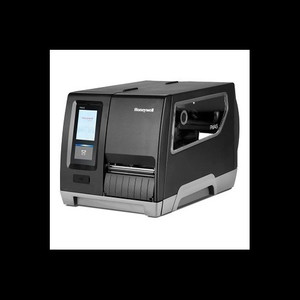
Honeywell PM45A10000030301 300 DPI Industrial Label Printer
The Honeywell PM45A10000030301 is a production-grade thermal transfer label printer engineered for high-volume enterprise labeling in warehouse, manufacturing, and distribution environments. With 300 DPI resolution and print speeds up to 300 mm/s (12 ips), this printer delivers consistently scannable barcode output across demanding supply chain operations where barcode quality and print consistency are critical to operations.
Key Features
- 300 DPI thermal transfer resolution with up to 300 mm/s (12 ips) print speed — delivers enterprise-scale production throughput. At 300 DPI, barcodes maintain sharp edge definition and high scan reliability even in high-velocity sorting and fulfillment lines where label blur or dropout would cause bottlenecks.
- 108 mm (4.25 in) maximum print width at 203 DPI — covers shipping labels, compliance labels, asset tracking tags, and variable-data fulfillment labels without requiring wider media or multi-label workarounds. 203 DPI mode extends width headroom if slightly reduced density is acceptable in your workflow.
- 256 MB SDRAM and 512 MB Flash memory — handles complex label templates with variable data, multi-barcode symbologies (QR, Code 128, UPC), and high-density graphics without frequent cache flushes or job queuing delays. Critical in high-mix environments where templates change every few labels.
- 3.5-inch color touch LCD display — provides real-time job monitoring, error alerts, and media status without requiring an external workstation. Operators can cancel jammed jobs or adjust darkness/speed on the fly, reducing downtime in high-volume runs.
- Rewinder with Label Taken Sensor — automates label handling and stacking in unattended or semi-attended production lines. The sensor confirms label removal and prevents overstack, lowering per-label operational labor costs.
- Multi-protocol emulation: ZPL II, ZSim2, Direct Protocol, Fingerprint, and IPL — enables the PM45A10000030301 to replace legacy Zebra or Datamax printers with minimal workflow disruption. Existing label templates and print jobs require no translation, accelerating deployment in heterogeneous IT environments.
- Multiple connectivity: Ethernet (10/100 Mbps), USB 2.0 Device, USB 2.0 Host (x2), RS-232, and Wi-Fi 802.11 a/b/g/n/ac — integrates directly with WMS, ERP, and cloud print management platforms without requiring gateway hardware or proprietary drivers. Dual USB Host ports support barcode scanners or external label roll feeders without daisy-chaining.
- Android OS with HTTPS encryption and LPR analytics support — enables secure networked operations. HTTPS protects label data in flight; LPR (Line Printer Request) analytics track job completion, media consumption, and device health, feeding into enterprise monitoring tools.
- Operating temperature range 5°C to 40°C (41°F to 104°F) — suitable for standard warehouse and manufacturing floor conditions. Storage specs (-20°C to 70°C) support broader facility deployments (cold storage, outdoor staging areas) as long as the device is powered down during transit or storage in extreme conditions.
- Humidity tolerance 10–90% non-condensing — handles humid fulfillment centers and dock areas without condensation damage, though avoid direct spray or submersion.
- Dimensions 483 × 295 × 284 mm (19.0 × 11.6 × 11.2 in); Weight 12.1 kg (26.7 lbs) — compact footprint with fixed hanger mounting allows desktop or wall installation in tight spaces. Weight is manageable for single-person repositioning, though permanent mounting with the included hanger is recommended for vibration isolation on conveyor systems.
Integration & Compatibility
The PM45A10000030301 integrates with any system that supports ZPL II or standard LPR/IPP print protocols. Legacy Zebra and Datamax environments can migrate without template rewrites. Firmware updates and configuration are managed via the color LCD or Ethernet-connected administration interface. The printer's Android foundation supports future firmware enhancements and third-party plugin development if your WMS or ERP roadmap demands custom label logic.
When to Choose a Different Model
If print width exceeds 108 mm or you require 600 DPI resolution for pharmaceutical micro-labeling or dense GS1 DataMatrix codes, evaluate higher-resolution or wider-format variants within the Honeywell industrial printer line. If your environment demands explosion-proof certification (ATEX/IECEx) or intrinsic safety for hazardous areas, the PM45A10000030301 is not suitable — consult your distributor for certified alternatives. For light-duty or on-demand labeling under 1,000 labels/day, consider lower-speed desktop models.
Frequently Asked Questions
Q: What barcode symbologies does the PM45A10000030301 support?
A: The printer supports all standard 1D symbologies (Code 128, Code 39, UPC-A/E, EAN, ITF, Codabar) and 2D formats (QR Code, PDF417, DataMatrix, Aztec) through ZPL II and IPL commands. Your WMS or label design software will generate the appropriate barcode escape sequences.
Q: Can I integrate the PM45A10000030301 with my existing Zebra or Datamax label workflow?
A: Yes. The printer's ZPL II, Fingerprint, and IPL emulation layers ensure compatibility with label templates and print jobs designed for legacy systems. You may need to validate template output on a test run, but no fundamental rewriting is required.
Q: What is the maximum label length the PM45A10000030301 can print?
A: The printer does not have a hard maximum label length in the specifications provided. Label length is limited by your print driver's job queue and available memory (256 MB SDRAM). Consult the datasheet or contact the manufacturer for continuous roll or variable-length testing parameters.
Q: Does the PM45A10000030301 work with standard thermal transfer ribbon?
A: Yes. The printer is compatible with any thermal transfer ribbon (wax, wax-resin, or full resin) at standard 110 mm × 300 m rolls. Ribbon width must match your label width; consult the user guide for ribbon loading procedures and certified ribbon vendors.
Q: What is the power consumption of the PM45A10000030301?
A: Exact power draw is not specified in the available data. The printer requires a US power cord (110–240V AC input based on regional standard). Contact the manufacturer or your distributor for max/typical wattage to size backup power or UPS capacity.
Q: Can the PM45A10000030301 handle pre-printed label stock?
A: The printer is designed for thermal transfer printing on blank media. Pre-printed stock with inks or coatings may not bond properly with thermal transfer ribbon. Test any non-standard media before committing to production volume.
Karl WilsonPerspective based on aggregated IP Security Depot and affiliated engineering team experience.
The Honeywell PM45A10000030301 represents a pragmatic choice for organizations managing high-throughput labeling at distribution centers, order fulfillment, and manufacturing floors where thermal transfer quality and protocol flexibility are non-negotiable. The combination of 300 DPI resolution with 12 ips throughput (300 mm/s) ensures both barcode edge fidelity and sufficient speed for most pallet-and-case labeling workflows without requiring multi-unit staging.
Technical Highlights:
- 256 MB SDRAM + 512 MB Flash — eliminates memory contention in variable-data or multi-template runs. Most competing models at this price point max out at 128 MB SDRAM, which causes observable delays when processing label queues >50 jobs with embedded graphics or DataMatrix codes.
- ZPL II, Fingerprint, and IPL emulation — the multi-protocol suite is the real differentiator. In heterogeneous environments mixing Zebra legacy systems with new infrastructure, this feature cuts migration risk significantly. You're not locked into a single vendor's command language.
- Dual USB 2.0 Host ports — unusual at this price tier. Enables direct attachment of barcode scanners or external media feeders without daisy-chaining through a workstation or Ethernet gateway. Real operational value in lean fulfillment spaces.
- Wi-Fi 802.11ac + Ethernet — provides redundant network paths. If Ethernet goes down (switch failure, cabling issue), the printer can fall back to Wi-Fi without print job loss. Ethernet is preferred for sustained high-volume printing; Wi-Fi is acceptable for moderate or bursty print patterns.
Deployment Considerations:
- Thermal transfer ribbon cost discipline: The PM45A10000030301 drives significantly higher ribbon consumption than direct-thermal printers due to the thermal transfer mechanism. Budget ribbon spend at roughly 30–50% of the printer's purchase cost over 18–24 months in high-volume environments. This is not a hidden cost, but it's critical to factor into TCO modeling.
- Temperature-sensitive environments: The operating range (5–40°C) excludes cold storage and outdoor dock areas where temperatures drop below 5°C. If your facility mixes climate-controlled and unheated shipping zones, position the printer in the heated area or expect slower print output in cold conditions.
- Rewinder dependency: The included rewinder with label-taken sensor is convenient, but it requires label stock of consistent thickness and width. Odd-size or variable-width labels may jam the rewinder, forcing manual label collection and defeating the automation benefit.
- Fixed-hanger mounting: The printer mounts via a fixed hanger bracket. Ensure your installation surface is vibration-isolated (rubber isolators, not direct bolting to a conveyor frame) to prevent print quality degradation or ribbon slippage on long print runs.
Deploy the PM45A10000030301 in high-volume order fulfillment, warehouse receiving, or manufacturing floor labeling where you need a proven, protocol-flexible platform that doesn't force you into a single ecosystem. It's not the cheapest option, but the memory, multi-protocol support, and dual USB Host ports justify the investment in complex or multi-vendor label environments. For basic single-protocol, low-volume shops, a simpler thermal transfer model would suffice.