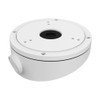
Hikvision DS-1281ZJ-DM26 Inclined Ceiling Mount
The Hikvision DS-1281ZJ-DM26 is a precision-engineered inclined ceiling mount built from aluminum alloy. It solves a specific problem: many ceiling geometries—dropped tiles, angled soffits, structural beams—make vertical camera mounting impractical or impossible without sacrificing coverage. This mount allows you to angle the camera away from the ceiling plane, recovering field-of-view and sight lines that would otherwise be blocked.
Key Features
- Inclined mounting angle: Positions cameras at an offset to the ceiling plane, eliminating the need to reposition the camera itself and preserving optical field-of-view in constrained spaces. Avoids the common scenario where vertical mounting leaves blind zones directly below.
- Aluminum alloy construction: Aluminum delivers rigidity without excessive weight, resists corrosion in HVAC-heavy environments (important for office and retail buildings where ventilation ducts and ceiling-mounted systems are common), and provides stable load-bearing capacity across temperature swings typical in uninsulated or partially climate-controlled spaces.
- White finish: Neutral aesthetic blend with standard drop-tile and drywall ceiling systems. Less conspicuous than black mounts in corporate or hospitality environments where discrete mounting is a design preference.
- Compatible with select Hikvision camera models: Designed to integrate with specific Hikvision IP cameras in the portfolio. Verify compatibility with your chosen camera model before ordering to avoid field rework.
- Straightforward installation: Reduces deployment time when ceiling layout requires angled positioning. Mounting template and hardware allow you to position once and validate coverage before final fastening.
Integration & Compatibility
The DS-1281ZJ-DM26 is engineered for IP cameras in the Hikvision lineup. Confirm model compatibility with your camera's technical documentation or system integrator before installation. If you're retrofitting an existing ceiling or working around structural constraints, this mount becomes a prerequisite rather than optional—it often means the difference between full coverage and a coverage gap.
Typical Deployment Scenarios
Common use cases include retail stores with suspended ceilings and structural columns, office buildings undergoing renovation where camera routes must avoid ductwork, and warehouses with overhead conveyor systems or racking. Angled mounting is also valuable when you need to monitor sight lines at oblique angles—for example, capturing face-on recognition at a doorway when the ceiling point is offset from the optimal camera position.
For guidance on camera selection and mounting strategy for your facility, consult a camera buying guide or work with your systems integrator to validate ceiling geometry and load requirements before deployment.
Frequently Asked Questions
Q: What Hikvision camera models work with the DS-1281ZJ-DM26?
A: The mount is compatible with select Hikvision camera models. Verify your specific camera model against the compatibility list in the camera's datasheet or contact your integrator for confirmation before purchase.
Q: Can I use this mount on drywall or only on suspended ceilings?
A: The mount can be installed on both suspended-tile grids (via standard T-bar fastening) and solid drywall/concrete ceilings (with appropriate anchors for your substrate). Confirm anchor type and load rating for your ceiling material.
Q: Does the DS-1281ZJ-DM26 include fasteners and installation hardware?
A: Refer to the mount's documentation for a complete parts list. Typical inclined mounts include a mounting template and core hardware; some installations may require supplemental anchors depending on ceiling type.
Q: What angle of inclination does this mount provide?
A: The DS-1281ZJ-DM26 offers a fixed incline geometry optimized for standard ceiling offsets. If variable angle adjustment is required, consult your integrator about alternative mount options or installation techniques.
Q: Is the aluminum alloy finish suitable for humid environments like warehouses or kitchens?
A: Aluminum alloy is inherently corrosion-resistant, but prolonged exposure to salt spray (coastal facilities) or chemical vapors may require periodic cleaning. For harsh industrial environments, verify the mount's specific alloy specification and finish treatment with the manufacturer.
Ted PerryPerspective based on aggregated IP Security Depot and affiliated engineering team experience.
The DS-1281ZJ-DM26 is a straightforward but essential accessory—one you don't think about until you encounter a ceiling layout that makes standard vertical mounting fail. Aluminum alloy construction is the right material choice here: it's light enough that you're not straining ceiling anchors, rigid enough to hold a camera steady without sag, and naturally corrosion-resistant in the temperature-cycling environments typical of retail and office buildings.
Deployment Considerations:
- Ceiling geometry validation: Before ordering, measure the offset between the optimal camera position (based on coverage needs) and the nearest structural ceiling point. Verify the fixed incline angle matches your geometry—if not, you'll be repositioning the camera body itself, which defeats the mount's purpose.
- Load rating and anchor type: Confirm the mount's maximum load capacity and match it to your camera weight. Different ceiling types (suspended tile, drywall, concrete, metal deck) require different anchor strategies. A lightweight turret camera on a suspended-grid mount is low-risk; a heavy PTZ on a single drywall fastener is a failure waiting to happen.
- Compatibility check: This mount is designed for specific Hikvision models. A mismatch means either poor fitment or the need to shim or adapt the connection, adding labor and introducing reliability questions.
Deploy the DS-1281ZJ-DM26 when ceiling constraints genuinely block your camera placement options and standard wall or pendant mounts aren't viable. It's a tactical solution for geometric problems, not a general-purpose upgrade. If your ceiling is accessible and your camera position negotiable, solve the problem first, then mount.