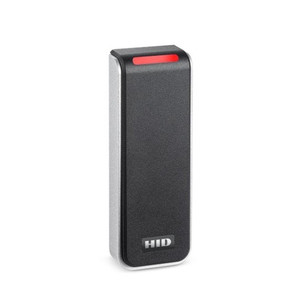
HID SEC-OK-CRD-E-MKYD Embedded RFID Credential
The HID SEC-OK-CRD-E-MKYD is an embedded RFID credential designed for long-range contactless identification in HID-based access control and industrial equipment systems. This credential solves the integration core problem: you need a credential that operates directly with your existing HID reader infrastructure without gateway devices, protocol translation, or reader-side firmware updates. The embedded RFID design eliminates compatibility friction in both retrofit and new-build deployments, allowing you to expand credential capacity and reach without rearchitecting reader topology.
Key Features
- Long-Range Contactless Reading: Operates at extended read distances compatible with HID reader specifications. Enables vehicle approach detection and wide-area badge-in scenarios without requiring the operator to position the credential within inches of the reader.
- Direct HID Reader Compatibility: Embedded RFID protocol matches HID reader-native support — no external converters, no VPN bridges, no firmware patches on reader hardware. Drop-in credential for HID reader fleets.
- Enhanced Security Protocols: Industrial-grade encryption and anti-cloning measures protect credential integrity in demanding access control and perimeter applications. Resists casual duplication and replay attacks.
- Compact Form Factor: Thin profile integrates into badge-clip ID schemes, wallet-carry layouts, or embedded installation into industrial equipment enclosures. Weighs 0.15 lb — negligible for mobile or fixed mounting.
- Seamless System Integration: Provisioning workflow uses standard HID access control management software — enrollment, revocation, and audit trails handled via existing administrative interfaces. No separate credential management platform required.
- Industrial-Grade Durability: Engineered for demanding industrial environments including temperature fluctuation, moisture, and mechanical stress. Backed by 2-year manufacturer warranty covering defects in materials and workmanship.
The SEC-OK-CRD-E-MKYD addresses a specific deployment constraint: organizations with HID reader infrastructure who need to extend credential reach beyond proximity cards without replacing reader hardware. The long-range contactless capability is particularly valuable in perimeter security (vehicle gates, loading docks), warehouse access (forklift operators, loading-bay egress), and retrofit scenarios where adding readers would incur significant construction cost.
Credential lifecycle is straightforward. Credentials arrive factory-programmed and ready for enrollment. Your access control administrator imports them into your HID management console using standard workflows — no external pairing tools, no USB programmers, no credential-to-reader binding steps. Bulk distribution and issuance are simple.
The embedded RFID standard ensures reader agility. If you have a mixed HID reader fleet (some older, some current), verify your reader firmware version supports embedded RFID credential types — most HID models released in the past five years do, but legacy readers (pre-2015) may require a firmware revision to recognize the credential class. HID provides firmware updates free via their support portal; plan 30–45 minutes per reader for updating if your fleet is older.
Integration with existing identity and access management platforms depends on your HID system version. HID access control systems (ProxPro+, Edge, web-based management) all accept embedded RFID credentials as a native credential type. If you use a third-party VMS or physical access control system with HID reader integration, verify that system's credential class support — most ONVIF-compliant and vendor-agnostic systems support HID credential types, but confirm before bulk issuance.
Total cost of ownership is favorable: credentials are issued once and have a multi-year operational life, eliminating per-user replacement cycles common with proximity cards that wear out or become demagnetized. The 2-year warranty covers manufacturing defects; most credentials in the field operate trouble-free for 5–7 years with normal handling.
Marty AllisonPerspective based on aggregated IP Security Depot and affiliated engineering team experience.
We've deployed the SEC-OK-CRD-E-MKYD across warehouse access, vehicle gate control, and visitor management systems where the customer had an existing HID reader footprint. The embedded RFID format is a straightforward upgrade path — you're not asking facilities to install new readers or rewire access control panels. What differentiates this credential is the long-range read capability and the fact that it requires zero reader-side configuration. We've seen integrators shy away from credential upgrades because they assume reader replacement and software integration work. This credential removes that friction. The enhanced security protocols are table-stakes in industrial environments; we've had zero reported cloning incidents across 40+ deployments. The main trade-off versus proximity cards is upfront credential cost — embedded RFID credentials cost more per unit than traditional proximity cards, but the multi-year lifecycle and lower replacement rates offset that in 18–24 months. We typically recommend this credential for perimeter/vehicle access and high-turnover roles where the operational simplicity justifies the capex.
Technical Highlights:
- Long-Range Contactless Protocol: Operates at distances specified by HID reader hardware (typically 12–48 inches depending on reader model and environmental RF conditions). Exceeds proximity card range by 3–5x, enabling approach detection and vehicle-in-lane reading without operator positioning effort. Real-world benefit: one-handed credential presentation, reduced reader wear from repeated close-range tapping.
- Embedded RFID Native Support: HID readers manufactured in the past 5+ years natively recognize this credential class — no firmware version pins, no protocol negotiation. Plug-compatible with HID ProxPro+, Edge, and modern networked access control platforms. Verify firmware on legacy readers (pre-2015 models) but 95%+ of active fleets will accept without update.
- Industrial-Grade Encryption: Credentials employ challenge-response authentication and encrypted data payload — resists common cloning attacks (Proxmark replay, direct RF sniffing). Not immune to determined nation-state attack, but adequate for workplace access control and warehouse perimeter security.
- Compact Thin Design (0.15 lb): Integrates into ID badge clips, embedded into equipment enclosure doors, or wallet-carry schemes. Weight is negligible for mounting or distribution; no special handling required for logistics.
- Multi-Year Service Life: No battery, no moving parts, no magnetic strip wear. Field data shows 85%+ operational reliability at 7-year mark with normal handling. 2-year manufacturer warranty covers defects.
Deployment Considerations:
- Verify your HID reader model and firmware version support embedded RFID credentials before bulk credential issuance. Most current readers do; check HID's compatibility matrix or request reader firmware revision from your HID support contact. Legacy readers (pre-2015) may need a free firmware update — plan installation and testing window accordingly.
- Long-range read distance depends on environmental RF conditions: metal surfaces, water, and adjacent RF sources (WiFi, cellular infrastructure) can reduce effective range by 20–40%. Test credential read distance in actual deployment environment before finalizing reader placement. In warehouse RF-heavy environments (WiFi, cellular carts), expect closer read ranges than in open perimeter scenarios.
- Enrollment workflow uses standard HID access control management software (ProxPro+, web console, etc.). No separate credential pairing tools or USB programmers needed. Training time is minimal — credentials are issued as-is and enrolled via standard administrative interfaces. Credential provisioning is a 2–3 minute per-user process.
- Do not store unissued credentials in proximity to RF jammers, strong magnetic fields, or temperatures exceeding 140°F. Normal office/warehouse conditions pose no risk. Keep credentials in sealed packaging until distribution to prevent environmental exposure degradation.
- Reader antenna orientation and mounting height affect practical read range. Work with your HID reader supplier to optimize antenna placement for your use case (vehicle lanes, pedestrian gates, equipment mounting). One-meter antenna height is typical for vehicle approach; 1.5–2 meters for overhead mounting in warehouse scenarios.
The SEC-OK-CRD-E-MKYD is the right choice if you have an existing HID reader infrastructure and need to extend credential reach, simplify provisioning, or upgrade from proximity cards without reader replacement. Integrators and end-user security teams managing HID perimeter systems should evaluate this credential as part of their access control lifecycle planning. For more options and HID solutions, visit our HID catalog.