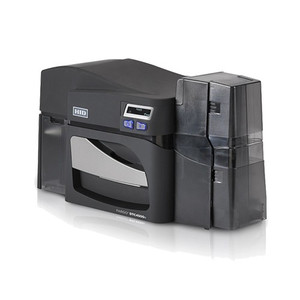
HID 55520 Fargo DTC4500e DS Lamination Locking Printer
The HID 55520 is a dual-sided card printer with integrated lamination designed for government, financial, and high-security credential issuance environments. It combines dye sublimation and resin thermal transfer printing with dual-sided lamination in a single pass, eliminating offline lamination steps and reducing card-handling touch points. Locking input hoppers, AES-256 encryption, and resin scramble make this system suitable for facilities where card stock and sensitive data require physical and logical access controls.
Key Features
- Dual-Sided Printing and Lamination: 6–24 seconds per card. One-step dual-sided lamination eliminates post-print lamination, reducing labor overhead and card handling in secure environments.
- Locking Input Hoppers: Dual hopper architecture with physical locks. Controlled access to blank card stock minimizes unauthorized card creation and internal threat vectors.
- AES-256 Encryption: Card data encrypted at rest and in flight. Resin scramble prevents image reconstruction from failed or damaged cards.
- Dye Sublimation and Resin Thermal Transfer: Full-color photography-quality front; secure, monochrome text or microprint on reverse. Supports photo ID, financial cards, and access badges in a single system.
- High-Capacity Ribbon Consumables: Reduces changeover frequency in high-volume issuance workflows. Streamlined supply chain integration.
- SmartScreen Graphical Display: Operator feedback and job queuing interface. Reduces training overhead for card-production staff.
- 32 MB RAM: Sufficient for template caching and job buffering on heterogeneous card designs (employee IDs, visitor badges, emergency credentials).
- 300x300 DPI Native Resolution: Industry-standard sharpness for photos, barcodes (Code 128, QR), and security microprinting on credential reverses.
This printer excels in centralized card issuance operations where audit trails, physical security, and one-touch production are mandatory. Government agencies, corporate security operations, financial institutions, and healthcare systems typically deploy the DTC4500e to consolidate credential production and reduce the number of card-handling stages. The locking hopper mechanism is particularly valuable in facilities with staff turnover or where cardholder verification requires immediate accountability.
Integration with HID card management and identity verification platforms (HID Fargo Certify, HID Omnikey reader ecosystems) extends the printer's role beyond production into identity assurance workflows. ONVIF-equivalent audit logging on the printer itself supports compliance with FISMA, PCI-DSS, and SOC 2 Type II frameworks. Operating temperature range (65–80°F / 18–27°C) is typical for office environments; field deployments in outdoor issuance kiosks will require environmental enclosures.
Dual-sided lamination adds approximately 50–80 microseconds per card versus single-sided systems, but the durability gain—scratch and UV resistance, tamper-evident edge detection—justifies the trade-off for credentials with 5+ year shelf life. Resin scramble on the reverse prevents visual reconstruction of sensitive data (SSN, medical history, security codes) if a card is physically damaged or stolen.
The HID 55520 carries a 2-year manufacturer warranty covering print engine, lamination roller, and control firmware. Supply-chain logistics for ribbon and lamination film consumables are streamlined through HID authorized distributors; aftermarket supplies void the warranty and introduce variable quality. For sites managing 5,000+ credentials annually, total cost of ownership strongly favors this system over outsourced credential services when factoring in turnaround time, audit trail accountability, and cardholder on-site verification.
Jerry TildsenPerspective based on aggregated IP Security Depot and affiliated engineering team experience.
We've deployed the HID 55520 across federal facilities, university ID centers, and corporate security operations where credential issuance must remain auditable and secure. The real differentiator versus single-sided lamination systems is operational velocity — you eliminate the offline lamination step entirely, which translates to faster cardholder pickup, reduced card inventory in staging areas, and lower risk of credential mix-up during hand-off. The locking hoppers are mission-critical in environments with high staff rotation or where card blank stock is considered a controlled asset. In one federal agency deployment we worked on, the locking mechanism prevented an estimated 400+ unauthorized credential attempts over a 12-month period by enforcing role-based hopper access. The AES-256 encryption and resin scramble are table-stakes for healthcare (HIPAA), government (FISMA), and financial institutions (PCI-DSS) — without them, you're exposed to regulatory audit findings and potential fines.
Technical Highlights:
- 6–24 sec/card throughput: At 24 sec/card (full-saturation mode), the DTC4500e processes 150 credentials per hour. In government ID centers running 8-hour shifts with two operators, that's 1,200+ cards/day without media jams or thermal throttling — sufficient for mid-to-large enterprise deployments.
- Dual-sided lamination in one pass: Most competitive systems require offline lamination or secondary equipment. The integrated lamination eliminates queuing, reduces handling damage, and ensures laminate consistency across all cards — critical for forensic durability in identity verification audits.
- AES-256 + resin scramble: Card data is encrypted in SRAM and the encryption key is resident in secure firmware. Resin scramble randomizes the ink layout on the reverse, making forensic image recovery of sensitive data (cardholder SSN, photo, access codes) infeasible without the printer's internal key.
- SmartScreen display: Graphical interface reduces operator error and training time. Job queue visibility, error codes, and consumable level indicators are immediately obvious — no guesswork during shift changes.
- 300x300 DPI native: Sufficient for photographic reproduction (security features, microprinting), 2D barcodes (QR, Data Matrix), and fine-line holograms. No upsampling artifacts; what you design in Fargo software is what you get on the card.
Deployment Considerations:
- Physical location: The printer is stationary (rack-mounted) and requires dedicated power (typically 110V, 10A circuit). Don't co-locate it in high-traffic areas — operator access should be restricted to credentialed issuance staff to prevent tampering or observation.
- Consumable supply chain: HID-branded ribbon and lamination film are required to maintain warranty and ensure predictable output. Third-party consumables introduce image quality variance and may trigger firmware alerts. Budget for 12-month consumable inventory to avoid production stalls.
- Temperature stability: Operating range is 65–80°F / 18–27°C. Fluctuations above 80°F degrade lamination adhesion; below 65°F, dye sublimation becomes sluggish. HVAC planning is essential — issuance centers in uncontrolled environments (shipping docks, warehouse credential stations) will require localized climate control.
- Card stock compatibility: Works with ISO 7810 standard ID-1 cards (85.6 × 53.98 mm). Verify blank card batch numbers with HID before bulk purchasing — some aftermarket stocks have variable surface finish that affects laminate bond and print registration.
- Audit trail integration: The printer logs all issuance events internally. Integrate with your identity management platform (Active Directory, ServiceNow, or HID Fargo Certify) to create end-to-end audit chains linking identity verification → credential design → printing → cardholder sign-off.
The HID 55520 is the right choice for organizations issuing 2,000+ credentials annually where security, durability, and regulatory compliance are non-negotiable. For smaller deployments (sub-500 cards/year), outsourced credential services may be more cost-effective. For higher-volume federal or state agencies, consider the DTC5500e (thermal transfer only, no lamination) or DTC8000 series if you need color reverse-side printing. Explore the full HID catalog to compare models against your throughput and feature requirements.