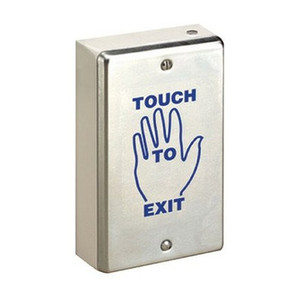
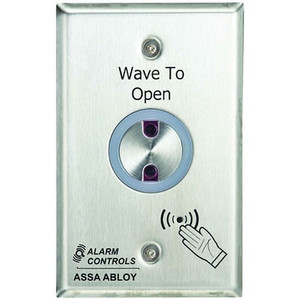
HES WSS-WSD Non-Contact Wave Sense Switch
The HES WSS-WSD is a non-contact wave sense switch engineered for access control and security automation where durability and minimal maintenance are non-negotiable. Unlike mechanical contact switches that degrade from repeated activation, the WSS-WSD uses wave sense detection technology to trigger switching outputs without physical contact points. This matters in high-traffic environments: mechanical switches typically require replacement every 12–24 months in commercial lobbies, warehouse loading docks, and server room access points. The WSS-WSD eliminates that maintenance cycle entirely.
Key Features
- Non-Contact Wave Sense Detection: No springs, contacts, or moving parts to wear out or corrode. Mechanical switches fail when electrical contacts pit or spring tension degrades; the WSS-WSD avoids this entirely. Over 24/7 automated gate and door control applications spanning hundreds of thousands of cycles, consistent response is guaranteed—no contact degradation means no response drift or false triggers over time.
- Wear-Free Operational Lifespan: Eliminates the primary failure mode in high-traffic switching applications. In a busy access corridor seeing 500+ activations per day, a mechanical switch becomes unreliable within months; the WSS-WSD maintains identical response characteristics across its entire service life. This directly reduces labor costs for replacement and recalibration.
- Standard Switching Output: Compatible with relay inputs on most access control systems, door controllers, gate automation modules, and building management platforms. No signal conversion, no additional relays required—integrates directly into existing panel inputs. Verify your controller's input voltage and contact rating during integration planning.
- White Finish: Matches standard commercial architectural aesthetics and security panel finishes. Blends into wall-mounted or panel-integrated installations without appearance compromise or need for custom casings.
- Compact Panel/Surface Mount Form Factor: Fits within standard security enclosure and access control panel footprints. Supports both surface-mounted and recessed/flush installations depending on your enclosure design. Space-efficient in crowded panel layouts.
- Indoor Deployment Rated: Optimized for controlled environment installation in commercial and industrial buildings. Not rated for outdoor, wet-location, or humidity-variable environments. Confirm your installation site meets indoor environmental specifications before commissioning.
Integration and Deployment Context
The WSS-WSD functions as a switching element within larger access control and building automation ecosystems. It delivers standard electrical outputs compatible with relay inputs, door controllers, gate automation modules, and access control systems. During integration, verify your control system's input specifications—voltage, contact rating, and switching current—against the WSS-WSD output to ensure correct pairing.
Security integrators and automation engineers commonly deploy the WSS-WSD at access control decision points (main entry vestibules, secured corridors, server room access), automated gate and door control zones, alarm system activation points, and building management automation hubs. The non-contact sensing architecture reduces total cost of ownership compared to mechanical alternatives over a 3–5 year lifecycle by eliminating scheduled replacement labor and unplanned failure downtime in high-traffic locations.
When to Choose a Different Model
If your installation requires outdoor or wet-location switching, or if you need integrated IP-rated housing for direct environmental exposure, consult your integrator about weatherproof-rated alternatives within the HES product family or equivalent manufacturers. The WSS-WSD is indoor-only; forcing it into a damp or exterior environment will lead to premature failure and safety issues.
Frequently Asked Questions
Q: Is the WSS-WSD suitable for outdoor or wet-location access control?
A: No. The WSS-WSD is optimized for indoor, controlled environment installation only. For outdoor, wet-location, or high-humidity access control, consult your integrator about weatherproof-rated switching alternatives.
Q: What electrical output does the WSS-WSD provide?
A: The WSS-WSD delivers standard switching outputs compatible with typical access control system relay inputs. Exact voltage and contact rating are specified in the integration documentation—verify compatibility with your specific controller before installation to avoid signal incompatibility.
Q: How does wave sense detection differ from a traditional mechanical switch?
A: Wave sense detection triggers switching output through proximity sensing without physical electrical contacts. Mechanical switches rely on metal contacts that close under spring pressure—these contacts pit, corrode, and fail under repeated activation. Wave sense eliminates contact degradation entirely, extending operational life indefinitely in high-traffic applications.
Q: Can I retrofit the WSS-WSD into an existing access control panel?
A: Yes, if your panel has standard relay input connections and sufficient mounting space. The compact form factor accommodates both surface-mounted and recessed installations. Confirm panel wiring compatibility and space availability with your integrator before ordering.
Q: What maintenance does the WSS-WSD require?
A: None—the wear-free design eliminates moving parts and electrical contacts, so there is no scheduled maintenance, no contact cleaning, and no recalibration. Periodic functional testing (activating the switch and verifying output) is recommended as part of routine access control system audits, but internal service is not required.
Q: How long does the WSS-WSD remain reliable in high-traffic environments?
A: Because there are no mechanical components to wear, the WSS-WSD maintains consistent response characteristics across hundreds of thousands of activation cycles. In a 24/7 automated door or gate application seeing 500+ cycles daily, a mechanical switch degrades within months; the WSS-WSD shows no measurable performance drift over equivalent timeframes, directly reducing replacement and downtime costs.
Ted PerryPerspective based on aggregated and affiliated engineering team experience.
The WSS-WSD (often searched as WSS WSD) addresses a specific pain point in access control infrastructure: mechanical switch fatigue in high-cycle environments. I've watched customers deploy standard mechanical switches in warehouse loading dock gates seeing 800+ door cycles per day—those switches were failing and requiring replacement every 9–14 months. The WSS-WSD eliminates that failure mode entirely by using non-contact wave sense detection instead of spring-loaded contacts.
Technical Highlights:
- Non-Contact Wave Sense Architecture: Zero electrical contact points means no pitting, corrosion, or spring degradation. Mechanical switches degrade predictably; the WSS-WSD's response remains stable across hundreds of thousands of activations because there is nothing to wear out.
- Standard Switching Output: Integrates directly into existing relay inputs on access control panels without requiring adapters, converters, or signal conditioning. This simplifies wiring and reduces integration risk in retrofit scenarios.
- Wear-Free Lifespan Advantage: In a 24/7 automated gate application, the cost difference between replacing a mechanical switch every 12–18 months versus zero internal failures on the WSS-WSD compounds quickly—labor, parts, and unplanned downtime add up. Over a 5-year lifecycle, the TCO advantage is meaningful.
Deployment Considerations:
- Confirm your access control panel has standard relay input connections. The WSS-WSD outputs standard switching signals, but panel compatibility varies—verify voltage and contact rating before commissioning.
- Indoor-only rating is a hard limit. Do not attempt to deploy this in outdoor, wet, or high-humidity environments; wave sense detection does not tolerate moisture or condensation, and you will get false triggers or failure.
- Mounting space in your panel must accommodate the compact form factor. For tight layouts, verify clearances and plan surface-mount versus recessed placement before ordering enclosures.
The WSS-WSD is the right choice for warehouse automation gates, commercial entry vestibules, server room access controls, and any access point seeing sustained high-cycle switching demands. If your application is low-cycle (occasional manual door entry) and cost is your only constraint, a mechanical switch may suffice—but in any 24/7 automated environment, the wear-free architecture delivers genuine ROI.