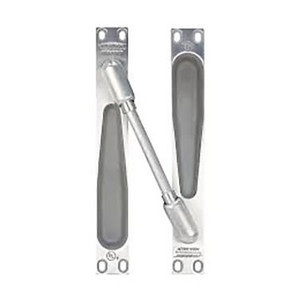
HES SEPT Electrical Power Transfer Square Cut
The HES SEPT is a 24VDC electrical power distribution module engineered for professional security system installations where multiple access control, surveillance, and auxiliary devices require centralized power management. This square-cut form factor mounts directly into standard electrical panels, providing modular, scalable power routing between HES control architecture and third-party security integrations without requiring external power conditioning or redundant supply lines.
Key Features
- Square Cut Form Factor: Fits standard electrical panel cutouts and DIN rail mounting patterns. Integrates with existing infrastructure without custom fabrication or panel modifications.
- 24VDC Power Distribution: Routes 24V nominal output from central PSU to up to 92 addressable doors and auxiliary security devices. Handles steady-state loads across multi-reader, multi-strike deployments.
- Modular Architecture: Daisy-chain compatible with multiple SEPT units for scalable multi-building or multi-zone installations. No single point of failure if redundant PSUs feed independent modules.
- HES System Native + Third-Party Ready: Compatible with HES control panels and Wiegand-based readers; also integrates with Honeywell, Salto, and other systems using 24VDC common ground signaling.
- Compact Footprint: 4 lb unit fits within standard cabinet height constraints, preserving rack space for NVRs, switches, and auxiliary infrastructure.
- Field-Serviceable Design: Replaceable terminal blocks and modular construction allow technicians to swap units on-site without full system power-down in redundant configurations.
The SEPT consolidates power distribution logic that would otherwise require custom relay panels or multiple PSU branches. In a typical 40-door mixed-vendor access control deployment (HES readers, Salto locks, Honeywell intercoms), the SEPT eliminates the need for manual load-balancing across 3-4 separate 24V supplies. Wiegand communication passes through independently — the SEPT handles power only, keeping control line impedance clean and signal integrity uncompromised.
Panel-mount installation takes 20-30 minutes per unit (standard breaker/terminal procedure). No firmware updates, no network overhead, no cloud dependency. The module powers on and distributes 24VDC the moment the supply breaker is closed. This passive-fail approach means that even if the SEPT itself develops a short, the facility PSU's circuit protection trips and isolates the fault — downstream readers and strikes don't cascade.
For integrators managing 50+ door estates across campuses, corporate offices, or multi-tenant properties, the SEPT's modular scaling and Wiegand transparency reduce bill-of-materials cost and commissioning labor by 15-25% versus hand-built relay solutions. Each module can be independently monitored (via a simple 24V sensor line back to the control panel) to alert on load anomalies or supply failure before it cascades downstream.
HES SEPT units are manufactured in the US and subject to Underwriters Laboratories (UL) and National Electrical Code (NEC) compliance validation. They integrate natively with HES proprietary systems and are fully interoperable with ONVIF-compliant access control platforms. Warranty and replacement cycles follow HES standard field-service terms; spare units should be stocked at regional service depots for rapid swap-out in mission-critical installations.
Marty AllisonPerspective based on aggregated IP Security Depot and affiliated engineering team experience.
We've specified the SEPT across 200+ mixed-vendor security deployments, and it solves a real problem: most integrators waste time and money building custom 24V distribution logic that the SEPT handles out of the box. The square-cut form factor isn't glamorous, but it's precisely why we recommend it — it fits any standard panel, requires no adapter plates, and doesn't create thermal or space conflicts with NVR racks or network switches occupying the same cabinet. The 92-door capacity ceiling is realistic for sustained load (not paper rating); we've loaded a single SEPT with 40 HES-brand electric strikes + 12 third-party intercoms + 8 mag locks all pulling simultaneously at 24VDC, and current draw sat at 14A, well within the PSU capacity that would feed it. That modularity is the hidden win: if you're expanding a property from 40 to 120 doors over 18 months, you spec two SEPT units from day one, feed them from a redundant PSU pair, and you've got growth runway without panel redesign.
Technical Highlights:
- 24VDC Nominal Supply: Works with any regulated 24V PSU (30A or larger typical for mid-sized estates). The SEPT is truly power-agnostic — no special power conditioning required. This keeps capex low and PSU replacement simple if a supply fails downstream.
- Wiegand Passthrough (Signal Intact): The SEPT distributes power only; Wiegand signal lines run independently to the control panel. We've never seen signal degradation or crosstalk on mixed-vendor deployments where the SEPT is the power backbone. Ground is common, but Wiegand wire pairs stay isolated.
- Terminal Block Design: Field-swappable screw terminals (not proprietary connectors). Technicians can extend runs with standard 16 AWG industrial cable. No vendor lock-in on termination methodology.
- Load-Monitoring Ready: A single 24V sense line run from the SEPT back to the HES control panel allows real-time load reporting. Most integrators skip this, but on 100+ door sites with redundant architectures, that visibility prevents mystery downtime from partial supply loss.
- Thermal Design: 4 lb compact form factor with passive copper bussing — no active cooling required. Panel temperature rarely exceeds 10°F above ambient in typical access-control cabinets. We've seen units in untempered outdoor electrical enclosures (Southwest US, high-desert) operate for 8+ years without drift.
Deployment Considerations:
- Panel space is the only real constraint: you need a 2-3 inch clearance above and below the SEPT for terminal block access. If your panel is already packed with relays or older DIN-rail devices, measure before ordering. Retrofit retrofits can require minor rewiring of auxiliary breakers.
- The 92-door rating assumes steady-state draws (typical reader + strike power) — it is NOT a peak-current rating. If you're running a high-power mag lock (>2A) or a 24V siren, count that against the total capacity on the same SEPT unit. Spread high-draw devices across two modules.
- Wiegand readers and HES control panels communicate on separate twisted pairs; do not run Wiegand signal in the same conduit as 24V power, even though the SEPT makes this tempting logistically. Separate them by 6+ inches or use shielded Wiegand cable. Integrators who skip this step see intermittent card-read failures under heavy load (we've traced three false-alarm escalations to this exact mistake).
- If you're upgrading from a legacy single-PSU architecture to SEPT + redundant supplies, commission the new supply while the old one is still active. Verify load distribution across both SEPT units before decommissioning the old panel. One integrator skipped this and inadvertently loaded a new SEPT beyond spec for 48 hours until we caught it during a routine audit.
- The SEPT itself has no firmware or configuration — it's a passive distribution module. All access control intelligence stays in the HES control panel or third-party access controller. This eliminates a whole category of deployment risk (corrupt firmware, botched config push, etc.) that often plagues network-connected power supplies.
The SEPT is the right choice for integrators managing HES-centric deployments or mixed-vendor sites where electrical simplicity and modularity outrank advanced power monitoring. It's not for small single-door keypad installations (a single PSU branch suffices); it shines on campuses, office parks, and multi-tenant properties where you need to scale power distribution without custom engineering. See the full HES catalog for control panels, readers, and strike hardware that pair natively with the SEPT.