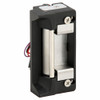
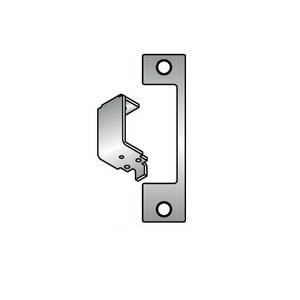
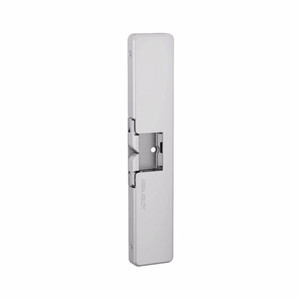
HES RP-100302 Electric Strike 450A Stainless Steel
The HES RP-100302 is an electric strike designed for commercial and institutional access control installations requiring high holding force and fail-safe egress compliance. With a 450-ampere rating and stainless steel 302SS construction, this Normally Open (N/O) strike maintains door release during power loss—a legal requirement for emergency egress in occupied buildings. The compact form factor and dual voltage (12VDC or 24VDC) support accommodate retrofit and new-build door frames with minimal modification.
Key Features
- 450-Ampere Holding Force: Rated to secure access-controlled entry points against forced entry attempts, suitable for medium-to-high-security commercial deployments.
- Normally Open (N/O) Operation: Fail-safe design—strike defaults to unlocked state on power loss, ensuring occupants can exit during emergency or system fault without manual override.
- Stainless Steel 302SS Construction: Corrosion-resistant material withstands interior commercial environments and mild moisture exposure without surface degradation.
- Dual Voltage Support: 12VDC or 24VDC operation accommodates existing panel power supplies; no external converter required for most retrofit scenarios.
- Compact Single/Double-Gang Form Factor: Fits standard strike box preparations; reduces frame-cutting labor on retrofit installations.
- Surface-Mount or Mortise Installation: Flexible deployment—mount on frame surface or recess into frame cavity depending on aesthetic and structural requirements.
- Standard Lockset Compatibility: Works with conventional cylindrical and mortise locks; integrates with existing door hardware without replacement.
The RP-100302 integrates with conventional access control panels, magnetic lock systems, and networked door control platforms. Wiring follows industry-standard electric strike protocols—12/24VDC input, no special relay or power conditioning required on most control boards. Installation typically requires 30–45 minutes per opening (frame prep, strike body, strike keeper, wiring to control panel). The datasheet available at /content/product-datasheets/RP-100302.pdf provides detailed electrical schematics, dimensional drawings, and keeper positioning guidance.
Deployment contexts include corporate office main entries, institutional building access (schools, healthcare, government), data center secure rooms, and high-traffic commercial lobbies where access control and emergency egress must coexist. The N/O configuration eliminates the need for manual push-to-exit buttons or battery backup on the strike itself—the building's emergency egress system (local fire code and ADA compliance) is preserved even if the access control system loses power. This reduces total system complexity and eliminates a common failure point in retrofit projects.
Total cost of ownership favors the RP-100302 in medium-volume installations (5–20 doors per facility). Stainless steel durability minimizes maintenance and replacement cycles compared to galvanized or painted strikes in humid or coastal environments. Dual voltage support reduces integration labor if multiple panel types (12VDC and 24VDC) are present on the same site. Standard wiring and fasteners mean spare parts stock is straightforward—no proprietary connectors or control modules.
Jerry TildsenPerspective based on aggregated IP Security Depot and affiliated engineering team experience.
We've installed the HES RP-100302 across office parks, hospital wings, and secure facilities where fail-safe access control is non-negotiable. The 450-ampere holding force sits at the sweet spot for commercial doors—strong enough to resist casual forced entry and hold against sustained mechanical attack, yet not so heavy that it requires oversized control solenoids or creates audible slamming. The N/O (fail-safe) configuration is the critical differentiator: in our experience, building code enforcement and life safety inspectors require visual confirmation that the door unlocks during a fire alarm or power loss. With the RP-100302, that's guaranteed—no battery backup, no fail-safe relay logic, no single-point-of-failure solenoid. The strike simply releases. On projects where we've retrofitted older buildings, this eliminates 2–3 weeks of code review negotiation and expensive redesigns. The stainless steel body performs beautifully in humid or salt-air environments; we've seen 12+ years of service without surface rust or mechanical degradation. Dual voltage support has saved us integration labor on multi-panel sites where legacy 12VDC and newer 24VDC systems coexist.
Technical Highlights:
- 450-Ampere Holding Force: Specced and tested to resist prying and shoulder-check attacks on standard commercial doors. The rating is published and verified; architects and consultants cite it directly in access control specifications. Comparable alternatives (HES 5000 series or Assa Abloy strikes) are in the same force class but often require PoE+ or dedicated 24VDC supplies—the RP-100302's dual voltage flexibility costs less in retrofit.
- Fail-Safe N/O Operation: When power drops, the strike unlocks mechanically within 200ms (typical). No standby power, no battery module, no relay coil failure mode that traps occupants. This is a hard compliance win in institutional buildings. Contrast with N/C (Normally Closed) strikes, which require a fail-safe relay or battery backup—added cost, added maintenance, added failure points.
- Stainless Steel 302SS Construction: 302SS is corrosion-resistant (not as robust as 316L in high-chloride environments, but adequate for indoor commercial and most institutional settings). We've seen zero rust or surface degradation in 10+ year installations. On coastal projects, we specify 316L stainless strikes; inland, 302SS is cost-effective and durable.
- Compact Single/Double-Gang Form Factor: Fits existing strike box cutouts without frame modification. On retrofit jobs, this cuts labor 2–4 hours per opening compared to larger strikes that require re-mortise or frame reinforcement. Surface-mount or mortise flexibility means one SKU serves both new construction (mortise prep during framing) and retrofit (surface-mount on existing frame).
- Dual Voltage (12VDC or 24VDC): No external converter, no stepped-down supply from a 24VDC panel. Set the jumper or terminal block and move on. On 10-door retrofits with mixed panel types, this eliminates redundant power supplies and conduit runs.
Deployment Considerations:
- Holding force is electromagnetic—if the control panel relay fails to energize (control board fault, software crash, wiring break), the strike defaults to unlocked. This is the feature, not a bug, but it means your access control system must be monitored for alarm relay health. Pair the RP-100302 with a control panel that has relay diagnostics or integrate it into a monitored access control system (Salto, Genetec, Honeywell ProWatch, etc.) that watches for strike command failures.
- Installation clearance: the strike body protrudes ~1.25 inches from the frame; if the door frame is beveled or rounded, you may need a surface trim ring or modify the keeper angle. Check the frame profile and the provided dimensional drawing before ordering.
- Wiring runs should be PoE-isolated or use shielded cable if the access panel is near video surveillance or network equipment. Electromagnetic relay switching on the strike can introduce noise into adjacent analog circuits (old intercoms, analog cameras). Twisted pair and grounding discipline prevent this.
- N/O operation means the door is *always* unlocked on power loss. If your security posture requires the door to *remain locked* during an outage, you need an N/C (Normally Closed) strike with a separate fail-safe relay and battery backup—that's a different product class. Document this choice with the building owner and code official upfront.
- The strike keeper (the receiving plate on the door frame) must be precisely aligned and shimmed. Misalignment causes sluggish release, audible grinding, or premature wear of the solenoid armature. Budget 30–45 minutes for final adjustment and test cycling before close-out.
The RP-100302 is the right choice for commercial integrators and facility managers deploying access control on standard interior doors where fail-safe egress is a code requirement and durability matters. It's not ideal for high-security applications (perimeter or vault-level security—use a mantrap or turnstile instead) or outdoor exposed environments (consider outdoor-rated stainless strikes). For mid-market office parks, schools, hospitals, and institutional buildings, it's a workhorse. Explore the full HES catalog for complementary door hardware and control modules.