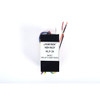
HES RLP-24 24VDC Relay Logic Pack for Access Control
The HES RLP-24 is a 24VDC relay logic pack module purpose-built to extend relay-switching control across HES access control systems and compatible 24VDC control panels. This compact interface sits between the access control panel and field-mounted locking hardware—electric strikes, solenoid locks, and auxiliary devices—translating access decisions into synchronized relay commands that govern multi-door lock operation across a single installation. Deployments range from small office suites to mid-scale facilities requiring centralized relay logic without expanding the main control panel footprint.
Key Features
- 24VDC relay switching module: Operates on standard 24VDC power, compatible with HES control systems and any 24VDC-rated access panel. Eliminates the need for separate power conditioning or interface conversion.
- Multi-device relay control: Manages simultaneous switching of multiple door strikes and locks via relay logic. Enables coordinated unlock sequences and lock-down scenarios across 92-door installations.
- Wiegand communication: Reads Wiegand format credentials from keypads and readers, allowing direct integration with standard HES reader ecosystems without protocol conversion or middleware.
- Compact rack-mount form factor: DIN-rail or rack-mount enclosure design fits in control rooms and mechanical spaces. Footprint-efficient deployment minimizes cabinet real estate in existing electrical closets.
- Direct strike and lock interfacing: Wired relay outputs drive electric strikes, solenoids, and auxiliary devices without intermediate relays. Reduces point-of-failure nodes and simplifies field troubleshooting.
- US-sourced manufacturing: Built and supported domestically, with full technical documentation and integration guidance for HES system architects.
The RLP-24 operates as a control bridge: the access panel makes the authentication decision, the relay pack translates that decision into switch closures at the field device, and the door responds. No cloud connectivity, no network dependency—purely logic-level relay switching. This architectural simplicity is the module's greatest asset in retrofit scenarios where VMS integration is unavailable or unnecessary.
Deployment footprint is typically 1–5 RLP-24 modules per installation, depending on door count and relay fan-out requirements. A single module can control many doors if the electrical load per strike is modest (<1A per relay contact at 24VDC). Larger facilities or those with high-current loads (heaters, heavy solenoids) may require load analysis to determine whether parallel or series relay configuration is feasible, or whether additional modules are needed.
Integration with HES control systems is straightforward: wire the panel's relay outputs to the RLP-24 inputs, configure the panel's access rules (credential match = relay fire), and connect the RLP-24 relay outputs to the strike or lock solenoids in the field. Wiegand credential readers plug directly into keypad ports on the RLP-24, eliminating intermediary wiring runs to a remote panel. This topology works well for small-to-medium multitenant buildings, office parks, and facilities where a single centralized access database can govern multiple entry points.
The module's resilience comes from its lack of networking dependencies. Unlike IP-based access controllers, the RLP-24 cannot be remotely compromised via internet attacks or firmware vulnerabilities. Relay operation is deterministic: no software bugs, no firmware updates, no cloud outages. The trade-off is that real-time remote access-rule changes require either a serial/USB connection to the main panel or a physical visit to reprogram the control logic.
Marty AllisonPerspective based on aggregated IP Security Depot and affiliated engineering team experience.
The RLP-24 occupies a specific niche in the access control landscape: it's the workhorse relay interface for integrators who need deterministic, network-free door control. We've deployed dozens of these across small-to-medium facilities—office parks, warehouse checkpoints, multitenant buildings—where the customer either has no network infrastructure in the mechanical room, wants no network dependencies for security-critical doors, or is retrofitting an aging HES panel and needs to add controlled doors without replacing the entire control architecture. The module's real strength is its simplicity: Wiegand in, 24VDC relay out, no middleware, no VPN, no cloud. In environments where uptime and audit simplicity matter more than real-time remote reporting, this is the right tool.
That said, the RLP-24 is not a substitute for an intelligent access control panel or VMS integration. It's a relay logic extender. If you need credential management, audit trails, real-time lockdown commands, or integration with video surveillance platforms, you're looking at a different product class entirely. The module shines when the access rules are stable and simple: badge shows up, door unlocks. No complex time-based policies, no dynamic rule changes, no multi-facility federation.
Technical Highlights:
- 24VDC operation: Industry-standard voltage for door hardware—no specialty power supplies, no PoE+ complexity. Any 24VDC access control panel can supply the RLP-24; this reduces capex and eliminates power-delivery surprises on retrofit projects.
- Wiegand reader integration: Keypads and proximity readers operate directly on the module's keypad ports. No need to run Wiegand signals back to a remote access panel—the credentials flow directly to the relay logic. Simplifies wiring in distributed installations.
- Relay switching for field devices: The module's relay contacts switch the 24VDC supply to door strikes, solenoid locks, and auxiliary devices. Relay ratings are typically 2A–5A per contact at 24VDC, adequate for standard electric strikes but inadequate for high-current devices (heated vestibules, heavy duty mag locks). Know your device current draw before design.
- Modular scaling: Multiple RLP-24 modules can be stacked in a single enclosure, each handling a subset of doors or devices. This allows incremental expansion without replacing the main panel. We've seen customers add a second module years after initial installation to support new doors in a building addition.
- Failsafe/failsecure logic: The module's relay output polarity can be configured (normally open or normally closed contact) to set strike behavior on power loss. Plan your failsafe strategy during design—you cannot change this in the field without rewiring.
Deployment Considerations:
- Verify the main HES control panel's relay output specification before ordering. Not all HES panels support external relay logic modules; some require firmware variants or configuration flags to enable RLP-24 compatibility. Request the panel datasheet and cross-reference the relay output pinout.
- Current-load analysis is critical. Each relay contact on the RLP-24 has a rated amperage at 24VDC. Adding a heated vestibule or mag lock to the load may exceed the relay's continuous rating and require load shedding or a second module. Calculate total field device current draw and design accordingly.
- Wiegand line length matters. Wiegand signaling is not robust over long distances. If your readers are more than 100 feet from the RLP-24, run shielded twisted-pair (Cat5e minimum) and consider signal conditioning or inline repeaters to prevent credential drops.
- Indoor-only installation. The RLP-24 is not rated for outdoor environments, wet locations, or extreme temperature swings. Mount it in a climate-controlled mechanical room or electrical closet. Condensation and temperature cycling degrade relay contacts and connector integrity over time.
- Failsafe planning. Decide in advance whether you want doors to unlock (failsafe) or lock (failsecure) if power is lost. This decision must be made at design time—you cannot reprogram relay polarity once installed without physically opening the module.
The RLP-24 is the right fit for integrators and facility managers who prioritize simplicity, reliability, and offline operation over feature richness and remote cloud control. It's a proven technology in small-to-mid-market access control, with minimal failure modes and straightforward troubleshooting. For a deeper look at HES relay logic modules and compatible control ecosystems, explore the HES catalog.