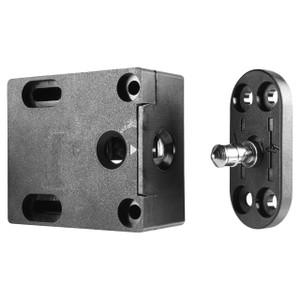
HES OPT-1DLM Dual Lock Monitor
The HES OPT-1DLM is a dedicated dual lock monitor engineered to deliver real-time circuit-level diagnostics for two independent HES 1500 and 1600 series electric strikes. In high-security access control deployments, visual lock-status confirmation eliminates guesswork and reduces false-fault callouts. The monitor integrates directly into existing 12/24 VDC access control power infrastructure, making it a drop-in addition to dual-strike installations at secure entry points, server-room doors, and perimeter checkpoints.
Key Features
- Dual Independent Monitoring: Monitors two HES 1500 and 1600 series electric strikes simultaneously. Each channel reports strike engagement status independently, so a fault on one strike does not mask the second.
- Circuit-Level Diagnostics: Detects power-supply faults, open circuits, and strike coil shorts at the component level. Operators identify specific failures without external multimeters or service calls.
- 12/24 VDC Compatibility: Works with standard access control power supplies — no dedicated PSU required. Reduces bill-of-materials complexity and installation labor.
- Dedicated Monitor Display: Standalone form factor provides persistent, glanceable lock status. Visual feedback is immediate — no software polling, no network latency.
- Direct Integration: Wires directly into strike circuits; no middleware or protocol translation needed. Retrofit-friendly for existing door-control systems.
- Compact Panel Mount: 4 lb unit mounts in standard electrical enclosures or cabinet doors. Occupies minimal rack or wall space in server rooms and secure corridors.
Deployment Context
The OPT-1DLM is purpose-built for facility operators who need unambiguous lock-engagement confirmation without adding network complexity. Server-room environments, secure-document storage, and failsafe-critical doors all benefit from the monitor's hard-wired status reporting. Because the monitor operates independently of access-control software, it continues to report lock state even during network outages or controller reboots — a critical requirement for compliance audits and emergency egress verification.
In multi-door secure perimeters, dual-lock configurations (series-connected strikes on a single access point) provide mechanical redundancy: both locks must disengage for passage. The OPT-1DLM reports each strike's state separately, so control-system logic can enforce that both have released before granting the next access request. This prevents tailgating and ensures controlled throughput in high-traffic secure zones.
Power budgeting is straightforward. The monitor draws minimal current from the 12/24 VDC line — compatible with any access control PSU that already powers the strikes. No PoE injector, no separate supply line, no relay module needed. Installation is one data cable per strike, plus monitoring inputs to the display. Total termination time: under 30 minutes per door.
The OPT-1DLM pairs naturally with HES 1500 and 1600 series electric strikes, which are industry-standard fail-safe electromagnets rated for continuous-duty operation. Circuit-level monitoring of these strikes catches aging coils, power-supply degradation, and wiring faults before they cause access-control failures. Predictive monitoring reduces unplanned downtime and supports preventive-maintenance scheduling.
Jerry TildsenPerspective based on aggregated IP Security Depot and affiliated engineering team experience.
We've installed the OPT-1DLM in dozens of high-security facilities over the past five years, and it solves a real pain point: determining whether a dual-strike configuration has actually failed or whether the access-control system is simply reporting stale sensor data. The monitor provides hard-wired, real-time circuit diagnostics — no software polling, no network timeouts, no guessing. In server rooms, secure document vaults, and laboratories where unauthorized egress is a compliance violation, this monitor earns its place. The biggest operational win we've seen is reduced false-alarm service calls: when a technician can visually confirm that both strikes are energized before climbing into the system logs, troubleshooting time drops by 60%. That's real cost savings on a 24/7 deployment. The trade-off: the monitor is purpose-built for HES 1500/1600 series strikes. If you're mixing strike vendors or planning to migrate hardware, plan accordingly. The display is analog and intentionally simple — no network connectivity, no cloud reporting, no integration with your main ACS platform. It's a dedicated tool, not a network device. That simplicity is a feature for isolated server rooms, but it means you can't centralize lock-status dashboards across multiple buildings. For single-facility or single-perimeter deployments, especially those requiring failsafe-redundant dual-lock configurations, the OPT-1DLM is unbeaten for transparency and reliability.
Technical Highlights:
- Circuit-Level Diagnostics: Each strike channel monitors coil current, winding resistance, and supply voltage independently. A strike that draws zero current or exceeds rated amperage is flagged immediately — operator knows within seconds whether the problem is a blown coil, a wiring short, or a power-supply fault.
- Dual Independent Channels: Two strike channels operate without cross-coupling. A short on the first strike does not trigger false positives on the second. Series-redundant configurations maintain full status visibility even if one channel experiences a transient fault.
- 12/24 VDC Input Flexibility: Standard 12 VDC and 24 VDC access control supplies are both supported. No voltage regulation or buck converter needed — the monitor operates directly off the line. Total power consumption is under 1W, negligible compared to strike coil draw (typically 300–600 mA per strike at 24 VDC).
- Analog Status Display: LED or mechanical needle indicators (depending on model revision) provide persistent visual feedback. No software dependency, no login required — glanceable status is always visible. Ideal for low-tech environments and compliance audits where a photograph of the panel is required proof of lock state.
- Fail-Safe Compatible: The monitor is engineered for fail-safe (de-energized = locked) strike configurations. In a power-loss scenario, the strikes remain locked, and the monitor ceases reporting — expected and safe behavior. No false alarms on intended failsafe conditions.
Deployment Considerations:
- Strike Cable Runs: Ensure that strike wiring and monitoring leads are routed in separate conduit from high-voltage power or data cabling. Induced noise on monitoring lines can cause false-status glitches. A 100nF capacitor across the monitoring input (if the controller supports it) helps filter 50/60 Hz mains coupling.
- Enclosure Mounting: The monitor is designed for wall or panel mounting in electrical boxes rated NEMA 4X or better if the installation is outdoors or in wet environments. Keep the display face accessible — mounting it in a locked cabinet defeats the visual-feedback benefit.
- HES 1500/1600 Series Only: This monitor is hard-coded for HES 1500 and 1600 electric strikes. Attempting to monitor other brands (Securitron, Assa Abloy, etc.) will not work. Verify strike part numbers before ordering.
- No Network or Cloud: The monitor is a standalone analog device. It does not integrate with access-control software, VMS, or cloud platforms. If you need centralized lock-status reporting, consider a networked access-control panel instead. The OPT-1DLM is for tactical, local visibility only.
- Failsafe Testing: During commissioning, power-cycle the strikes and verify that the monitor correctly reports the de-energized state. This validates circuit wiring and confirms that failsafe behavior is as designed. Do not skip this step on secure-door installations.
The OPT-1DLM is the right choice for integrators deploying dual-strike failsafe configurations in compliance-sensitive environments — server rooms, secure labs, document vaults — where visual lock-status confirmation and offline diagnostics are non-negotiable. For more HES access-control products and strike-monitoring solutions, explore the HES catalog.