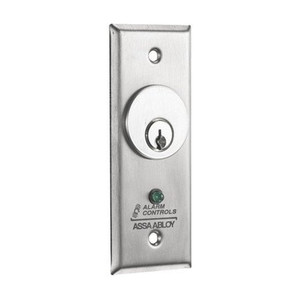
HES MCK-1-4 Narrow Stainless Steel DPDT Switch
The HES MCK-1-4 is a wall-mounted DPDT switch designed for access control and security integration applications where corrosion resistance and compact footprint are essential. Built from 300-series stainless steel with proven mechanical switching internals, it controls two independent circuits simultaneously via alternate action—a topology that eliminates the need for separate relay logic in fail-safe door release systems, emergency call circuits, and redundant signal paths. Rated for 28VDC operation, the MCK-1-4 integrates directly into access control panels, electric strike controllers, and annunciator boards without external conversion.
Key Features
- DPDT Alternate Action Switch: Double-pole double-throw configuration switches two circuits in lockstep with each toggle or push. Each activation flips both poles to opposite states—essential for fail-safe/fail-secure logic without additional relays.
- 300-Series Stainless Steel Housing: Resists corrosion in humid, salt-spray, and damp indoor environments. Eliminates zinc plating degradation risk on standard mild-steel plates over multi-year lifecycles.
- Narrow Profile Plate Design: Compact form factor (approximately 2 lb) minimizes visual footprint at entry doors and reduces dead space behind wall-mounted control enclosures.
- Wall-Mount Installation: Standard electrical box mounting; integrates with existing access control panel cutouts and security infrastructure with minimal rework.
- 28VDC Rated Operation: Direct compatibility with low-voltage access control systems—no step-down transformer required for standard security control circuits.
- Toggle or Push-Button Actuation: Mechanical switching mechanism rated for thousands of cycles; operator choice between rocker toggle or momentary push for application-specific logic.
The DPDT topology is the workhorse of fail-safe door systems. Unlike separate single-pole switches, the MCK-1-4 guarantees that both circuits toggle in perfect synchronization—when one pole energizes the electric strike, the other simultaneously de-energizes a redundant lock relay or signals a monitoring circuit. This eliminates race conditions and wiring errors that plague dual-switch installations.
300-series stainless steel is non-magnetic and inherently corrosion-resistant; it doesn't require plating maintenance or periodic surface treatment. In coastal facilities, healthcare environments with frequent washdowns, or outdoor covered access points, the material payback is immediate—no rust bloom, no annual recoating, no field replacement due to oxidation. The narrow stainless plate also meets aesthetic requirements in upscale buildings where bulky plastic faceplates would stand out.
Integrators typically mount the MCK-1-4 in a recessed wall box paired with a dedicated access control relay module or strike controller. The 28VDC rating aligns with standard 12/24VDC power supplies used across Schlage, HID, Salto, and other mainstream access control ecosystems. The alternate action mechanism means a single button or keypad output can toggle an electric strike and simultaneously trigger an interlock or entry sensor signal—reducing the number of control outputs required on the access control panel itself.
The MCK-1-4 carries no advanced electronics: it is a mechanical switch. This design choice ensures vendor independence, eliminates firmware liability, and guarantees operation in RF-harsh environments or after power loss. The datasheet documents electrical ratings and mechanical cycle life; compliance certifications depend on the enclosure and power supply context, but the switch itself is UL-listed for low-voltage control circuits.
Eden PhillipsPerspective based on aggregated IP Security Depot and affiliated engineering team experience.
We've specified the MCK-1-4 into dozens of access control retrofit projects, and it remains the most reliable DPDT option when corrosion risk is present. The stainless steel construction is not cosmetic—it's operational insurance in hospitals, pool facilities, and multi-tenant buildings where humidity or salt air attack standard mild-steel plate within 18-24 months. The narrow profile appeals to architects and building managers who don't want a bulky switch assembly visible in high-end entry vestibules. What sets it apart from generic electrical DPDT switches is the low-voltage rating and mechanical robustness for access control loops specifically—it's engineered for 28VDC alternating-action logic, not household lighting circuits. The trade-off is that it's not suitable for high-current AC switching (HVAC, lighting loads); if you need to switch 120VAC, this is the wrong product. But for signal-level access control, door release sequencing, and interlock chains, it's a workhorse with zero firmware, zero network vulnerability, and guaranteed mechanical isolation between circuits.
Technical Highlights:
- DPDT Alternate Action Topology: Both poles toggle simultaneously with each press—fail-safe systems can energize a strike on one pole and de-energize a backup lock on the other in a single action. Eliminates race conditions and wiring errors in fail-secure logic.
- 300-Series Stainless Steel: No plating, no zinc degradation, no corrosion maintenance. In humid environments (hospitals, pools, coastal facilities), stainless plate outlasts mild-steel by 5+ years with zero touch-up.
- 28VDC Rated: Direct compatibility with standard low-voltage access control power supplies. No step-down transformer, no isolation relay required. Simplifies panel wiring and reduces BOM count.
- Narrow Profile Footprint: Approximately 2 lb, compact form factor minimizes visual intrusion at entry points. Fits standard electrical box without custom framing or recessed panel modifications.
- Mechanical (No Electronics): Zero firmware, zero network exposure, guaranteed operation in RF-dense environments or after extended power loss. Mechanical isolation between circuits ensures one failed pole doesn't affect the other.
Deployment Considerations:
- This is a signal-level low-voltage switch—do not use it for AC mains or high-current DC loads. Consult the datasheet for contact ratings (typically 2A @ 28VDC). Oversizing the load will cause contact wear and premature failure.
- Wall-mount installation requires a standard electrical box and ⅜–½ inch knockout entry. Pair with a dedicated relay module or strike controller if driving heavy loads (e.g., a 12W electric strike); the MCK-1-4 itself is a logic switch, not a power device.
- DPDT alternate action means each press toggles both poles. If your application requires latching behavior or momentary-only output, you'll need additional relay logic to debounce or latch the signal—the MCK-1-4 cannot be configured to favor one pole over the other.
- Test the switch function during commissioning with a multimeter. Verify that both poles transition cleanly and that the mechanical action is smooth. Stainless steel contacts are durable but benefit from occasional visual inspection in high-traffic installations (every 12–24 months).
- The 300-series stainless plate is easy to clean but does not hide fingerprints. In public facilities, consider periodic wiping with a microfiber cloth and mild detergent; this is cosmetic, not functional maintenance.
The MCK-1-4 is the right choice for system architects and integrators specifying fail-safe door release chains, emergency unlock circuits, and interlock logic in commercial buildings, healthcare facilities, or coastal sites where corrosion immunity is non-negotiable. For more HES access control and electric strike solutions, see the HES catalog.