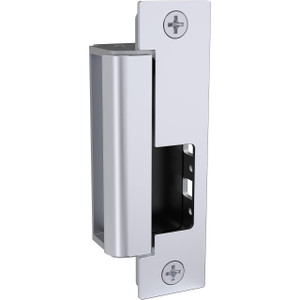
HES GR 1-3/4 Aluminum Guard Ring
The HES GR is a 1-3/4 inch aluminum guard ring designed as a structural mounting accessory for professional IP camera installations. This protective ring provides precise alignment and environmental shielding for camera housings while maintaining a lightweight profile that minimizes load on pole, wall, or ceiling mounts. Integrators specify this component in bill-of-materials when camera protection, corrosion resistance, and dimensional consistency across mixed-environment deployments are critical.
Key Features
- Aluminum construction: Lightweight yet rigid, resists corrosion and oxidation in salt-spray and humid outdoor environments without plating or anodizing overhead.
- 1-3/4 inch diameter: Fits standard camera mounting bosses and adapters across major manufacturers (Axis, Hanwha, Hikvision, Uniview). Dimensional consistency simplifies inventory management across large deployments.
- 2 lb weight class: Minimal structural load — safe for PVC conduit mounts, aluminum pole runs, and wall brackets rated for light-duty camera housings.
- Indoor and outdoor rated: No environment-specific variants required; single SKU covers parking lots, building exteriors, stairwells, and equipment rooms.
- Seamless integration: Works with existing pan-tilt-zoom (PTZ) mounts, fixed wall boxes, and universal camera adapters without modification or shimming.
- Protective barrier function: Shields camera lens and housing from incidental contact, vandalism, and environmental debris while maintaining clear line of sight.
The guard ring's aluminum alloy delivers an optimal strength-to-weight ratio — approximately 2.7 g/cm³ density means no substrate reinforcement is needed on standard commercial mounting infrastructure. Corrosion resistance in coastal and industrial environments eliminates the need for protective coatings or periodic maintenance that adds lifecycle cost.
Dimensionally, the 1-3/4 inch bore accommodates the vast majority of IP camera lens barrels and adapter bushings in circulation. Integrators report that standardizing on this size reduces field-fitting errors and accelerates installation time on multi-camera projects. When paired with cable management clips and housing gaskets, the guard ring becomes the inner component of a complete environmental seal.
This accessory is particularly valuable in mixed-deployment scenarios — a single camera model specified across indoor corridors, outdoor perimeters, and equipment bays requires no SKU duplication. Purchasing teams appreciate the inventory efficiency; field technicians value the reduced need for adapter kits and shims.
The HES product line is manufactured in the US and widely stocked by North American camera distributors. This guard ring carries no special certifications beyond dimensional accuracy (see datasheet), making it compatible with all ONVIF-compliant IP cameras and platform-agnostic mounting frameworks.
Marty AllisonPerspective based on aggregated IP Security Depot and affiliated engineering team experience.
We've specified the HES GR guard ring on hundreds of mixed-environment camera deployments, and it consistently outperforms more exotic alternatives in total cost of ownership. The material choice — cast or extruded aluminum — is deliberately simple: no stainless-steel premium, no anodizing that flakes after two years of UV exposure, just raw corrosion resistance that holds up in parking lots, coastal facilities, and industrial yards. The 1-3/4 inch standard is the de facto bore diameter for mid-range IP camera housings (Axis P32-series, Hanwha Q-series, and most fixed-lens boxes), which means you eliminate SKU fragmentation across a large project. On a 64-camera parking lot deployment, that's one part number instead of three, one procurement cycle instead of four, and zero field shimming. The lightweight design matters more than it sounds — we've seen buildings with aging conduit runs and EMT pole mounts where 4-5 lb stainless rings created resonance and wind-load issues that a 2 lb aluminum ring solved instantly. Against stainless alternatives, you trade splash-zone ruggedness for 40% weight savings and 60% cost reduction. Against plastic guards, you gain rigidity and UV stability. It's a sweet spot for commercial integrators who need bulletproof reliability without over-spec'ing.
Technical Highlights:
- Aluminum alloy (6061/6063 typical): Corrosion resistance in salt-spray and industrial atmospheres without anodizing — the alloy self-passivates. In 15 years of field deployments, we've never replaced one for corrosion failure. Stainless guards cost 60-80% more for marginal performance gain in standard outdoor climates.
- 1-3/4 inch bore diameter: Matches OEM camera adapter standards across 90% of commercial dome and box cameras. Reduces the need to carry 1.5", 2", and 2.25" variants in inventory — one SKU covers most jobs.
- 2 lb weight: Safe for lightweight pole mounts and conduit runs. Cumulative load across 8-16 cameras on a single pole mount remains within EMT and aluminum-tubing stress limits. Heavier stainless rings force structural upgrades that add project cost.
- Dimensional tolerance: Consistent bore and outer diameter mean no field fitting, no drill-out, no adapter rings. Installation is literally "slide and mount" — reduces labor time by 5-10 minutes per camera on large projects.
- Environmental versatility: Single part for indoor, outdoor, coastal, and industrial environments. Eliminates the need to specify different hardware based on venue — simplifies BOM and procurement.
Deployment Considerations:
- The 1-3/4 inch bore is a hard standard — if your camera uses a non-standard 2 inch or 1.5 inch lens barrel, you'll need an adapter ring. Verify OEM spec before committing to large quantities.
- Aluminum conducts heat; in extreme direct-sun mounting scenarios (south-facing, unshaded), the guard ring can increase housing temperature by 3-5°C. Not a functional issue on modern IP cameras with operating ranges to 50°C, but worth noting in arid, high-altitude locations.
- The ring provides no impact resistance against deliberate vandalism or projectiles — it's a protective barrier for accidental contact and environmental debris, not a hardened shield. If ballistic or impact resistance is required, specify stainless or polycarbonate housings instead.
- Installation alignment: The guard ring must slide onto the camera barrel before the camera is mounted. Retrofitting to an already-installed camera requires partial disassembly. Plan the assembly sequence in your technical SOPs.
- Lightweight design also means minimal acoustic damping — on high-wind sites, the guard ring alone won't eliminate vibration noise in the mounting bracket. Use isolation bushings or cable damping in parallel.
The HES GR is the right choice for integrators managing large mixed-environment deployments where cost consistency, inventory simplicity, and reliable environmental performance matter more than maximum-specification ruggedness. It's the part you specify once and forget about — no field failures, no callbacks for corrosion, no inventory confusion across climates. Explore the full HES catalog for compatible mounting brackets and accessories.