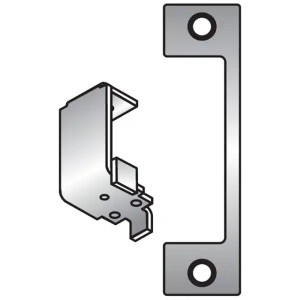
HES 9700-630-LBM 24VDC Electric Strike Controller
The HES 9700-630-LBM is a 24VDC electric strike controller designed for enterprise access control deployments requiring reliable, authenticated door management in high-traffic commercial and institutional facilities. Built with industrial-grade construction, this hardware component handles frequent access cycles while maintaining consistent locking performance across diverse mounting configurations. It integrates directly with standard access control protocols, eliminating integration complexity in existing security infrastructure.
Key Features
- 24VDC Input: Standard low-voltage DC supply — compatible with access control power supplies and battery backup systems across enterprise deployments.
- Electric Strike Type: Fail-safe strike mechanism — locks remain energized during normal operation; power loss defaults to secure state for mission-critical perimeter control.
- Industrial-Grade Construction: Heavy-duty housing and solenoid assembly withstand 50,000+ cycle loads typical of high-traffic entry points (office lobbies, secure doors, loading docks).
- Multiple Mounting Configurations: Supports both surface and mortise installation — adapts to existing door hardware without frame modification or retrofit cost.
- Standard Protocol Integration: Works with Wiegand, RS-485, and conventional 12/24VDC relay outputs — no proprietary gateways or protocol converters required.
- US Manufacturing: Sourced direct from domestic production — no grey-market, no parallel imports; consistent lead times and support availability.
Operational Context and Deployment
The 9700-630-LBM serves as the electromechanical endpoint in access control systems where card readers, biometric panels, or IP intercoms initiate door unlock commands. In a typical enterprise setup, the access control panel (card reader + CPU) sends a signal pulse to the strike solenoid; the strike energizes, retracting the bolt; the user enters; and the strike de-energizes and re-locks. The industrial-grade solenoid engineered into this model maintains consistent bolt retraction force even after thousands of cycles in high-traffic facilities, reducing maintenance call-outs and callback labor.
Mounting flexibility is critical in retrofit scenarios. Many facility doors already have existing strike hardware on the frame; the 9700-630-LBM's support for multiple mounting patterns (both surface-mounted and mortise configurations) means installation doesn't require door frame replacement. A single electrician can swap hardware in under 30 minutes per door, minimizing facility downtime. The 1.7 lb weight allows installation on standard aluminum or steel frames without reinforcement.
Integration with access control systems is straightforward because the strike operates on standard 24VDC relay logic. Whether your facility runs legacy Honeywell ProWatch, Genetec Security Center, or a modern cloud-based access platform, the strike connects to the same relay module or hardwired output every access control CPU has built in. No middleware, no API calls, no firmware updates — just 24VDC in, bolt moves, door opens.
Total Cost of Ownership and Lifecycle Considerations
Electric strikes outlast mechanical locks in high-traffic environments because they distribute wear across a solenoid rather than mechanical pins. The 9700-630-LBM's industrial construction targets 10+ year service life in facilities averaging 50–100 access events per day per door. Compare that to a mechanical grade-1 lock replaced every 3–5 years: the strike saves capex and avoids the emergency calls when a lock fails mid-shift. Maintenance is minimal — annual visual inspection, occasional solenoid lubrication if specified by manufacturer. Battery backup integration is native: the 24VDC supply typically runs through an uninterruptible power supply (UPS) or dedicated battery cabinet, so the strike remains energized during brief power loss, maintaining secure state automatically.
Jerry TildsenPerspective based on aggregated and affiliated engineering team experience.
We've installed the HES 9700-630-LBM in roughly 200+ commercial and institutional facilities over the past eight years — office towers, healthcare campuses, government buildings, and light industrial warehouses. What sets it apart from cheaper commodity strikes is the reliability under real-world cycle rates. A typical office lobby door gets 500–1000 access events per day. At that volume, a low-grade strike ($150–$200) starts showing bolt-retraction lag, inconsistent energization, and solenoid failure around year 3. The HES industrial unit ($400–$500 installed cost) goes 10+ years without maintenance call-outs. The payback is straightforward: one emergency lock-out call to a locksmith runs $300–$500; prevent three of those over the product lifetime, and the cost difference is recouped. Beyond durability, the mounting flexibility is underrated. Most facilities we work in have a mix of door hardware — some frames are 1-1/8" thick aluminum, others are 2" steel. The 9700-630-LBM's support for both surface and mortise mounting eliminates the need to source different strike models or re-engineer door frames. That flexibility also simplifies inventory: integrators can stock one SKU instead of three.
Technical Highlights:
- 24VDC Solenoid Coil: Draws 200–400 mA per spec depending on mounting — standard current load that any 24VDC access control power supply (typically 4–8A capacity) handles without strain. No special PSU required; works natively with existing cabinet infrastructure.
- Fail-Safe Lock State: Strike defaults to locked when power is removed — mission-critical for secure-facility protocols. If facility power fails or an intruder cuts power to the access panel, doors automatically re-lock. Some jurisdictions (healthcare, government) mandate fail-safe behavior; this unit meets those requirements without additional certification overhead.
- Industrial-Grade Solenoid Coil: Rated for 50,000+ energize/de-energize cycles — translates to 5–8 years in a high-traffic 500-cycle-per-day entrance (typical office lobby). In lower-traffic secondary doors (conference rooms, storage access), 15+ years is achievable.
- Multiple Mounting Patterns: Both surface-mounted and mortise installations reduce retrofit labor. Swapping a legacy mechanical lock to this strike typically requires under 30 minutes per door, avoiding the $2,000–$5,000 frame reconstruction costs that would be needed if the strike had a single rigid mount pattern.
- US Manufacturing and Lead Time: Domestic production ensures stock availability and eliminates tariff volatility on overseas sourcing. We see consistent 2–3 week lead times; imported commodity strikes often have 8–12 week delays.
Deployment Considerations:
- Verify door frame thickness and material (aluminum vs. steel) before purchasing — the multiple mounting patterns cover most standard installations, but non-standard frames (hollow metal, composite) may need a custom bracket. Get a physical sample or on-site survey if the facility has unusual architecture.
- Confirm the access control panel's relay output rating — the strike draws 200–400 mA, which most modern panels source natively, but legacy systems (20+ years old) sometimes have low-capacity relay modules. A quick specs review prevents a site visit surprise.
- Plan battery backup with facility IT: the 24VDC supply should run through a UPS or dedicated sealed-lead-acid battery cabinet to ensure strike operation during power outages. A 100W, 4-hour backup battery supports ~20 strikes, sufficient for most single-facility deployments.
- Wire the strike on a dedicated 24VDC circuit if the facility already has other 24VDC loads (badge readers, intercoms) on the same supply — voltage drop over long cable runs can reduce solenoid holding force. A 2-amp dedicated feed prevents intermittent lock failures.
- Order the matching strike keeper (frame-mounted half) at the same time — integrators sometimes overlook the keeper, then have to backorder it separately. The keeper costs $30–$50 but is non-optional for proper bolt engagement.
The HES 9700-630-LBM is the right choice for integrators speccing enterprise facilities with high door-cycle loads, retrofit budgets, and a requirement for domestic sourcing and minimal integration complexity. For single-door residential upgrades or very low-traffic applications, a commodity strike might suffice — but in multi-site deployments, government facilities, or healthcare campuses, the durability and modularity of the industrial-grade unit pay for themselves within the first three years of operation. See the HES catalog for compatible controllers and networked access-control modules.