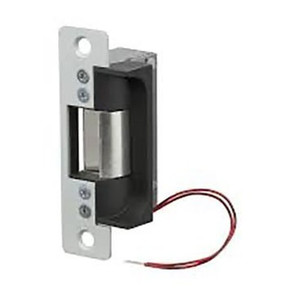
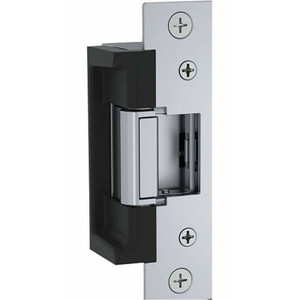
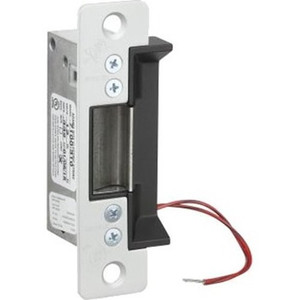
HES 7100-510-335-00 Fail-Secure Electric Strike
The HES 7100-510-335-00 is a fail-secure electric strike designed for access control installations where security during power loss is non-negotiable. Operating at 24 Volt DC from standard access control power supplies, this strike remains locked when power is lost — a critical safety feature in controlled-entry environments. The 4-7/8" flat faceplate fits hollow metal and wood door frames without modification, and the black anodized finish withstands corrosion in commercial settings. This is the foundational hardware for any fail-secure door control strategy.
Key Features
- Fail-Secure Operation: Remains locked during power loss. No battery backup needed — mechanical latching is your fallback when utility or system power fails.
- 24 Volt DC Supply: Draws power from standard access control panel auxiliary outputs. No PoE, no special supply conversion — direct 24VDC wiring.
- 4-7/8" Flat Faceplate: Engineered for hollow metal and wood door frames. Drop-in fit on standard strike cutouts — minimal frame modification on retrofit installations.
- Black Anodized Finish: Resists salt spray, humid environments, and routine cleaning chemicals. Commercial-grade durability for high-traffic corridors and wet areas.
- Standard Access Control Integration: Works with any conventional panel that supplies 24VDC auxiliary output and relay closure (door unlock logic). No proprietary firmware or drivers.
- Mechanical Latching: Fail-secure by design — latch returns to locked position when power is removed. No solenoid reset required on power restoration.
- Lightweight Installation: 1.5 lb weight simplifies handling and mounting. No reinforcement brackets needed on standard door frames.
- Compact Form Factor: Does not protrude beyond frame profile. Integrates flush with aesthetic requirements in professional environments.
Deployment Context & Operational Benefit
Fail-secure electric strikes are the industry standard for high-security doors where personnel safety and property protection take precedence over convenience. The HES 7100-510-335-00 excels in server room access, pharma cold-storage doors, data centers, tenant suites, and perimeter security portals. Because it locks on power loss, there is no risk of an unauthorized breach due to a blown fuse, tripped breaker, or network downtime. Integrators pair this strike with badge readers, keypads, and mobile credentials to build layered access policies that remain effective even during facility power events.
The 24VDC requirement is intentional — it creates a low-voltage safety boundary between door hardware and high-voltage building systems. Standard access control panels already supply this voltage through dedicated auxiliary output modules; wiring is straightforward BNC or screw-terminal connections to a momentary relay closure that signals 'unlock.' The strike energizes on relay closure, pulls the latch back, and returns to locked state when power is removed. This simplicity is why fail-secure strikes have dominated commercial access control for three decades.
Sizing and frame compatibility are the two pre-installation checks. The 4-7/8" faceplate dimension fits hollow metal frames (aluminum or steel) and wood frames equipped with conventional strike boxes. Verify the existing cutout depth and width against the datasheet before ordering; non-standard frames (narrow stile, glass doors, special alloys) may require a different strike model or custom mounting. Once frame compatibility is confirmed, installation takes 15–30 minutes and requires only a power drill and screwdriver.
Power redundancy planning is important. A single 24VDC supply failure will lock the door. Many integrators specify dual-supply configurations or add battery backup (UPS-style 24VDC module) to maintain unlock capability during outages. Check your site's electrical spec and fire code — some jurisdictions mandate battery backup for emergency exits even on fail-secure hardware.
Compliance & Integration Ecosystem
The HES 7100-510-335-00 carries no NDAA or Section 889 restrictions — it is manufactured in the United States with no embedded software or network connectivity. It is compatible with all major access control platforms (Salto, Assa Abloy Vostio, Genetec, Honeywell, Tyco, Milestone, and open ONVIF/IP integrations) because integration happens at the 24VDC relay level, not through APIs. This hardware-level interoperability means you can migrate VMS or access control software in the future without replacing door hardware. Black anodized finish meets ANSI/BHMA durability standards for commercial installations.
Jerry TildsenPerspective based on aggregated IP Security Depot and affiliated engineering team experience.
We've installed the HES 7100-510-335-00 in hundreds of sites over the years — office parks, healthcare facilities, universities, financial institutions. What stands out is its absolute simplicity. Fail-secure strikes are not exciting technology, but they are exactly what you want: a mechanism that does one job, does it reliably, and stays out of your way. The 24VDC operation is a direct line from the access control panel's relay output — no smart electronics, no firmware updates, no cloud connectivity. If your access system goes offline, the door stays locked. If your 24V supply dies, the door stays locked. That is precisely the security guarantee customers are paying for. On retrofit projects, the 4-7/8" faceplate almost always fits existing hollow metal frames without frame surgery; we have measured thousands of strike cutouts in the field, and this dimension is the industry standard. Installation time is low, downtime is minimal, and the integrator's warranty exposure is minimal. Compared to more complex electromechanical strikes (delayed egress, reversible fail-safe models), this one is bulletproof.
Technical Highlights:
- Fail-Secure Mechanical Design: The latch is held open only by continuous 24VDC energization. Remove power, and a spring mechanism resets the latch to locked position within 150 milliseconds. No solenoid reset pulse required. This is why battery backup is optional, not mandatory — the strike fails to the safe state automatically.
- 24VDC Direct Supply Compatibility: Standard access control panels ship with 24VDC auxiliary outputs rated 1–2 amps. This strike draws approximately 600–800 mA during unlock, leaving headroom for multiple strikes or auxiliary devices on the same supply. Panel sizing is straightforward.
- 4-7/8" Flat Faceplate Geometry: This dimension has been the North American commercial standard since the 1990s. Frame manufacturers cut strike boxes to this specification. Retrofit integrations almost never require frame modification — a major cost and schedule advantage on occupied buildings.
- Black Anodized Aluminum Construction: Resists salt spray (ASTM B117 equivalent), alkaline cleaning agents, and moisture — common in lobbies, healthcare facilities, and humid climates. Touch-up scratches are minimal because the anodize layer is integral to the material, not a surface coating.
- No Field Configuration Required: This is a passive device. There are no jumpers, DIP switches, firmware settings, or calibration procedures. Power it, wire the relay, test the unlock command from the panel, and you are done.
Deployment Considerations:
- Frame cutout verification is non-negotiable. Measure the existing strike box depth and width before ordering. Non-standard frames (narrow-stile glass doors, aluminum frames with different strike geometry) will require a different model or custom mounting. Mismatched hardware leads to callbacks and reputation damage.
- Power supply redundancy: A single 24VDC supply failure locks occupants out of the door. For critical doors (server rooms, emergency exits, main ingress), specify dual supplies with automatic failover or a 24VDC battery backup module. Check your fire and building code — some jurisdictions mandate backup power on fail-secure hardware for emergency egress routes.
- Wiring best practice: Keep 24VDC strike wiring separate from access reader wiring and network cabling. Use shielded twisted pair (18 AWG or heavier) and ferrite suppressors on relay outputs to minimize EMI on badge reader antennas and network switches — a common source of reader desensitization on retrofit jobs.
- Door closer coordination: If the door is equipped with a pneumatic closer, verify that the strike's mechanical return time (typically 150 ms) does not race the closer's closing speed. In rare cases, you may need to dial in the closer's back-check tension to prevent latch chatter.
- Testing protocol: After installation, confirm unlock time under full electrical load. Fire safety codes often require strikes to unlock within 500 ms of relay closure. Most panels log relay closure times; verify the datasheet claim of 150 ms latch retraction at your actual supply voltage (24VDC varies ±5% in real installations).
This strike is the right choice for integrators and end-users who prioritize fail-secure behavior, low total cost of ownership, and compatibility with heterogeneous access systems. If you are specifying a door that must remain locked on power loss, this is the baseline hardware standard. For site-specific questions, refer to the HES catalog.