Panduit FHP9N-LA1X16 HD Flex 1x16 PON Splitter Cassette
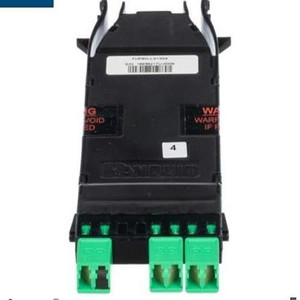
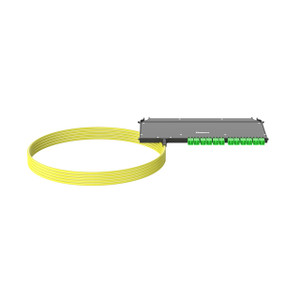
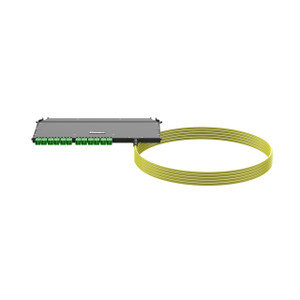
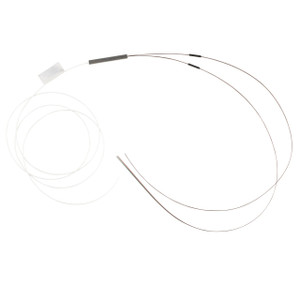
The Panduit FHP9N-LA1X16 is a full-width 1x16 passive optical splitter cassette engineered for high-density PON deployments in central offices, headend facilities, and enterprise fiber aggregation points. Built on the HD Flex modular platform, this LC/APC-to-LC/APC splitter delivers six cassettes per rack unit—enabling 96 split ports in a single RU when fully populated. Integrated port shutters eliminate contamination risk during staged deployments, while zirconia ceramic ferrules ensure insertion loss stays within 0.2 dB across all 16 outputs. For operators managing GPON, XGS-PON, or NG-PON2 architectures where cabinet space is constrained and adds are frequent, this cassette bridges the gap between passive infrastructure and active OLT gear without sacrificing access or reliability.
Key Features
- 1x16 split ratio: Single input fiber fans out to 16 LC/APC outputs, supporting standard PON topologies from GPON (1:32/1:64) to XGS-PON (1:128) via cascaded stages
- LC/APC connectors on all ports: Angled Physical Contact terminations hold back-reflection below -60 dB, mandatory for long-haul single-mode and high-split-count PON to prevent upstream receiver saturation
- HD Flex compatibility: Installs directly into FLEX**12 chassis and patch panels—no adapters or brackets—allowing mix-and-match with other HD Flex splice, adapter, and MTP modules in the same enclosure
- 6 cassettes per RU capacity: Full-width form factor occupies one slot in a six-slot 1U frame, yielding 96 split outputs per rack unit or 1,848 outputs in a 42U cabinet when densely packed
- Integrated port shutters: Both input and output LC ports ship with captive dust caps that prevent airborne particle ingress during installation, critical in live central offices where open ports can collect debris between fiber pulls
- OS2 single-mode fiber (9 micron core): Supports wavelengths from 1260 nm to 1625 nm, covering O-band through L-band for CWDM overlay, PON coexistence, and future coherent optics without cassette replacement
- Zirconia ceramic ferrule construction: Industry-standard material ensures mechanical durability across 500+ mate cycles and thermal stability from -40°C to +75°C without ferrule deformation
- RoHS compliant, multi-standard certified: Meets ISO/IEC 11801, ANSI/TIA-568-C.3, TIA-604-5 (FOCIS-5), and TIA-604-10 (FOCIS-10) for both North American enterprise and international carrier deployments
- Black housing with clear port labeling: High-contrast input/output markings remain legible under cabinet LED lighting, reducing wrong-port errors during MACs in cramped CO environments
Passive optical networks collapse dozens of individual fiber homerun strands into a single feeder by inserting optical splitters at strategic aggregation points—typically at the central office for GPON or at intermediate distribution hubs for XGS-PON. The FHP9N-LA1X16's 1x16 architecture fits the first-stage split in a two-stage cascade (1x8 CO + 1x4 hub = 1:32 total) or serves as the sole split in lower-density deployments where 16 endpoints share a single OLT PON port. LC/APC connectors are non-negotiable in this application: the 8° ferrule angle directs back-reflected light into the cladding rather than returning it to the source, keeping return loss below -60 dB even after dozens of connect/disconnect cycles. Standard LC/UPC (0° polish) would allow 4–10% of incident light to bounce back, swamping the OLT's upstream receiver and collapsing link budgets on high-split or long-reach PON spans. Every port on this cassette—input and all sixteen outputs—uses LC/APC, ensuring you can patch from OLT to ONT without introducing a single UPC mismatch that would tank system margin. The OS2 fiber spec extends usable bandwidth out to 1625 nm, which matters when overlaying CWDM channels for business services (1470–1610 nm) on top of residential PON (1490 nm down, 1310 nm up) or when migrating to next-gen PON variants that shift downstream wavelengths to avoid legacy coexistence interference.
Panduit's HD Flex ecosystem treats the 19-inch rack as a Lego kit: FLEX**12 chassis accept any combination of splice cassettes, adapter panels, MTP-to-LC breakouts, and splitter modules in a common six-slot-per-RU frame. The FHP9N-LA1X16 occupies one full slot, leaving five slots available for other functions—install three more 1x16 splitters plus two 24-port LC adapter panels in the same RU, giving you 64 split outputs and 48 patch ports in 1.75 inches of vertical space. This modularity collapses what used to require separate shelves (splitters on one shelf, patch panels on another, splice trays on a third) into a single integrated frame, reclaiming 4–6U per cabinet and often deferring costly cabinet additions for 18–24 months in space-constrained COs. The integrated shutters solve a practical headache: in staged fiber builds, you populate the splitter today but don't land all 16 output fibers until phase two or three; without shutters, those open LC ports collect dust, metal shavings, and HVAC grit that later causes 2–5 dB insertion loss spikes and intermittent link flaps when you finally plug in. The captive design means the shutter stays attached to the cassette body (it doesn't fall into the cable trough and get lost), and it snaps off with thumb pressure when you're ready to insert the connector—no tweezers, no fumbling in dim overhead lighting. Installation is tool-free: slide the cassette into an open slot, hear the click as the retention tabs engage, route your input fiber from the OLT shelf or building entrance terminal, route your 16 outputs to the MDF or to a second-stage splitter rack, and you're live. No screws, no mounting ears to align, no post-install sag from under-secured modules.
Compliance with TIA-604-5 and TIA-604-10 guarantees interoperability with every major OLT vendor (Nokia, Huawei, ADTRAN, Calix) and ONT manufacturer, eliminating the "splitter from vendor A won't hit insertion loss spec with OLT from vendor B" gotchas that plague uncertified passive components. The cassette's published insertion loss is ≤0.2 dB plus the theoretical 1x16 split loss (approximately 13 dB), meaning your total link budget hit is 13.2 dB worst-case—well within the 28–32 dB margin available on Class B+/C+ PON optics. Zirconia ceramic ferrules maintain that performance across the -40°C to +75°C range you'll see in outdoor cabinets (pedestal-mount in northern climates) or in minimally climate-controlled huts, and they survive the 500-cycle test regimen required by TIA-568-C.3 without the 0.5+ dB drift you'd get from lower-grade polymer ferrules. For deployments mixing residential GPON (2.5G down / 1.25G up) with business XGS-PON (10G symmetric) on the same physical infrastructure, the cassette's full O-through-L-band transparency ensures that CWDM wavelengths (1470, 1490, 1510 nm, etc.) pass without crosstalk or added attenuation, letting you light up premium services without rejiggering the passive layer. The black housing might seem cosmetic, but it matters in forensic troubleshooting: when you're tracing a flapping circuit at 2 AM with a headlamp, high-contrast white-on-black port labels (Input 1, Output 1–16) are faster to read than molded gray-on-gray markings, cutting your mean time to identify the correct output port and swapping a suspect jumper from 8 minutes to under 2.