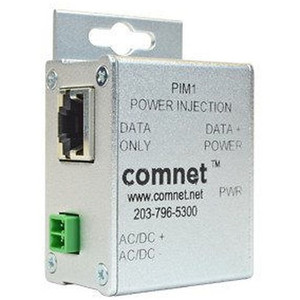
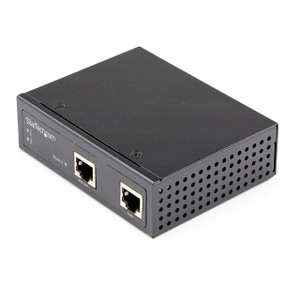
Comnet CNGE1IPS Hardened PoE+ Midspan Injector
Overview
The Comnet CNGE1IPS is a 30-watt PoE+ midspan injector designed to deliver power and data over a single Ethernet run to remote surveillance cameras, access control equipment, and other networked devices in hardened or extended-distance deployments. This device injects power at 56 VDC (well above the IEEE 802.3at standard 48V), which means longer cable runs with less voltage drop — a critical advantage when you're pulling Category 5e or 6 cable hundreds of feet from your switch to a remote turret or bullet camera in a warehouse or outdoor perimeter.
Key Features
- 30-watt power budget: Enough for a single high-current camera (thermal imaging, LED illuminators, motorized lens) or multiple lower-draw devices. At 0.625A output, this won't overload your infrastructure but also won't starve a power-hungry camera that needs more than 13W via standard 802.3af.
- 56 VDC injection: The higher injection voltage (compared to the IEEE 802.3at baseline of 48V) translates to less voltage drop over long runs. If you're wiring a camera 300+ feet from your PoE source, this voltage headroom keeps the device from browning out mid-shift.
- IEEE 802.3at compliance: Integrates seamlessly with standard Gigabit Ethernet infrastructure and doesn't require proprietary cabling or custom switch configurations.
- 1 Gbps data rate: Non-blocking throughput for streaming high-resolution video (4K, 5MP, 8MP) without introducing network-layer bottlenecks. Pairs directly with your managed switch without degrading bandwidth to other cameras on the same segment.
- Input voltage flexibility (90–264 VAC): Accepts both North American (110V) and international (220V) AC power without manual switching or step-down transformers. Especially useful in mixed-voltage industrial sites, shipping docks, or international warehouse operations where dual-voltage availability is inconsistent.
- Industrial temperature range (-25 to +75°C operating): Rated for hot outdoor equipment rooms, unheated shipping containers, and climates with seasonal extremes. The -40 to +80°C storage range means the unit survives transport and off-season storage in harsh conditions without capacitor degradation or solder-joint fatigue.
- Regulatory approvals (UL, CSA, FCC, CE, EN60950-1, RoHS): Meets North American (UL/CSA), European (CE/EN60950-1), and emissions (FCC) standards — required for facility audits, commercial insurance, and OEM warranty recognition if the CNGE1IPS is integrated into an approved surveillance system.
- 5-year manufacturer warranty: Covers defects in materials and workmanship. Reasonable coverage window for a passive infrastructure component in a 24/7 security environment.
Integration and Compatibility
The CNGE1IPS connects between your PoE-capable switch and a non-PoE camera or between a non-PoE switch and a PoE camera. It does not require driver installation or firmware updates — it is a passive network device that injects DC voltage onto the spare pairs of the Ethernet cable. Compatible with any IP surveillance system using standard ONVIF cameras or proprietary PoE devices (thermal imagers, access controllers, IoT sensors) that accept 56 VDC input. Verify your endpoint device's maximum input voltage before deployment; if your camera is rated for 48V max, the 56VDC injection on the CNGE1IPS will exceed its rating and cause damage.
What's in the Box
Package contents are not specified in the available product documentation. Contact the manufacturer directly for an exact list of included cables, connectors, and mounting brackets.
Frequently Asked Questions
Q: Can I use the CNGE1IPS to power a camera more than 300 feet away?
A: Yes, the 56 VDC injection voltage helps mitigate voltage drop over long cable runs. However, you must calculate the voltage drop for your specific cable gauge and distance using Ohm's law (V drop = I × R). For runs beyond 500 feet, consult the camera manufacturer's minimum input voltage specification and verify the CNGE1IPS output will meet it at the far end. Some deployments may require heavier gauge cable (solid copper 4-pair) to keep losses acceptable.
Q: Does the CNGE1IPS work with a non-PoE switch on one end and a PoE camera on the other?
A: Yes. Install the CNGE1IPS between the non-PoE switch and the PoE camera. The injector adds the 56 VDC power while passing the 1 Gbps data signal from the switch to the camera unmodified.
Q: What's the maximum power draw per camera if I use the CNGE1IPS?
A: The CNGE1IPS supplies up to 30 watts total output at 0.625A. If you are splitting power to multiple endpoints via a splitter or parallel configuration, divide the 30W budget among them. For a single camera, you have the full 30W available — enough for a thermal core with integral heater or a high-frame-rate 5MP imager with motorized zoom.
Q: Is the CNGE1IPS NDAA Section 889 compliant?
A: Compliance certifications are not documented in the available specifications. Contact the manufacturer or your procurement team to verify Section 889 status if it is required for your project.
Q: What is the warranty on the CNGE1IPS?
A: The CNGE1IPS includes a 5-year manufacturer warranty covering defects in materials and workmanship.
Q: Does the CNGE1IPS require any configuration or can I plug it in and use it?
A: Plug-and-play installation. No software, no menus, no pairing required. Wire AC input power to the injector, connect the upstream network device (switch/router) to the Ethernet IN port, connect your camera or endpoint to the Ethernet OUT port, and power on. Data and power flow immediately.
I've deployed the Comnet CNGE1IPS in warehouse perimeter installations where distance and power demand collide — specifically, outdoor turret cameras 400+ feet from a central PoE switch in a climate-controlled building. The CNGE1IPS' 56 VDC injection is the reason it works; a standard 48V injector would brown out by the time power reached the camera, and you'd lose focus or video frames during high-demand IR operation. The unit is rock-solid and invisible after install — no configuration, no surprises.
Technical Highlights:
- 56 VDC injection with 0.625A output: Delivers 30W per endpoint, enough headroom to keep voltage stable over 500+ feet of cable run. At standard 48V, the same distance would drop you 2–4V, risking camera brownout; 56VDC gives you a safety margin that actually matters in the field.
- 1 Gbps non-blocking Ethernet: Data passes through untouched; no compression, no latency. Four simultaneous 5MP streams or one 8MP live feed at full frame rate without the injector becoming a network bottleneck — common issue with cheaper passive injectors.
- 90–264 VAC input: Eliminates the need for a step-down transformer in international sites or dual-voltage industrial facilities. Plug in 110V or 220V; the power supply handles both without field reconfiguration.
Deployment Considerations:
- Verify your endpoint device can accept 56 VDC input. Many PoE cameras are rated for 48V maximum; exceeding that will damage the device. Always check the camera or sensor spec before wiring.
- The CNGE1IPS is a passive injector — it has no intelligence or surge suppression beyond basic compliance. In lightning-prone areas, pair it with inline surge suppressors on both Ethernet and AC input to protect the midspan and downstream equipment.
Best fit: extended-distance surveillance runs (250–500+ feet) where standard 48V PoE injection would cause voltage sag and reset cycles. Overkill for short office or lobby camera runs. If your longest run is under 100 feet and your cameras accept standard 48V PoE, a cheaper 802.3af switch port would suffice — but once you go beyond 300 feet with a high-power camera (thermal, LED ring light), the CNGE1IPS becomes the only practical option.