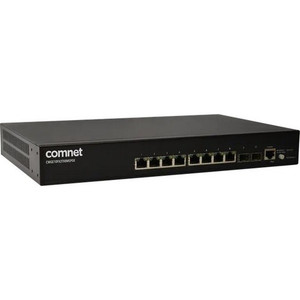
Comnet CNGE24MS2 Hardened Managed Ethernet Switch
Overview
The Comnet CNGE24MS2 is a 24-port managed Ethernet switch engineered for outdoor and harsh-environment surveillance and industrial deployments. It combines eight 100/1000Base-FX SFP fiber ports with sixteen gigabit combo ports (TX or FX), delivering 48 Gbps switching bandwidth with sub-8µs latency—critical for real-time video streaming across distributed camera networks. Operating from −40°C to +75°C, the CNGE24MS2 handles temperature extremes without de-rating, making it viable for rooftop installations, remote sites, and equipment cabinets without climate control. The unit supports multiple Ethernet redundancy protocols (ComRing, C-Ring, MSTP, RSTP, STP) to eliminate network interruptions caused by single link failures—recovery time under 20 ms on C-Ring topology. This is the switch you deploy when a network outage costs you footage or system downtime.
Key Features
- 48 Gbps switching bandwidth with 7 µs latency: Low latency ensures video frames stream without jitter-induced buffering on the recorder side. At 48 Gbps fabric capacity and sub-8µs hop delay, the CNGE24MS2 can handle dozens of simultaneous 1080p+ streams without queuing delays that compress video quality on playback.
- 8 fiber SFP + 16 combo ports: Fiber uplinks eliminate ground loops and extend range—deploy SFP modules for single-mode fiber to reach distant buildings (10+ km). Combo ports accept either RJ-45 copper or SFP modules, giving you flexibility to migrate from copper to fiber without hardware replacement. Supports ComNet SFP modules for matched impedance and distance ratings.
- ComRing, C-Ring, MSTP/RSTP/STP redundancy: ComRing is ComNet's proprietary ring protocol; C-Ring (Compensated Ring) recovers from link failure in under 20 ms across up to 250 switches. If your surveillance network uses ring topology (common in linear routes: parking lots, fence lines, perimeter roads), C-Ring convergence speed beats standard STP, preventing recorder packet loss during transient link events.
- Device Binding + 802.1X authentication: Restrict network access by binding MAC addresses to specific ports, blocking rogue devices. 802.1X adds RADIUS-backed user authentication for admin access. Combined with SNMPv3 encryption, this locks down the switch against unauthorized configuration changes or snooping.
- Advanced DOS/DDOS auto-prevention: If an IP address floods the switch with traffic beyond a configured rate, the switch auto-locks that source for a set period, quarantining the attacker without manual intervention. Protects your VMS and camera management servers from bandwidth exhaustion attacks.
- Application-based QoS with 4 priority queues: Tag video traffic (RTSP, RTMP) with 802.1p CoS values; the switch prioritizes those frames, ensuring security cameras and NVR heartbeats get bandwidth before general LAN traffic. Prevents a Windows backup from starving your video feeds.
- IP-based bandwidth limiting per port: Throttle each connected device (camera, encoder, NVR) to a user-defined rate. Useful for WAN links where you want to enforce a 5 Mbps per-camera limit to avoid uplink saturation on a 50 Mbps site connection.
- VLAN (802.1Q) support with 256 VLANs: Segment cameras, access-control systems, and management traffic into separate broadcast domains. IGMP v2/v3 snooping with 256 multicast groups per VLAN prevents multicast floods that degrade performance on low-bandwidth links.
- Jumbo frames up to 9.6 KB: Reduces CPU overhead on encoders and NVRs by fitting more video data per frame. Measurable benefit on high-bitrate 4K+ deployments or when running multiple protocols (RTSP, SIP, SNMP, syslog) simultaneously.
- 8K MAC address table: Supports large networks with up to 8,000 MAC-to-port bindings without aging-out entries. Standard limit is 4K; this headroom is meaningful for campuses with hundreds of IoT devices and cameras.
- DDM (Digital Diagnostic Monitoring) on SFP modules: Remotely monitor voltage, current, and temperature of each SFP transceiver in real time via SNMP. Predicts SFP failure before it happens; pull a failing module before it goes dark.
- HTTPS/SSH + SNMPv3: All management traffic (web UI, CLI, SNMP) can be encrypted. Prevents credential sniffing if someone has physical tap access to the management network.
Integration & Compatibility
The CNGE24MS2 speaks standard Ethernet protocols (802.3, 802.3u, 802.3ab, 802.3z, 802.3x, 802.3ad, 802.1p, 802.1Q, 802.1D, 802.1w, 802.1s, 802.1x, 802.1AB) and integrates with any ONVIF-compliant camera or NVR. Management is available via SNMP v1/v2c/v3, RMON, web-based GUI, Telnet, RS-232 console (CLI), and Windows-based eConsole utility—your choice of interface depending on your network admin workflow. LLDP support auto-discovers connected devices. IPv6 support future-proofs the switch for next-generation networks. LACP (link aggregation) lets you bond multiple ports for redundant uplinks to your core switch or NVR.
Environmental & Power
Operating temperature range of −40°C to +75°C means no de-rating in extreme heat or cold; many industrial switches derate performance above 60°C. Storage range extends to −40°C to +85°C. Operating humidity up to 95% non-condensing handles humid coastal and tropical sites. Power input accepts 100–240 VAC or 36–72 VDC (DC rail systems common in remote/backup-battery scenarios). Power consumption is 33 W typical—minimal load on your UPS or solar charge controller. Fault relay output (24 V @ 3 A) can trigger an alarm in your BMS or send a dry contact to a remote monitoring system if the switch loses power or link.
Mechanical & Reliability
Desktop or 19-inch rack mount form factor (17 × 13.5 × 1.7 in, 9.5 lbs). MTBF >100,000 hours (roughly 11 years at continuous operation). RS-232 DB9 console port for out-of-band access if Ethernet management fails. Front-panel LEDs indicate power, ring status, fault, and per-port link state.
What's in the Box
The CNGE24MS2 ships with a console cable (RS-232). Fiber SFP modules and copper Ethernet cables are sold separately.
Frequently Asked Questions
Q: What is C-Ring recovery time and how does it compare to RSTP?
A: C-Ring (Compensated Ring) achieves failover in under 20 ms over up to 250 switches. Standard RSTP typically converges in 30–50 ms depending on topology and configuration. For video surveillance, the 20–30 ms difference is measurable—fewer dropped frames and faster restoration of NVR connectivity during link faults.
Q: Can I use standard SFP modules, or must I buy ComNet SFP modules?
A: The CNGE24MS2 works with standard 100/1000Base-FX and 100/1000Base-X SFP modules from any vendor. ComNet-branded modules are available for guaranteed compatibility and DDM support; third-party modules generally work but may not report diagnostics.
Q: What is Device Binding and how does it improve security?
A: Device Binding restricts traffic on a port to specific MAC addresses you whitelist. If an attacker plugs a device into a switch port, they cannot communicate unless their MAC is registered. Combined with 802.1X, it becomes difficult for rogue devices to join the network without credentials.
Q: Does the CNGE24MS2 support PoE power delivery?
A: No, the CNGE24MS2 is a Layer 2/3 managed switch without integrated PoE. It is designed to connect to PoE-capable upstream switches or separate PoE injectors. This design simplifies the switch and allows independent scaling of PoE budget.
Q: What management protocols does the CNGE24MS2 support?
A: SNMP v1/v2c/v3, RMON, web-based GUI (HTTP/HTTPS), Telnet (SSH for encryption), RS-232 CLI console, and Windows eConsole utility. LLDP auto-discovery and LACP link aggregation are also supported.
Q: Is the CNGE24MS2 suitable for outdoor cabinet deployment?
A: Yes. The −40 to +75°C operating range and 5–95% humidity tolerance make it suitable for outdoor and unheated/uncooled cabinets. However, outdoor cabinets should still include thermal management (fan/thermostat) to stay within the rated range during extreme weather.
I've deployed the CNGE24MS2 in several remote surveillance networks where temperature extremes and link redundancy are non-negotiable. The −40 to +75°C operating range means you don't have to baby the hardware in rooftop cabinets or desert installations—it just works. The 48 Gbps switching fabric with 7 µs latency handles 40+ simultaneous 1080p streams without frame drops, which is critical when your NVR is eating video from a distributed camera array and you cannot afford a recorder reboot.
Technical Highlights:
- C-Ring redundancy with sub-20ms recovery: In a linear topology (perimeter fence, building spans), C-Ring convergence is noticeably faster than RSTP. You lose fewer video frames during link faults, and the NVR reconnects before viewers notice an outage. Over a 250-switch ring, this is the difference between seamless failover and a 30–50 second black screen.
- 8 fiber SFP + 16 combo ports: Fiber uplinks eliminate ground-loop hum that corrupts analog video and causes ethernet link flapping. Deploy single-mode SFP modules for 10+ km runs to distant campuses. Combo ports let you run copper to nearby cameras and fiber to distant nodes—all from one switch, no need for a separate fiber switch.
- Advanced DOS/DDOS lockout + 802.1X + Device Binding: The auto-prevention fabric locks out flooding sources within milliseconds. 802.1X forces credential authentication before any device gets network access. Device Binding whitelists MAC addresses per port, blocking spoofing. Together, these layers make it very hard for an insider or outsider to inject rogue cameras or sniff video feeds.
Deployment Considerations:
- The CNGE24MS2 is not a PoE switch—it has no integrated power delivery to cameras. You must pair it with a separate PoE injector or upstream PoE switch. Plan your power budget independently; this is not a limitation, just a design trade-off that keeps the switch simple and efficient.
- If you're migrating from copper to fiber, start with combo ports (RJ-45 + SFP slots). You can leave cameras on RJ-45 while upgrading your uplinks to fiber without touching the switch configuration. However, verify SFP module compatibility—third-party modules generally work but may not report DDM diagnostics; ComNet-branded modules are guaranteed to work and provide temperature/voltage alarms.
This is the right choice for campuses, perimeter networks, and remote sites where single link failures cost you hours of unrecovered footage. C-Ring redundancy + fiber flexibility + harsh-environment rating make the CNGE24MS2 the backbone for outdoor surveillance networks that cannot tolerate downtime.