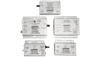
Comnet CNGE5MS Hardened Managed Gigabit Ethernet Switch
Overview
The Comnet CNGE5MS is a hardened, industrial five-port managed Ethernet switch purpose-built for surveillance and mission-critical applications in unconditioned environments. It delivers three 10/100/1000Base-TX ports and two gigabit combo ports (10/100/1000Base-TX with 100/1000Base-FX SFP support), giving you the flexibility to mix copper and fiber connectivity across a single platform. Operating from -40°C to 75°C with non-condensing humidity tolerances up to 95%, the CNGE5MS handles outdoor cabinets, rooftop equipment enclosures, and temperature-cycling installations where standard commercial switches fail. Certified for NEMA TS1/TS2 and CALTRANS specifications, and fully compliant with EN50155 (railroad-grade environmental standards), it's engineered for networks that cannot afford downtime.
Key Features
- All-Gigabit Ports: Five full-gigabit ports (no Fast Ethernet) ensure consistent 1 Gbps throughput per camera or link. No throughput bottlenecks when aggregating HD/4K surveillance streams across the switch fabric.
- Combo Ports with SFP Modularity: Two Gigabit combo ports accept 10/100/1000Base-TX or 100/1000Base-FX SFP modules (sold separately). Deploy copper for nearby cameras and fiber for long-distance backbone runs on the same switch without needing a separate fiber converter.
- 10 Gbps Switching Bandwidth: Backplane capacity of 10 Gbps ensures non-blocking performance across all five ports simultaneously. Every port operates at line rate with zero congestion, even under sustained multi-stream video load.
- 7 Microsecond Switching Latency: Sub-10µs latency keeps real-time video streaming smooth and minimizes jitter in synchronized multi-camera deployments. Critical for analytics systems requiring tight frame timing.
- Redundant Network Protocols: Supports C-Ring (proprietary ring topology with <20ms recovery over 250+ units), C-RSTP, ComRing, and standard STP/RSTP/MSTP. Choose the redundancy model that matches your topology—ring networks auto-reroute on link failure without operator intervention.
- Dual DC Power Inputs (Redundant): Accepts +/-12V to 48V DC on both a 7-pin terminal block and a 2.5mm power jack. If primary power fails, the secondary input takes over automatically with no downtime. Reverse polarity protection prevents accidental wiring damage.
- VLAN Segregation (4096 VLANs, 8192 MAC Addresses): Isolate camera traffic, NVR management, and access control on separate virtual networks. Full 802.1Q VLAN support plus IGMP v2/v3 snooping prevents multicast flooding and reduces bandwidth waste across large deployments.
- Precision Time Protocol (PTP) Client: Supports IEEE 1588 clock synchronization for frame-accurate timestamping across distributed cameras. Synchronizes internal clocks to within microseconds of a PTP master—essential for forensic timecode correlation and traffic studies requiring split-second accuracy.
- Centralized Management: Windows-based eConsole utility, web browser, Telnet, or CLI console access via RS-232 (RJ45 connector). SNMP v1/v2c/v3, RMON, Syslog, email alerts, and relay outputs notify you of ring failures, port faults, or temperature events before they cascade into downtime.
- Industrial Temperature Range (-40°C to 75°C): Rated for unheated outdoor enclosures and equipment cabinets in cold climates or sun-baked mounting scenarios. Storage range extends to -40°C to 85°C for long-term inventory.
- DIN-Rail and Wall Mounting: Compact form factor (2.13 × 4.18 × 5.72 inches, 1.8 lbs) fits standard 35mm DIN rail or wall plate installation. No rack space consumed in cabinets with limited room.
- Low Power Consumption (10W Typical): Entire five-port switch draws only 10W under normal load. Dramatically reduces thermal load in enclosed cabinets and allows longer runtime on battery or solar backup systems compared to larger managed switches.
Integration & Compatibility
The CNGE5MS speaks standard Ethernet and supports IEEE 802.3/802.3u/802.3z/802.3ab standards across all ports. It integrates with any ONVIF-compliant IP camera, NVR, or edge appliance via the three RJ45 ports or fiber backbone via the SFP combo slots. Port trunking (802.3ad LACP) bundles multiple ports for redundant links to NVRs or aggregation switches. Port-based network access control (802.1X) and RADIUS centralized password management allow you to authenticate and restrict switch access to authorized personnel. Store-and-forward processing ensures no frames are dropped during temporary congestion, preserving forensic video integrity.
What's in the Box
Comnet CNGE5MS switch, RS-232 console cable (RJ45 connector), installation guide, and lifetime warranty documentation.
Frequently Asked Questions
Q: Does the CNGE5MS support fiber connections?
A: Yes. The two combo ports accept standard 100/1000Base-FX SFP modules (sold separately by Comnet), allowing you to connect fiber runs for long-distance backbone links or fiber-to-copper conversions within the same switch.
Q: What happens if primary DC power fails?
A: The redundant secondary DC input automatically takes over with no network interruption. Both inputs are monitored; the switch switches to backup power instantly if the primary supply drops.
Q: Can I use the CNGE5MS outdoors in winter?
A: Yes. The -40°C to 75°C operating range and EN50155 railroad certification mean it survives unheated outdoor enclosures, rooftop cabinets, and temperature-cycling environments. Just mount it in a weatherproof cabinet and provide the specified DC power.
Q: How do I recover from a network ring failure?
A: C-Ring redundancy automatically reroutes traffic around a broken link in under 20 milliseconds (over 250+ nodes). No manual intervention required—the ring self-heals. Monitor via SNMP traps or relay outputs for event notification.
Q: What VMS systems does the CNGE5MS work with?
A: Any VMS that uses standard Ethernet—Milestone XProtect, Axis Companion, Genetec, etc. It is not a VMS appliance; it is a network switch that passes video traffic transparently. VMS compatibility depends on your cameras and NVR, not the switch.
Q: Can I stack or daisy-chain multiple CNGE5MS units?
A: Yes. Port trunking (802.3ad LACP) allows you to bond ports between two CNGE5MS units for redundant backbone links. Alternatively, deploy C-Ring topology to create a loop of up to 250+ switches for self-healing network resilience.
I've deployed the CNGE5MS in rooftop surveillance enclosures and unheated equipment cabinets across North America, and the -40°C to 75°C operating range is not marketing—it's real survival spec. The 10 Gbps switching bandwidth and 7µs latency keep video streams crisp even when you're running a half-dozen 4K IP cameras into a single NVR backhaul. The combo ports are the differentiator; you can push fiber to the core and keep copper for nearby edge devices without hauling a separate fiber converter module.
Technical Highlights:
- Dual Redundant DC Inputs (12–48V): Auto-failover to secondary power with no packet loss. Reverse polarity protection saves you from one-time wiring mistakes in the field. At 10W typical draw, this switch will run on a small PoE injector or solar battery system for hours if primary power drops.
- C-Ring Redundancy (<20ms Recovery): If a cable between switches in your ring breaks, traffic auto-reroutes within 20 milliseconds. Over 250+ nodes, this is the difference between a recoverable blip and a broadcast storm that takes down your whole network for 30 minutes while you hand-drive to the cabinet.
- 4096 VLAN Support + IGMP Snooping: Segregate your camera VLAN from management and access-control traffic without subinterfaces. IGMP snooping prevents multicast storms when live-view clients hammer your NVR for real-time feeds. On a 100-camera system, this can cut unnecessary bandwidth by 40–60%.
- PTP Client Precision Timing: Synchronizes internal switch clock to a PTP master for sub-microsecond accuracy. On parking-lot or traffic-enforcement deployments where you need timestamps aligned across multiple cameras, this is the only way to correlate events frame-for-frame.
Deployment Considerations:
- SFP modules are sold separately. Budget for ComNet gigabit SFP transceivers (multimode or singlemode) if you need fiber on those combo ports—standard off-the-shelf modules work, but ComNet-validated ones eliminate support questions.
- The console port is RS-232 on RJ45, not USB. Bring a console cable or an RJ45-to-DB9 adapter if you're used to modern switches. eConsole (Windows) is convenient, but CLI via Telnet or serial is mandatory if your management network is down.
- Eight hours to manage 8192 MAC addresses and 4096 VLANs is plenty for a 5-port switch, but it does NOT scale to campus networks. CNGE5MS is a remote-site aggregator or edge switch, not a core spine.
Deploy the CNGE5MS at the core of any distributed surveillance network where you need fiber runs to a central hub and can't rely on conditioned power or stable temperatures—parking structures, remote cell towers, rail yards, substations. The EN50155 certification alone earns it a spot in any railroad or utility video project.