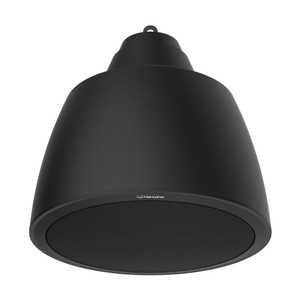
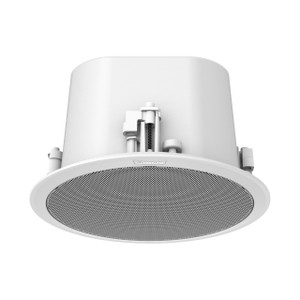
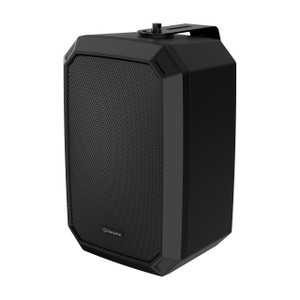
Hanwha SPA-W100W IP Wall Speaker
The Hanwha SPA-W100W is a professional-grade IP wall speaker built for enterprise public address, emergency notification, and security paging in large indoor and semi-outdoor environments. This device bridges traditional PA infrastructure with modern IP networks, allowing integrators to deploy zone-based audio control across dozens of spaces without separate analog amplifiers or wiring runs.
Overview
The SPA-W100W delivers 101 dB SPL (PoE+) or 97 dB SPL (standard PoE) — enough output to cover open warehouse floors, retail zones, or transport terminals without excessive distortion. The dual-driver design (5-inch low-frequency driver + 0.5-inch high-frequency tweeter) ensures intelligible speech across a 180° × 120° horizontal/vertical coverage pattern, critical when audio needs to reach side-mounted walls or overhead zones.
Power comes entirely over Ethernet: PoE or PoE+ via a single cable, which eliminates the need for separate 12VDC supplies or line-level audio runs — a real cost and labor saver on retrofit projects. The onboard 10W Class D amplifier holds THD+N below 0.1%, meaning minimal harmonic distortion even at sustained high volume, which keeps voice announcements crisp and reduces listener fatigue.
Key Features
- Dual PoE power modes (97 dB vs. 101 dB output): Standard 802.3af PoE maxes out at 97 dB; PoE+ (802.3at) unlocks the full 101 dB headroom. Budget-constrained installs can still deploy at lower SPL; high-noise environments (factory floors, transit stations) justify the PoE+ switch upgrade.
- 2-way speaker design with 180° × 120° coverage: The tweeter handles clarity in the speech range (0.5–20 kHz); the woofer anchors low-frequency presence. This split reduces the need for multiple speakers per zone and improves speech intelligibility compared to single-driver boxes.
- SIP/VoIP with up to 256 multicast zones: Instead of unicast streams to individual speakers (which scales poorly), the SPA-W100W joins multicast groups — one network stream reaches 50+ speakers simultaneously, cutting bandwidth and CPU load on your VoIP server by 80–90% in large deployments.
- Multi-source PA control (up to 48 input sources): Route audio from your PBX, VMS, or emergency notification system. Each source can be scheduled or priority-queued, so emergency alerts preempt background music without manual intervention.
- Built-in text-to-speech (English, German, French, Spanish, Russian): Generate dynamic announcements (departure times, alerts, instructions) on-demand without pre-recorded audio files. Reduces storage overhead and deployment lead time for new zones.
- IP54 weatherproof rating: Resistant to direct spray and dust — suitable for covered loading docks, indoor/outdoor transitional spaces, or humid factory floors. True outdoor (IP65–67) use would require an additional protective enclosure, but IP54 handles most semi-protected mounting scenarios.
- 1 GB internal memory + microSD slot (up to 32 GB): Store fallback audio files or custom announcements locally. If network connectivity drops, the speaker can still play pre-loaded emergency messages, a safety margin for mission-critical alert systems.
- Dry contact I/O for security integration: Wire the speaker to your access control, alarm panel, or occupancy sensor. Trigger announcements automatically when motion is detected, a door is forced, or an elevated alert status is activated.
- SUNAPI interface for programmatic control: Integrators can script zone assignments, volume control, and source routing directly into third-party systems (Milestone, Genetec, custom Python/Node.js stacks), avoiding manual configuration for large multi-tenant or modular deployments.
- SHA-2 encrypted password protection with user roles: Admin, setup, user, and guest accounts enforce access control. Digest authentication and per-user logging track who modified zone settings, satisfying audit trails in healthcare, financial, and government facilities.
- Frequency response 120 Hz–20 kHz (−10 dB); S/N ratio >91 dB (A-weighted): The lower 120 Hz floor means bass-heavy announcements don't lose definition. SNR >91 dB ensures quiet spaces hear announcements without speaker hiss or background noise floor becoming noticeable.
Integration & Compatibility
The SPA-W100W operates as a standard SIP endpoint and supports Asterisk, Grandstream, Yealink, and Cisco PBX systems out of the box. IPv4 networking (DHCP or static), HTTP/mDNS discovery, NTP time sync, and UDP/TCP transport make it plug-compatible with most enterprise VoIP stacks. Audio formats (WAV, MP3 at 16–48 kHz, 64–320 kbps) are widely supported, so legacy audio libraries rarely require transcoding. If you're already running an Hanwha IP camera system with a networked VMS, adding the SPA-W100W integrates cleanly via the same network path.
Operating temperature range −20°C to +50°C and humidity up to 85% (non-condensing) means cold warehouse loading docks, hot retail stockrooms, and humid manufacturing floors all stay within spec. EMC compliance (KS C 9832/9835, EN 55032/55035, FCC Part 15) and safety certifications (KC/UL/CAN CSA 62368-1) satisfy most North American and European installations.
When to Choose a Different Model
If your deployment requires true outdoor (fully exposed to rain and direct sun), evaluate higher IP-rated variants in the Hanwha PA lineup or consider external weatherproof enclosures for the SPA-W100W. For single-room or low-zone-count scenarios where analog amplifiers are already installed, retrofit costs may favor keeping legacy PA infrastructure rather than network migration. If you need sub-100 Hz bass extension for music distribution (not speech), consult a larger or powered subwoofer-paired solution.
Frequently Asked Questions
Q: Does the SPA-W100W require PoE+ or can I use standard PoE?
A: Standard 802.3af PoE (Class 4, ~13W) powers the speaker at 97 dB SPL. PoE+ (802.3at, ~25W) unlocks the full 101 dB capability. If your network switch has available PoE+ ports, use it for maximum headroom in noisy environments. Standard PoE is sufficient for lower-volume applications.
Q: How many zones can I control simultaneously?
A: The SPA-W100W supports up to 256 zones via multicast group assignment. A single audio stream can reach all speakers in a zone without overwhelming your network, unlike unicast which would require one stream per speaker.
Q: Is the SPA-W100W suitable for outdoor use?
A: IP54 rating handles semi-protected mounting (covered docks, transitional indoor/outdoor spaces, humid factory floors). For fully exposed outdoor installation (direct rain, continuous sunlight), use an external protective enclosure or consider a higher IP-rated speaker variant.
Q: Can I integrate the SPA-W100W with my existing Grandstream or Cisco PBX?
A: Yes. The SPA-W100W registers as a SIP endpoint and works with Asterisk, Grandstream, Yealink, and Cisco systems. It requires network access and valid SIP credentials configured during provisioning.
Q: What formats does the SPA-W100W support for stored audio files?
A: WAV and MP3 (16–48 kHz sampling, 64–320 kbps bitrate). Most modern audio tools (Audacity, ffmpeg) export to these formats without issue.
Q: Can I trigger announcements from my security system or VMS?
A: Yes, via dry contact inputs/outputs and SUNAPI programmatic interface. Wire a relay from your alarm panel to the speaker's dry input, or use your VMS API to call SUNAPI endpoints for dynamic announcements tied to motion detection or alerts.
Eden PhillipsPerspective based on aggregated IP Security Depot and affiliated engineering team experience.
The SPA-W100W is purpose-built for IT and security integrators rolling out enterprise-scale IP audio without ripping out analog PA wiring. Its dual PoE power modes (97 dB standard, 101 dB with PoE+) give you flexibility: start lean on a crowded switch, upgrade selectively to PoE+ for high-demand zones. The 256-zone multicast control is the real win — one network stream services dozens of speakers, cutting server CPU and bandwidth overhead by 80–90% compared to unicast PA systems.
Technical Highlights:
- Dual-driver 2-way design (5-inch LF + 0.5-inch HF): Passive architecture means fewer internal components to fail, longer mean time between service calls, and superior speech intelligibility compared to single-driver alternatives. Frequency response from 120 Hz ensures low-frequency announcements don't lose definition.
- 10W Class D amplifier with THD+N <0.1%: Very low distortion at sustained high volume. Voice announcements stay clear even at 101 dB, reducing listener fatigue and improving comprehension in noisy spaces.
- 1 GB internal storage + 32 GB microSD slot: Pre-load emergency announcements and fallback audio. If the network goes down, critical alerts still play locally — a practical safety margin for life-safety applications.
- Multi-source PA (48 input sources) with scheduling: Route audio from PBX, VMS, security console, or weather alerts. Each source can be priority-queued, so emergency messages preempt background music automatically without manual intervention.
Deployment Considerations:
- IP54 rating covers semi-exposed mounting (covered loading docks, indoor/outdoor transitions, humid factory floors), but true outdoor use (persistent rain, direct sun) requires an external protective enclosure. Plan accordingly on retrofit projects.
- PoE power budget: Standard PoE (~13W) is sufficient for 97 dB operation; PoE+ (~25W) unlocks full 101 dB headroom. Audit your switch capacity before specifying hundreds of units — PoE+ deployments on older infrastructure may require a switch upgrade.
- Multicast routing requires network engineering: if your LAN uses strict IGMP snooping or firewalled VLAN boundaries, multicast groups may not traverse zone boundaries. Test multicast propagation in your environment before finalizing large-scale zone architecture.
The SPA-W100W is a solid anchor for VoIP/PA convergence projects in warehouses, retail chains, healthcare campuses, and transit facilities where you want to migrate from isolated analog PA to centralized IP audio control. Its SUNAPI interface and dry contact I/O integrate cleanly into security automation workflows — particularly valuable when audio announcements need to trigger automatically on alarm events or occupancy changes.