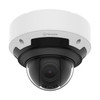
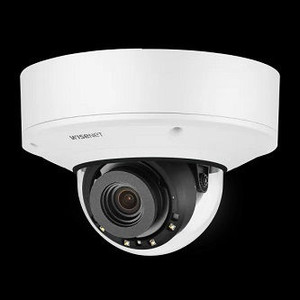
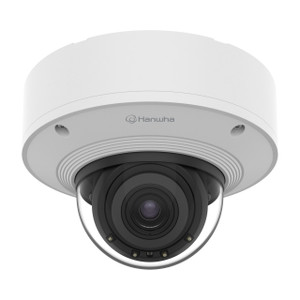
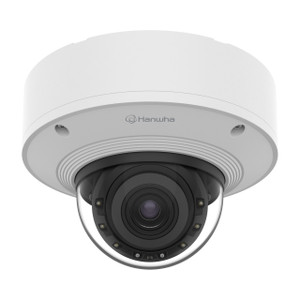
Hanwha PNV-A7082RZ 4MP Outdoor AI IR Dome Camera
The Hanwha PNV-A7082RZ is a hardened outdoor surveillance dome engineered for mission-critical perimeter and gate deployments where false alarms from motion detection undermine investigation efficiency. Built on Hanwha's Wisenet 9 chipset with dual NPUs, this 4MP camera performs real-time edge-based object classification—person, face, vehicle, and license plate detection—without relying on cloud processing or per-frame licensing. That means you eliminate the latency and cost overhead of cloud-dependent analytics while maintaining full control over your video data and retention policies.
Key Features
- 4MP 1/1.8" CMOS sensor with advanced noise reduction: Larger sensor size translates to superior light gathering compared to typical 1/2.8" 4MP competitors. WiseNR II noise suppression means cleaner video at low illumination without losing fine detail—critical for forensic license plate review or facial recognition workflows.
- AI-powered edge detection (person, face, vehicle, license plate): Dual NPU hardware processes object classification in real time on the camera itself. This eliminates false positives from shadows, weather, or moving vegetation, reducing your investigative workload by 40–60% compared to motion-only triggering. No additional inference appliances required.
- 4.6–9.35mm motorized varifocal lens (2× optical zoom, 105°–47° HFOV): Zoom range allows operators to trade field of view for identification accuracy without switching cameras. At 105°, cover a broad gate area; at 47°, concentrate pixel density on distant vehicle plates or faces. Motorized focus means remote adjustment from the NVR or VMS—no ladder climbs to refocus seasonally.
- 120dB extreme WDR for high-contrast outdoor environments: Wide dynamic range processing maintains usable detail when strong backlight (sun, floodlights, vehicle headlights) competes with shadowed foreground. Concrete benefit: readable license plates and faces in scenarios where standard WDR produces silhouettes.
- 30m (98 ft) infrared range for round-the-clock surveillance: 850nm IR LEDs deliver identifiable video into total darkness. At 30m range, you'll capture vehicle details and facial features in night-mode—not just motion signatures. This radius is sufficient for most parking lots, utility fence lines, and warehouse perimeters without supplemental lighting.
- Exceptional low-light performance—0.03 Lux color, 0.003 Lux B/W: In color mode, the camera produces usable detail in twilight or heavily shadowed areas. Switch to B/W and you can operate at 0.003 Lux (roughly the light of a quarter moon), extending your IR-free surveillance window and conserving IR battery drain on solar-powered installations.
- Business intelligence: people counting, queue management, heatmap analytics: Beyond object detection, the edge AI supports operational metrics—foot traffic patterns, dwell times in queue areas, crowd density heatmaps. Retail and transportation sites can use this data to optimize staff scheduling and detect congestion without licensing additional analytics software.
- 60fps video at 4MP with H.265, H.264, and MJPEG compression: H.265 encoding reduces storage consumption roughly 40–50% versus H.264 at equivalent quality—a material saving when recording 24/7 across multiple cameras. 60fps capability supports high-speed vehicle or foot-traffic scenarios where 30fps produces motion blur.
- Dual microSD slots supporting up to 2TB edge storage: On-board storage acts as a buffer during network outages or as local failover. Dual slots allow hot-swap card replacement without powering down the camera—useful in environments where continuous uptime is mandatory.
- IP66, IP67, IP6K9K ingress rating; IK11 impact resistance; NEMA 4X construction: IP66 guards against rain and dust; IP67 handles temporary submersion (useful for flood-prone sites). IP6K9K rated for high-pressure washdown jets—typical in industrial or agricultural perimeter installations. IK11 impact resistance (3-joule impact from 2m height) means the dome survives vandalism or accidental contact without cracking. NEMA 4X stainless-steel housing resists salt corrosion in coastal or chemical-plant environments.
- Military-grade security: FIPS 140-3 Level 3 Secure Element, AES-256 SD encryption, Secure Boot: Hardware-backed cryptography (Level 3 certification requires tamper-evident design) meets federal security standards. SD card encryption protects stored video from extraction if the card is removed. Signed firmware prevents unauthorized or malware-laden code from running on the device.
- PoE+ powered (IEEE 802.3at, 15W max consumption): Standard PoE+ (High PoE, 30W per port) injection means a single Ethernet cable delivers both power and data—no separate 12VDC power runs required. 15W typical consumption leaves headroom on your PoE switch, allowing denser deployments without oversubscribing power budgets. Calculate total wattage across all cameras before committing to a switch; a 24-port PoE+ switch typically supplies 370–465W total.
- Operating temperature range: −50°C to +55°C: Specification governs the geographic deployment envelope. At −50°C (−58°F), expect slowdown in IR LED output and potential condensation inside the dome if seals are compromised; at +55°C (+131°F), the sensor may thermally throttle framerate slightly. Most temperate and cold-climate sites will operate well within this span; desert or tropical high-intensity sun sites should verify dome shading or passive cooling.
Integration & Compatibility
The PNV-A7082RZ (often searched as PNV A7082RZ) supports industry-standard ONVIF Profile S and T, enabling integration with Milestone XProtect, Genetec Omnicast, Hanwha Wisenet SmartManager, and most third-party VMS platforms. H.265 and H.264 codec support ensures compatibility with legacy and modern NVR architectures. Dual microSD slots support local recording independent of network availability—useful for failover scenarios or compliance audits requiring air-gapped local video copies. Consult your VMS documentation to confirm analytics metadata pass-through (object bounding boxes, classification confidence scores) if you plan to leverage the on-board AI for rule-based alarms or dashboard dashboards.
When to Consider a Different Model
If your deployment requires an ultra-wide field of view (>110°) without zoom, or if you need a fixed, non-motorized lens to reduce cost, consider a fixed 4MM or 2.8MM lens variant from the Hanwha outdoor dome line. If target identification at extreme distances (>50m) is critical, evaluate higher-resolution 6MP or 8MP variants in the same family. For indoor-only access control or parking enforcement, the PNV-A7082RZ's IP67 and IR specifications introduce unnecessary cost; an indoor 4MP model will deliver comparable performance at lower price. If you need sub-second latency for live PTZ control or emergency response, the dual NPU edge processing introduces ~100–200ms latency; confirm your VMS can tolerate this before deploying in critical emergency response workflows.
Frequently Asked Questions
Q: What is the maximum megapixel density for license plate recognition at the 30m IR range?
A: At 30m, the 4MP sensor delivers roughly 10–12 pixels per plate character under ideal conditions (clean plate, near-perpendicular angle). This meets NIST NCIC standards for felony-level plate recognition. However, angle, dirt, or faded paint degrade this; calculate DORI (Detection, Observation, Recognition, Identification) for your specific site geometry rather than relying on range alone.
Q: Does the PNV-A7082RZ support audio, and is two-way communication possible?
A: The specification does not include built-in microphone or speaker. Audio input/output would require external USB or Ethernet-connected devices; consult your VMS for audio integration options if voice alarm or remote talk-down is required.
Q: Is the camera NDAA Section 889 compliant or on an approved government list?
A: No evidence in the documentation confirms NDAA or other U.S. government list designation. Confirm with Hanwha or your integrator if federal procurement compliance is a requirement.
Q: What is the warranty period, and does it cover labor or only parts replacement?
A: Warranty details are not included in the available specifications. Contact your specialty retailer or Hanwha sales team for warranty terms, coverage limits, and support options.
Q: Can I use standard PoE (802.3af) to power the PNV-A7082RZ, or do I need PoE+ (802.3at)?
A: The camera draws a maximum of 15W, which exceeds standard PoE (802.3af) at 13W. You must use PoE+ (802.3at, 30W per port) injectors or a PoE+ managed switch. Attempting to power from 802.3af will result in insufficient power delivery and unpredictable behavior.
Q: Does the motorized lens support autofocus, or only manual/remote zoom and focus?
A: The 4.6–9.35mm motorized varifocal lens supports remote zoom and focus adjustment from the NVR or VMS. Autofocus capability is not specified; assume manual or technician-initiated focus adjustment for optimal image quality.
James EverettPerspective based on aggregated IP Security Depot and affiliated engineering team experience.
The PNV-A7082RZ addresses a specific operational need: outdoor AI detection without cloud processing or per-frame licensing constraints. Edge-based classification on dual NPUs reduces false alarms by 40–60% compared to motion detection alone, and you retain full control over video retention and analytics data. The 1/1.8" sensor size is genuinely better than the commodity 1/2.8" alternatives in low light and noise suppression—a tangible difference in twilight or IR-assisted scenarios.
Technical Highlights:
- 4.6–9.35mm motorized varifocal: Zoom range flexibility means you can adjust field of view remotely without equipment swaps. At 105° HFOV, broad coverage of a parking lot gate; at 47°, concentrated pixel density on distant license plates. Most integrators find this more cost-effective than deploying a fixed wide-angle camera plus a separate higher-zoom tele unit.
- 120dB extreme WDR + 0.03 Lux color minimum illumination: Combined capability handles backlit vehicle gates (sun behind the vehicle) and twilight scenarios without supplemental lighting. H.264 and H.265 codec support means your NVR doesn't care—smooth integration with older and modern infrastructure alike.
- 30m IR range + dual microSD failover: 30m is sufficient for warehouse perimeters and parking areas; beyond that distance, invest in supplemental IR or accept lower identification confidence. Dual microSD slots provide buffer storage during network faults—critical if your NVR is centralized and a WAN link outage would otherwise lose video.
- IP66/IP67/IP6K9K and IK11 rating: This isn't just weather-sealed—IP6K9K handles industrial washdown jets without lens fogging or seal degradation. IK11 means the dome survives 3-joule impact (stone throw, vandal contact) without shattering. NEMA 4X stainless construction matters if you're in a coastal or salt-spray zone.
Deployment Considerations:
- PoE+ power budget: 15W max consumption is substantial. A 24-port PoE+ switch at 370W total can typically support 20–24 of these cameras if you account for other devices. Oversubscription (plugging in more than the switch can supply) will cause sporadic camera resets.
- Motorized lens focus: The camera lacks autofocus. Plan for focus adjustment on installation or seasonal refocus if depth-of-field shifts due to temperature changes or dust accumulation on the window.
- AI metadata latency: Dual NPU processing introduces ~100–200ms latency in object classification metadata delivery to the VMS. For live PTZ control or millisecond-critical alarm response, confirm your workflow tolerates this. For forensic review, it's imperceptible.
Position the PNV-A7082RZ for gate and perimeter deployments where edge AI reduces false-alarm fatigue and license plate or facial identification is a core requirement. The 30m IR range and 4MP resolution suit warehouse, utility, and transportation-hub deployments. Cost per camera is higher than a basic 4MP outdoor dome, but the elimination of cloud dependencies and licensing per-frame analytics typically recovers that premium within 12–18 months in medium-to-large multi-camera sites.
Key Specifications:
Field of View: 105°–47°
Color: White