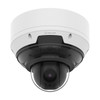
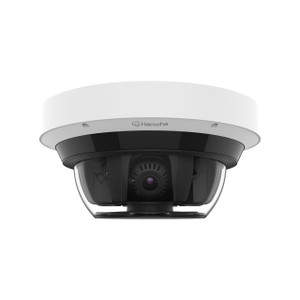
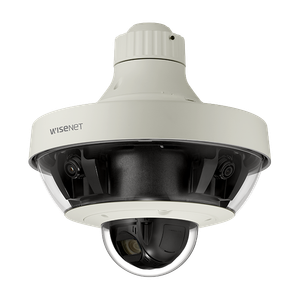
Hanwha PNM-C19183RVTP 5MP Multi-Channel Outdoor AI PTZ Camera
The PNM-C19183RVTP is a hybrid outdoor PTZ network camera that eliminates the traditional trade-off between panoramic coverage and investigative detail. This single mounting point solution pairs three fixed 5MP channels with a dedicated 4MP PTZ module, delivering wide situational awareness alongside magnified inspection capability—meaning you deploy one device instead of four, reducing cabling runs, switch port consumption, and integration complexity.
Key Features
- Three fixed 5MP channels at 30 fps: Each channel delivers a 123° ultra-wide horizontal field of view, covering large perimeter areas with minimal blind spots. Ultra-wide lenses minimize the need for overlapping coverage or additional cameras across parking lots, courtyards, or building facades.
- Dedicated 4MP PTZ module with 18× optical zoom: Operators can pivot, tilt, and zoom to inspect distant events in real time or during forensic review—license plates, facial features, or asset details become legible without losing the panoramic context from the fixed channels.
- 120 dB wide dynamic range (WDR): High-contrast outdoor scenes—bright sky against dark building shadows, direct sun glint on vehicle windows—render usable detail across the entire frame. No more washed-out highlights or crushed shadows in mixed-lighting deployments.
- Integrated IR illumination to 15 m (49 ft): Extends visibility into low-light and complete darkness without external lighting. Useful for 24/7 perimeter monitoring or after-hours facility surveillance where ambient light drops to near zero.
- Edge-based AI with classified object detection: On-camera processing identifies people, faces, vehicles, and license plates with attribute analysis—vehicle type, color, clothing color. No external analytics server required. Bandwidth and latency constraints won't delay threat detection.
- H.265 compression and WiseStream III optimization: Cuts storage and bandwidth requirements roughly 40–60% compared to H.264 across 24/7 recording. Critical when managing dozens of multi-channel PTZ devices or working within constrained network budgets.
- Business intelligence analytics: People counting, vehicle counting, queue management, and heatmap visualization allow facility managers to derive operational insights—identify congestion points, peak traffic times, asset concentration areas—without hiring external analytics consultants.
- IP66 outdoor construction: Direct rain and dust ingress won't degrade performance. Not rated for full submersion (that requires IP67 or higher), but suitable for exposed outdoor mounting in temperate and tropical climates.
- PoE++ (802.3bt) power delivery: Draws power from a single network cable. PoE++ switches are now standard in mid-range and enterprise deployments, so no separate 12VDC or 24VAC power runs are needed.
- microSD card local storage up to 512 GB (2 cards supported): On-device recording provides failsafe backup when network connectivity drops. Two card slots allow redundancy or extended retention without external NVR dependency.
Integration & Compatibility
The PNM-C19183RVTP supports ONVIF Profile S and T, enabling integration with most mainstream network video management systems and ONVIF-compliant VMS platforms. Edge AI processing occurs locally on the camera—no ACAP or plug-in architecture is required. For deployments relying on bandwidth-constrained or high-latency networks, edge analytics reduce dependency on external servers and improve real-time response times.
Typical Deployment Scenarios
- Large outdoor retail and commercial properties: Parking lots and entry courtyards benefit from the fixed channels' panoramic coverage; the PTZ zoom capability investigates theft, vehicle damage, or incidents in detail without installing separate cameras.
- Industrial and manufacturing facilities: Perimeter surveillance and outdoor asset monitoring benefit from the hybrid approach—overview coverage identifies anomalies; PTZ zoom allows operators to confirm details before dispatching security personnel.
- Transportation hubs and traffic management: License plate capture and vehicle classification occur at the edge; cloud-side analytics or law enforcement queries benefit from forensic zoom capability without requiring separate LP recognition cameras.
- Critical infrastructure and secure compounds: 24/7 monitoring with integrated IR extends surveillance into night hours. Classified object detection and intrusion monitoring reduce false positives compared to simple motion detection.
Frequently Asked Questions
Q: Can the PNM-C19183RVTP record all four channels (three fixed + PTZ) simultaneously at full resolution?
A: Yes. The camera records all three 5MP fixed channels and the 4MP PTZ module concurrently at 30 fps, delivering four independent video streams. Bandwidth and storage capacity depend on compression settings and retention policy, but the hardware supports full simultaneous capture.
Q: Does edge AI processing reduce bandwidth compared to transmitting raw video to a cloud or NVR-based analytics platform?
A: Significantly. Classified object detection, people counting, and license plate attributes are computed on the camera itself. Only metadata tags and optional event-triggered full-resolution clips are sent upstream, cutting typical bandwidth consumption by 60–80% versus continuous 5MP streaming. WiseStream III further optimizes by reducing bitrate on low-motion areas.
Q: What is the warranty coverage on the PNM-C19183RVTP?
A: Refer to the manufacturer's warranty documentation or contact an authorized Hanwha Vision distributor for specific terms and conditions. Standard Hanwha IP camera warranties typically cover hardware defects; check with your supplier for extended coverage options.
Q: Is the PNM-C19183RVTP NDAA Section 889 compliant?
A: Hanwha Vision products are subject to U.S. export control regulations. Confirm compliance status with your procurement team and an specialty distributor before deployment in federal or defense applications.
Q: What is the maximum pan/tilt speed of the PTZ module, and can operators control it remotely?
A: The PTZ module delivers 18× optical zoom capability and can be controlled via ONVIF-compliant VMS platforms, third-party control software, or integrated camera management interfaces. Exact pan/tilt speed and acceleration profiles are documented in the manufacturer's datasheet; consult technical documentation for preset speeds and acceleration ramps.
Q: Can the two microSD card slots be configured for redundancy or extended storage?
A: Yes. Two independent 512 GB microSD cards allow operators to configure primary + backup recording, or use both slots for extended retention. Consult the camera's management interface or technical documentation for specific slot configuration options.
James EverettPerspective based on aggregated IP Security Depot and affiliated engineering team experience.
The PNM-C19183RVTP solves a genuine operational headache: the traditional choice between wide panoramic coverage and investigative zoom detail. Most outdoor deployments force you to choose—either install multiple fixed 4MP or 5MP cameras with overlapping coverage to cover a parking lot, or add a separate PTZ for detail shots. The PNM-C19183RVTP (often searched as PNM C19183RVTP) compresses this into a single device: three fixed 5MP channels deliver 123° ultra-wide coverage per channel, while the dedicated 4MP PTZ with 18× optical zoom handles forensic investigation or real-time incident response. One mounting point, one cable run, one switch port instead of three or four.
Technical Highlights:
- 120 dB wide dynamic range: High-contrast outdoor scenes render detail across the entire tonal range—no more choosing between blown-out sky and crushed shadows. Critical for perimeters where direct sun and building shadow contrast exceeds 100:1 ratio.
- H.265 with WiseStream III: Reduces bandwidth and storage footprint by 40–60% versus H.264. Real number: a 24/7, four-channel deployment cuts monthly storage from ~4 TB to ~1.6–2.4 TB. Meaningful on multi-camera systems where NVR storage scales linearly.
- Edge AI with classified object detection: People, faces, vehicles, license plates, and attributes (vehicle type, color, clothing) are detected on-camera. No external analytics server dependency—latency drops, processing continues even if network bandwidth tightens.
- IR illumination to 15 m (49 ft): Extends coverage into night hours without external lighting infrastructure. For 24/7 outdoor monitoring, this eliminates the cost and installation complexity of auxiliary light sources.
Deployment Considerations:
- Four simultaneous streams require network planning: Three 5MP fixed channels + one 4MP PTZ at 30 fps, H.265-compressed, still consume bandwidth. At typical compression ratios, expect 4–8 Mbps combined. Ensure your network backbone and switch uplink support this. Edge recording via dual microSD cards (512 GB each) provides failsafe backup when the network drops.
- PTZ zoom is optical, not digital: The 18× zoom is real magnification—no interpolation artifacts. But tight framing of distant subjects (vehicle plates at 50+ meters) depends on lighting, sensor sensitivity, and atmospheric clarity. In haze or heavy backlight, even optical zoom won't recover detail that wasn't captured by the sensor.
- IP66, not IP67: Suitable for exposed outdoor mounting—rain, dust, and wind are no issue. But full submersion (if the camera is mounted near or below water level) requires IP67 or higher. Confirm mounting location before ordering.
Deploy this model when you need full-scene situational awareness plus investigative detail without multiplying camera count, cabling, and management overhead. Parking lots, building perimeters, transportation hubs, and outdoor asset monitoring all benefit from the hybrid architecture. If your brief is purely fixed wide coverage with no zoom requirement, a simpler multi-sensor or panoramic camera may be more cost-effective. If zoom alone is the priority, a dedicated PTZ might be lighter. But when you need both in one box, the PNM-C19183RVTP eliminates the typical trade-off.
Key Specifications:
Color: White