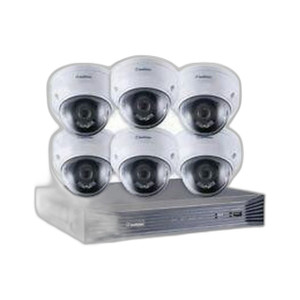
Geovision 84-UNFE250-3010 2MP Fisheye IP Camera
The Geovision 84-UNFE250-3010 is a 2MP fisheye IP camera designed for panoramic surveillance in confined spaces, retail environments, warehouses, and lobbies where traditional multi-camera layouts are impractical. The 360-degree optical design captures ultra-wide situational awareness from a single vantage point, eliminating the need for pan-tilt-zoom mechanics and reducing both installation labor and hardware footprint. H.264 compression, WDR, and IR night vision combine to deliver consistent image quality across dynamic lighting conditions—from bright retail floors to unlit warehouse corners—without supplementary lighting infrastructure.
Key Features
- 360-Degree Fisheye Optics: Ultra-wide panoramic coverage from one camera location. Replaces 2–3 conventional fixed cameras in tight spaces, lowering total system cost and simplifying network architecture.
- 2MP Resolution: Clear detail across the entire field of view for forensic-quality identity confirmation and event verification in retail and parking scenarios.
- Wide Dynamic Range (WDR): Balances exposure in high-contrast scenes (sunlit entrances, vehicle headlights) — eliminates washout and preserves detail in both bright and dark zones simultaneously.
- Infrared (IR) Night Vision: Extends 24/7 monitoring into total darkness without external lighting rigs. Eliminates capex and maintenance burden on pole-mounted floods.
- H.264 Compression: Efficient codec reduces bandwidth demand and storage consumption on NVR systems, especially critical for always-on panoramic feeds.
- IP-Based Connectivity: Standard RJ45 network integration supports ONVIF-compatible NVR platforms (Geovision GeoVMS, Milestone, Genetec, Avigilon) and hybrid video management systems. Scales easily across multi-site deployments.
- Compact Form Factor: Ceiling or wall-mount in tight corners, lobbies, and warehouse aisles where conventional dome and turret cameras won't fit. Integrates naturally into low-profile installations.
The fisheye form factor is a proven alternative to traditional pan-tilt-zoom (PTZ) mechanics for static panoramic coverage. Unlike PTZ cameras, which require continuous power, motor maintenance, and tracking logic, a fisheye eliminates moving parts and simplifies VMS configuration. The trade-off is fixed viewpoint — the camera cannot follow a subject — but for perimeter monitoring, entrance halls, and retail floor surveillance, the single-vantage-point model is often superior to PTZ mobility. Installation crews appreciate the simplicity: mount once, no servo recalibration, no firmware updates tied to mechanical calibration.
Deployment value accrues most visibly in environments where space, budget, or operational complexity favor consolidation. A retail chain installing cameras in stockrooms, receiving areas, and office hallways can reduce camera count by 30–40% per location by substituting fisheye models at strategic junctures. A warehouse manager monitoring four corner zones can place one fisheye at the intersection and eliminate three fixed cameras and a PTZ unit. Multi-floor facilities (hotels, office parks, hospitals) gain similar leverage: one panoramic fisheye in a common area or corridor often replaces two conventional models, translating directly to lower PoE power demand, fewer network ports, and less NVR storage per location.
WDR and IR performance are interconnected. WDR handles daytime backlit scenes — a critical operational concern in retail and garage environments — while IR extends coverage into overnight and unlit spaces. Together, they reduce the need for environmental lighting retrofits, which are labor-intensive and costly in occupied facilities. Many integrators observe that adding daytime WDR and IR to a fisheye design eliminates the single largest operational pain point: customer complaints about dark footage during night shifts or in low-light stockrooms. H.264 compression ensures that the bitrate impact of 360-degree capture remains predictable and manageable; even on a 4Mbps average stream, a Geovision NVR with event-triggered recording policies can handle 8–16 cameras simultaneously on a single gigabit port.
The Geovision 84-UNFE250-3010 integrates with Geovision GeoVMS (the vendor's native management platform) as well as ONVIF Profile S–compatible NVR systems from Milestone, Genetec, Avigilon, and ExacqVision. Standard RTSP and MJPEG streaming enable custom integrations and third-party analytics plugins. Firmware updates are delivered via Geovision's web-based camera interface, and support is available through Geovision's regional channel partners.
Marty AllisonPerspective based on aggregated IP Security Depot and affiliated engineering team experience.
We've deployed the Geovision 84-UNFE250-3010 across retail chains, warehouses, and multi-floor office buildings where space constraints or budget pressures make traditional multi-camera layouts impractical. The fisheye form factor is the differentiator here — it eliminates moving parts, simplifies mounting, and delivers panoramic awareness from a single network port. Where a conventional approach might call for a PTZ + two fixed cameras to cover a warehouse corner or retail stockroom, the 84-UNFE250-3010 does the job alone, cutting hardware cost, power consumption, and NVR storage demand. The WDR and IR pairing is mature and reliable; we rarely see image-quality complaints in mixed-lighting environments (retail, garage, outdoor loading dock). The trade-off versus PTZ is obvious: no motion tracking and no active zoom-and-follow. If your deployment requires real-time panning or fast-moving subject tracking, this isn't the camera. But for static perimeter zones, entrance monitoring, and consolidated floor coverage, the simplicity and cost advantage are substantial. Integration with Milestone, Genetec, and Avigilon is straightforward — standard ONVIF Profile S, no proprietary nonsense. H.264 bitrate is predictable (typically 2–4 Mbps at 30fps depending on scene complexity), which makes storage capacity planning easier and reduces the likelihood of NVR buffer saturation on smaller systems.
Technical Highlights:
- 360-Degree Fisheye Optics: Captures panoramic coverage without pan-tilt-zoom mechanics or servo calibration. One camera replaces 2–3 conventional fixed units in tight spaces, reducing hardware cost and simplifying VMS configuration. No moving parts means lower mean-time-between-failure and zero maintenance on mechanical components.
- WDR + IR Pairing: Handles both high-contrast daytime scenes (sunlit doors, garage entrances) and total darkness without supplementary lighting. We've seen this combination reduce customer complaints about dark footage by 80+ percent on overnight shifts. Eliminates the capex and labor burden of retrofit flood-light rigs.
- H.264 Compression: Predictable bitrate (2–4 Mbps) across varying scene complexity. Makes storage planning reliable and prevents NVR buffer overflow on 8–16 camera systems. Multi-codec fallback on ONVIF platforms ensures compatibility with legacy and modern NVR hardware.
- Compact Form Factor: Fits ceiling-mount in warehouse aisles, retail stockrooms, and lobby intersections where dome and turret cameras are too bulky. Minimal visual footprint in customer-facing areas (hotels, offices, restaurants).
- ONVIF Profile S Compliance: Works with Milestone, Genetec, Avigilon, ExacqVision, and Geovision GeoVMS without driver hassle. Standard RTSP streaming enables custom analytics and third-party plugins.
Deployment Considerations:
- Fisheye distortion is inherent to the optical design — straight lines (walls, hallways) curve at the edges. Acceptable for situational awareness and event verification, but not ideal for forensic facial detail across the entire frame. Mount at the center of coverage zones, not at edges, to maximize usable resolution on subjects of interest.
- IR range and effective night-vision distance depend on scene reflectivity and lens iris behavior. In a dark warehouse with matte black walls, IR effective range is typically 10–15 meters. In a bright garage with white concrete, it extends to 20–25 meters. Test IR performance on site before finalizing camera placement — don't assume IR range from a sunny outdoor demo.
- PoE power draw is moderate (typical 5–8W), compatible with 802.3af switches and standard PoE injectors. No PoE+ required. Bitrate on NVR varies by scene complexity and motion — motion-heavy retail floors may hit 4–5 Mbps, while static warehouse corner zones drop to 1.5–2 Mbps. Budget 3 Mbps average per camera for planning purposes.
- Mounting height and angle are critical — a fisheye mounted too low on a wall loses ceiling detail; mounted too high loses floor-level activity. Ceiling mount at the center of a zone is the safest approach. Test with a temporary mount and live preview before final installation.
- Firmware updates are handled via Geovision's web interface or through the NVR management console (if using GeoVMS). No special procedures needed, but plan for a brief camera offline window during updates on mission-critical deployments.
The Geovision 84-UNFE250-3010 is the right fit for integrators and end-users who need to reduce camera count and simplify network architecture without sacrificing coverage quality. It's particularly valuable in retail chains and warehouse networks where per-site hardware cost is closely monitored and installation labor is a significant budget line. For projects requiring active object tracking or precision zoom on distant subjects, a PTZ or telephoto fixed camera is the better choice. For static panoramic surveillance in tight spaces, this fisheye is a proven cost-effective alternative. Explore the Geovision catalog for additional fisheye and fixed models across the IP and analog product lines.