
Outdoor Camera Enclosure and Housing Buyer's Guide
Outdoor camera enclosures and housings protect cameras from water, dust, vandalism, and temperature extremes while preserving the camera's image quality and IR illuminator performance. This guide covers IP ratings, NEMA classifications, heater and blower requirements, and the difference between camera-specific enclosures and electrical boxes.
- IP67 is the minimum for outdoor; IP68 or IP69K for wash-down and pressure-spray environments
- Heaters are required wherever temperatures drop below -10C; blowers help in humid climates
- Vandal-resistant IK10 enclosures are standard for ground-level and reachable mounts
- NEMA 4X enclosures handle salt spray and chemical exposure for coastal and industrial use
IP, IK, and NEMA ratings explained
IP, IK, and NEMA ratings are all stamped on enclosure spec sheets. Quick reference:
| Rating | Means | When to use |
|---|---|---|
| IP65 | Dust-tight, low-pressure water jets | Covered eaves, sheltered overhangs |
| IP66 | Dust-tight, powerful water jets | Standard outdoor mounts |
| IP67 | Dust-tight, immersion to 1m | Default for outdoor cameras |
| IP68 | Dust-tight, continuous immersion | Submersion or sustained wash |
| IP69K | Dust-tight, high-pressure hot water | Food processing, transit washbays |
| IK08 | Impact 5J | Indoor reachable mounts |
| IK10 | Impact 20J | Outdoor and parking-deck mounts |
| NEMA 4X | Corrosion-resistant outdoor | Coastal, chemical, marine |
| NEMA 12 | Indoor industrial, oil-tight | Manufacturing floor |
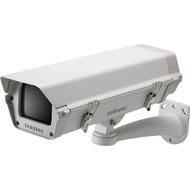
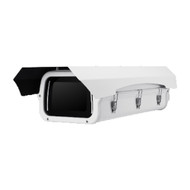
Recommended outdoor camera enclosures
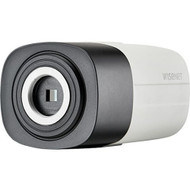
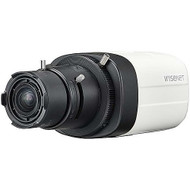
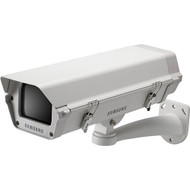
Cameras with built-in outdoor housing
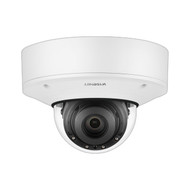
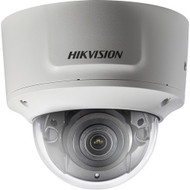
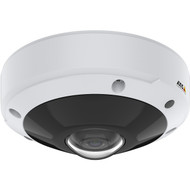
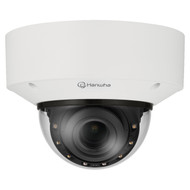
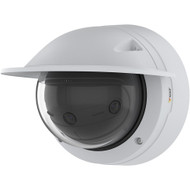
Dome cameras with integrated outdoor enclosures (no separate housing needed):
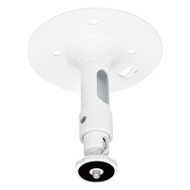
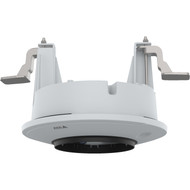
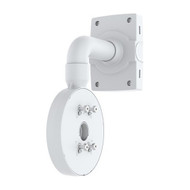
Mounts and brackets
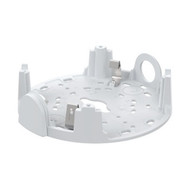
Mounts and brackets often paired with outdoor enclosures:
Heaters, blowers, and condensation
Heaters, blowers, and condensation control
Camera enclosures fail more often from condensation than from cold itself. The classic failure modes:
- Internal condensation on the camera lens. Caused by temperature differential between camera body and outside air. Fix: heater + sealed gasket.
- External fog on the window. Caused by humid morning air on a cooled glass. Fix: blower or heated window.
- Ice buildup on dome or window. Heater on the window itself is the only reliable solution.
- Sun glare and reflection. Sunshields and visors mitigate this — never let direct sun hit the lens. Particularly important for IR cameras at dusk/dawn.
Heater wattage and power: most outdoor heaters draw 8-20W. The camera PoE budget needs to account for this — a PoE+ (30W) midspan or switch port is typically required for any camera with built-in heater.
Electrical enclosures for PoE and fiber
Electrical enclosures for PoE switches and injectors
"Electrical camera enclosure" search traffic often points to people looking for NEMA-rated boxes to hold PoE injectors, fiber media converters, network switches, or PoE extender boards rather than the camera itself. These are sized by what's inside and the environment:
- 4" x 4" x 2" NEMA 4X. Small PoE injector or single-port fiber converter at a single camera location.
- 8" x 6" x 4" NEMA 4X with mounting plate. Multi-port PoE switch, fiber converter, surge protector. Typical at camera-tower bases.
- 12" x 10" x 6" NEMA 12 or 3R. Indoor industrial; small switch and fiber patch panel.
- 24" x 20" x 8" or larger. Multi-circuit enclosure with breaker, transformer, switch, and PoE injectors for a camera mast or rooftop array.
Frequently asked questions
- What's the difference between an IP rating and a NEMA rating?
- IP (Ingress Protection) is the international standard, two-digit (dust/water). NEMA is the North American equivalent, more focused on application (4X means outdoor + corrosion). For outdoor camera enclosures, IP67/IK10 is the common spec. For electrical equipment enclosures (PoE switches, fiber converters), NEMA 4X is more common.
- Do I need a heater for outdoor cameras in mild climates?
- Not for temperatures above -10C, but a blower helps in any humid climate. Coastal Florida cameras without blowers regularly fog up at dawn. The cost is small (typically $30-$100 extra on the camera or housing) and the benefit is consistent — install one if humidity exceeds 60% on average.
- How do I seal cable entries on an enclosure?
- Use cable glands rated to match the enclosure's IP rating, sized to the cable diameter (M16 or M20 typically for Cat6). Apply silicone to the gland threads on installation. Drip loops below the cable entry — water runs off the loop instead of following the cable into the housing. Inspect annually for cracked gaskets.
- Are clear domes worse than tinted for low-light performance?
- Tinted (smoke) domes cut about 1 f-stop of light from the image, which matters in low light. Clear domes preserve light but make the camera lens more visible. For most security applications, clear domes are preferred unless aesthetics or anti-prediction concerns override (casinos and high-security retail often pick tinted).
- Can I use a generic electrical box for an outdoor camera?
- Not recommended. Generic electrical boxes don't have the venting, drainage, mounting bracket pattern, or sunshield design of a camera enclosure. They also lack the standard window/dome cutout. Use a purpose-built camera enclosure for outdoor cameras; reserve electrical boxes for switches, PoE injectors, and fiber converters.
Spec an outdoor enclosure
Need help picking the right enclosure or NEMA box for a job? Senior Specialists can match enclosure ratings to your environment and quote channel-direct.
Talk to a specialist Browse enclosures