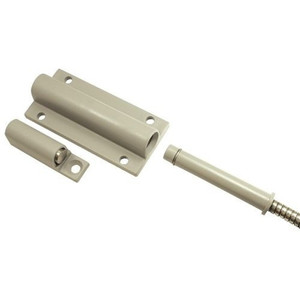
GRI GR2721 UL634 Level 2 High-Security Recessed Contact
The GRI GR2721 is a recessed magnetic contact sensor designed for access control and entry monitoring in high-security facilities. Built to UL634 Level 2 and ULC/ORD-C634 Level 2 standards, it provides tamper-resistant detection with minimal false-positive susceptibility in demanding environments. The solid-state sensing architecture eliminates moving parts, reducing maintenance overhead while delivering the reliability required for secure perimeter and door-frame installations.
Key Features
- UL634 Level 2 Certification: Tamper-resistant design tested to rigorous security standards. Resists defeat attempts and unauthorized sensor bypass techniques.
- Air Gap Sensing: 0 to 3/16" (4.76 mm) sensing range. Tight tolerance enables reliable surface-mounted or recessed installation on both wood and metal frames without alignment drift.
- Ultra-Low Operating Current: 10 µA draw. Minimal power footprint allows integration into battery-backed access control circuits with extended runtime on backup supplies.
- Vibration and Shock Insensitive: Solid-state construction eliminates false alarms from door slam, wind loading, or vehicle vibration — critical for high-traffic or outdoor-adjacent secure entries.
- Extended Temperature Range: Rated -35°C to +70°C operation. Maintains tamper-detection sensitivity in cold storage, rooftop mechanical spaces, and sun-exposed exterior frames.
- Recessed and Surface Mount: Ships with tamper plate, actuator, and stainless fasteners. Mounts flush on wood or metal surfaces — concealed installation reduces visual attack surface and improves aesthetics in controlled-access spaces.
- Lifetime Warranty: Manufacturer warranty covers workmanship, materials, and factory defects — no annual renewal cost on installed base.
The GR2721 is engineered for applications where entry-point integrity must be continuously verified without operational ambiguity. High-security server rooms, data centers, evidence lockers, pharmaceutical storage, and classified-document facilities routinely spec GRI Level 2 contacts because the certification pedigree and tamper architecture eliminate regulatory compliance risk. Paired with a modern access-control panel (Salto, DoorKing, HID) or a dedicated secure I/O module, the contact closes a circuit on door open and reports the state back to the access log.
Installation is straightforward on frame-mounted applications: mortise the sensor into the door frame header or sidelight, position the magnet actuator on the door itself, and wire both the contact terminals and tamper loop into your access-control input module. The 10 µA draw keeps wiring runs flexible — no need for oversized conductor bundles to ground distant sensors. Because the contact is passive (relay-based) rather than powered analog, it integrates with any generic NO/NC input on legacy and modern panels alike.
The tamper-plate and actuator assembly are included, which eliminates the nickel-and-diming common in budget contact lines. The stainless fasteners resist corrosion in humid or coastal environments. Field replacement is a five-minute swap — no downtime scheduling, no firmware updates, no commissioning overhead.
GRI contacts are sourced directly from the manufacturer and carry no grey-market or parallel-import risk. The UL634 Level 2 certification is the gate-keeper for federal facilities, healthcare networks with DEA licensure, and financial institutions subject to PCI compliance. If your project specifies "UL634 certified contact," the GR2721 is a proven solution with decades of field history.
Marty AllisonPerspective based on aggregated IP Security Depot and affiliated engineering team experience.
We've installed the GR2721 across federal courthouse security upgrades, pharma cold-chain evidence rooms, and bank vault ante-chambers — it's a workhorse contact that doesn't generate false-alarm fatigue or integration surprises. The UL634 Level 2 pedigree matters more than the spec sheet: compliance officers and security auditors recognize the certification immediately, which compresses the approval cycle on regulated projects. In our experience, integrators often underbid the soft costs of proving lower-cost contacts meet regulatory thresholds; specifying GRI Level 2 from the outset eliminates that negotiation risk. The 10 µA draw is genuinely low — we've wired 20+ contacts on a single 18/2 run without voltage drop, which simplifies panel I/O card density planning. The vibration immunity is the real differentiator versus cheaper piezo-based contacts: exterior door frames that vibrate in wind or traffic, loading-dock overhead doors, and server-room rollup gates all generate false alarms on sensitive-threshold contacts. GRI's solid-state sensing simply doesn't care.
Technical Highlights:
- UL634 Level 2 Tamper Resistance: The contact meets federal and insurance-carrier mandates for high-security entry points. Tamper-plate design prevents magnet substitution or sensor defeat without triggering the alarm loop. On regulated projects, this certification is non-negotiable.
- 10 µA Quiescent Draw: Unusually low power consumption allows extended operation on backup batteries and simplifies low-power access-control architectures. On systems with 50+ doors, this compounds to real budget savings on UPS sizing.
- Passive Relay Output: NO/NC switching — works with any panel input card, legacy or current. No powered sensor, no impedance matching, no analog calibration. Field-swappable in seconds.
- Insensitive to Vibration and Shock: Solid-state sensing eliminates false alarms from door slam, wind loading, or seismic activity. Critical for high-traffic or exterior-adjacent openings where piezo-based contacts would generate daily nuisance alerts.
- 0 to 3/16" Air Gap: Tight sensing tolerance enables reliable concealed (recessed) mounting without alignment drift over time. Wood and metal frames are both supported without any sensor re-calibration.
Deployment Considerations:
- The contact itself is passive and inert until wired into an access-control loop. Confirm that your panel's input card supports both door-open detection and tamper-loop monitoring. Legacy DKS or Salto systems require a separate tamper input — don't wire it as a standard N/O door contact or you'll lose tamper signaling.
- Mounting requires accurate positioning — the 3/16" air gap is forgiving, but exceeding it will create intermittent detection. On metal frames, use non-ferrous shims to avoid magnet-frame attraction reducing the effective air gap. Test with the provided actuator placement tool before final installation.
- The magnet actuator is integrated into the strike/frame plate — ensure the door swing clearance doesn't compress the plate or the magnet assembly will separate from the contact on closing. Common mistake on retrofit retrofits where door thickness varies.
- Tamper-loop wiring should be run in conduit or bundled separately from AC power to avoid EMI coupling. 18/2 or 20/2 is typical; use a dedicated input card channel and set the access-control software to log and alert on tamper events in real time.
- Testing: perform a monthly magnet-withdrawal test (manually open the door with the magnet removed) to verify the tamper circuit is functional. Many integrators skip this; it's five seconds per door and prevents discovering a broken tamper loop during an actual incident.
The GR2721 is the right choice for integrators and end-users who prioritize certification pedigree, regulatory compliance, and installation simplicity over commodity pricing. If your project specifies UL634 Level 2 or you're supporting a federal or healthcare facility, this contact is your baseline. Explore the full GRI catalog for complementary high-security hardware.