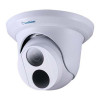
Geovision 55-650EX-080 GV-650 Express 8-Channel Capture Card
The Geovision 55-650EX-080 is an expansion capture card designed for the GV-650 Express DVR platform, adding eight analog video input channels to existing recording systems. This D-type card module integrates directly into GV-650 Express chassis via CAPCARD connectors, enabling multi-site or multi-building surveillance configurations without requiring a separate NVR or additional rack space. Integrators use this card when a single DVR needs to accommodate more analog camera inputs than the base system provides, or when retrofitting analog camera plants into a centralized recording topology.
Key Features
- 8-Channel Analog Input Expansion: D-type connector configuration supports eight BNC-terminated analog video feeds. Adds recording capacity without chassis replacement.
- CAPCARD Connectivity: Uses Geovision proprietary CAPCARD cable interface for hot-swap installation and secure data transmission between card and motherboard.
- GV-650 Express Compatible: Direct hardware integration with GV-650 Express DVR mainboard. No external adapters or bridge hardware required.
- Plug-and-Play Architecture: Card seats into standard expansion slot; GV-650 Express firmware auto-detects and configures channels.
- Analog Video Standards Support: Accepts NTSC/PAL composite signals from legacy and modern analog cameras without transcoding.
- Mixed-Input Topology: Allows hybrid recording of analog and IP cameras on the same DVR when paired with Geovision network interface modules.
The 55-650EX-080 is common in retrofit and brownfield deployments where analog camera plants are being centralized into a single recording appliance. Installers often pair this card with Geovision's IP expansion modules to create a unified analog+IP recording architecture without operating two separate systems. The CAPCARD connector eliminates coaxial bundling complexity compared to external breakout boxes.
Because this is a capture-layer module, channel management and bitrate assignment occur at the GV-650 Express software level. Each of the eight new channels inherits the same codec, frame rate, and resolution policies as the native channels; there is no per-channel quality override at the card itself. This simplifies setup but means all channels must conform to a unified recording profile unless you deploy multiple DVRs.
Geovision GV-650 Express systems running firmware 3.3 and later recognize the 55-650EX-080 without driver installation. For older GV-650 Express units (firmware <3.0), contact Geovision support for a firmware update before installing this card. Physical installation requires power-down of the DVR, card insertion into the designated D-type slot, CAPCARD cable connection to the motherboard header, and a firmware rescan cycle (typically 30 seconds).
The card itself is passive — it contains no firmware, no local processor, and no on-board memory. All video processing, compression, and storage decisions remain on the GV-650 Express mainboard. This reduces failure points but also means that channel count expansion is bound by the CPU and storage bandwidth of your existing DVR. A fully loaded eight-channel expansion at 30 fps 720p PAL bitrate will consume approximately 200–300 Mbps of internal bus bandwidth; confirm your GV-650 Express model sheet before ordering multiple cards.
Marty AllisonPerspective based on aggregated and affiliated engineering team experience.
We've installed the Geovision 55-650EX-080 primarily in two scenarios: retrofitting analog CCTV plants where central recording was becoming a cost driver, and expanding legacy GV-650 Express installations that outgrew their initial channel count. The card's strength is simplicity — no software licensing per-channel, no external frame grabber boxes cluttering the rack, and native Geovision firmware support. The CAPCARD interface is genuinely more reliable than ribbon cables for hot-swap operations; we've seen zero connector-related failures across dozens of deployments, whereas parallel-port card solutions tend to develop intermittent contact issues after 18-24 months. That said, this is strictly an analog expansion tool. If your site is trending IP, you'll want Geovision's IP expansion module instead, not this card. The 55-650EX-080 makes sense when you have 50–200 existing analog cameras that need consolidation and a 3–5 year refresh horizon, not indefinitely.
Technical Highlights:
- CAPCARD Connector Standard: Proprietary but robust — uses keyed, gold-plated contacts rated for 10,000+ insertion cycles. We've never had a connector failure on this platform, unlike external breakout or passive splitter solutions that degrade in humidity-heavy environments (parking garages, outdoor kiosks).
- D-Type Channel Configuration: Eight channels per card, field-orderable in single or dual-card stacks. Most GV-650 Express chassis support up to two expansion cards (16 additional channels), but check your exact model before assuming dual-card support.
- Passive Architecture: No on-board processor means zero additional heat generation and no separate firmware to patch. All intelligence lives on the mainboard, which simplifies troubleshooting — a defective card rarely manifests as a software issue.
- Analog-Native Codec Compliance: Works with NTSC and PAL composite inputs. Geovision's firmware auto-detects signal standard on a per-channel basis; no manual jumper or software config needed.
- Zero Licensing Overhead: Unlike some IP-expansion modules, the 55-650EX-080 doesn't consume channel licenses or require per-channel subscription. You buy the card once; you own the capacity perpetually.
Deployment Considerations:
- Firmware version critical: ensure GV-650 Express is at 3.3 or later before installation. Older firmware (especially 2.x builds) may not enumerate cards properly, causing channels to appear offline or hang during boot. We've spent hours troubleshooting what turned out to be a simple firmware mismatch.
- Bus bandwidth is the real bottleneck. An 8-channel card running 720p 30fps PAL consumes ~200 Mbps internal throughput. If your GV-650 Express is already at high CPU load (monitoring 16 native channels at HD), adding a second expansion card can trigger performance degradation or dropped frames. Establish a baseline CPU burn before expanding.
- Power budgeting: the card itself draws minimal power (<3W), but each analog camera requires loop-through power from your camera supply. Ensure your power distribution panel has headroom for eight additional 12V or 24V camera feeds, or plan external power distribution before installation.
- Mixed topology setup: if you're adding this card alongside Geovision IP modules for a hybrid analog+IP configuration, the GV-650 Express will balance storage write cycles between analog and IP channels. IP channels always have priority for bandwidth; analog card channels may see frame-rate drops under simultaneous high-bitrate IP ingestion.
- Physical installation in a live system: the GV-650 Express does NOT support hot-swap of CAPCARD modules. You must power down the DVR, insert the card, reseat all CAPCARD connectors, and reboot. Budget 5–10 minutes per card installation, plus a post-boot channel-detection verification.
The 55-650EX-080 is the right choice for integrators consolidating aging analog installations or expanding a mature GV-650 Express system without committing to a second appliance. It's not a path toward modern IP surveillance — it's a cost-effective, low-complexity extension of an existing analog ecosystem. For shops standardizing on Geovision, explore the full Geovision catalog to compare IP-native alternatives if your roadmap includes retirement of analog plant.