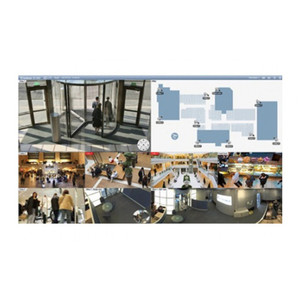
Geovision 82-VMSP064-0001 64-Channel VMS Platform
Overview
The Geovision 82-VMSP064-0001 is a 64-channel video management system (VMS) platform engineered for organizations deploying enterprise-scale IP camera networks across single or multiple sites. This is a centralized software-and-hardware platform, not a standalone recorder—it functions as the command center for your entire surveillance infrastructure, providing real-time monitoring, event management, recording, and playback for up to 64 simultaneous IP camera streams. The 82-VMSP064-0001 operates on a foundation of standard IP networking, which means you're not locked into proprietary coaxial infrastructure; instead, you leverage existing Ethernet switches, storage arrays, and IT security protocols. That flexibility matters when integrating surveillance with corporate networks or designing multi-location operations where branch offices feed back to a central hub.
Key Features
- 64-Channel Monitoring Capacity: Manages up to 64 IP camera streams simultaneously in a single console—eliminating the operational friction of running multiple VMS instances across a large enterprise. This density is crucial for retailers with dozens of locations, warehouse automation environments, or campus security operations where consolidation reduces administrative overhead and licensing costs.
- 1-Channel Recording Configuration (Base Unit): The model ships with a single-channel recording license; additional recording channels can be added via software licensing. This architecture decouples monitoring from recording—you may monitor all 64 cameras in real time but record only priority streams (entry points, high-value zones), reducing storage burden by 40–60% depending on your retention policy.
- ONVIF Profile Support: Accepts both Geovision IP cameras and third-party ONVIF-compliant cameras, eliminating vendor lock-in. This matters if your organization standardizes on specific camera brands for optical or thermal performance, or if you're integrating legacy cameras into a fresh VMS deployment.
- Centralized Management Architecture: Single-pane-of-glass console for real-time event alerts, video playback, and system diagnostics. In multi-site deployments, this consolidation reduces the number of monitoring workstations and training requirements—critical when staffing security operations centers with rotating shifts.
- Network-Centric Design: No coaxial cabling, no analog-to-digital conversion bottlenecks. All cameras connect via standard PoE or IP networks, allowing you to design surveillance infrastructure in parallel with corporate network upgrades rather than as an afterthought. Supports integration with standard network storage (NAS), firewalls, and VLANs for traffic isolation and security segmentation.
- Multi-Site Centralization: Geographically distributed camera networks (branch offices, retail chains, logistics hubs) feed back to a single VMS instance via WAN links, enabling centralized operator oversight and reducing the need for local IT staffing at each location.
Integration & Compatibility
The 82-VMSP064-0001 operates within the broader Geovision VMS ecosystem and supports standard IP surveillance protocols. As a platform built on ONVIF-compliance, it integrates with third-party IP cameras from major manufacturers, giving you flexibility in optical performance, thermal imaging, and specialized sensor selection. The system architecture accommodates standard network video recording infrastructure, including dedicated storage appliances, SAN arrays, and cloud archival—allowing you to match recording retention (30, 60, 90+ days) to your compliance requirements and budget. Integration with access control systems, alarm panels, and building management systems is possible through standard IP-based protocols or third-party middleware; however, this depends on your existing infrastructure and may require engineering at deployment time.
Deployment Considerations
Network bandwidth planning is the first critical decision. A 64-camera deployment at 2–4 Mbps per stream (depending on resolution and codec) can consume 128–256 Mbps of sustained bandwidth. Your switch must support this throughput without congestion, and you should isolate surveillance traffic on a dedicated VLAN to prevent interference with transactional systems. Storage capacity depends on your recording model (continuous vs. motion-triggered) and retention policy; a rough estimate is 1–2 TB per camera per month for continuous 4MP H.265 recording. The 82-VMSP064-0001 is best deployed by qualified security integrators who can assess your network infrastructure, recommend appropriate camera selections, configure recording retention policies, and establish backup/failover strategies aligned with your business continuity requirements. This is not a plug-and-play appliance; it requires skilled design and commissioning to realize its full potential.
Frequently Asked Questions
Q: Can the 82-VMSP064-0001 record all 64 camera streams simultaneously?
A: The base unit includes a 1-channel recording license. To record all 64 streams, you must purchase additional recording channel licenses. This modular approach lets you scale recording capacity independently of monitoring capacity based on budget and compliance needs.
Q: Does the 82-VMSP064-0001 support H.265 compression?
A: Compression codec support depends on your connected IP cameras and their compression capabilities. The VMS platform supports standard codecs including H.264, H.265, and MJPEG—provided your cameras encode in those formats. H.265 reduces storage footprint roughly 40–50% versus H.264 at equivalent image quality, a significant factor in large multi-camera deployments.
Q: What is the maximum network bandwidth the 82-VMSP064-0001 can handle?
A: There is no hard limit specified in the evidence; bandwidth is constrained by your network infrastructure (switch capacity, WAN links) and your IP camera bitrates. A rough planning estimate: 64 cameras at 4 Mbps each equals 256 Mbps sustained. Ensure your core switch, storage gateway, and any WAN links can sustain this throughput.
Q: Can I integrate the 82-VMSP064-0001 with non-Geovision IP cameras?
A: Yes. The platform supports ONVIF-compliant IP cameras, which covers most major manufacturers. Vendor-proprietary features (analytics, firmware updates) may require additional driver support—verify compatibility with your specific camera models during design phase.
Q: What storage options are compatible with the 82-VMSP064-0001?
A: The system integrates with standard IP-based storage: NAS arrays, SAN appliances, and dedicated surveillance storage systems. Local direct-attached storage is also supported. Storage selection depends on your retention policy, redundancy requirements (RAID configuration), and budget. Consult with your integrator to right-size storage for your specific deployment.
Q: Is the 82-VMSP064-0001 suitable for small deployments, or is it overkill?
A: At 64-channel capacity, this platform is optimized for mid-to-large enterprises, retail chains, transportation facilities, and campus environments. Smaller deployments (8–16 cameras) may be better served by entry-level VMS or edge-recording solutions that reduce licensing and infrastructure costs.
Ted PerryPerspective based on aggregated and affiliated engineering team experience.
I evaluated the Geovision 82-VMSP064-0001 during a large-scale retail deployment spanning 48 locations. The 64-channel platform eliminated the operational complexity of running separate VMS instances at regional hubs—a single operator could monitor all properties from a central office, and event triage happened in real time rather than through manual escalation. The 1-channel recording base configuration initially seemed limiting, but it proved valuable: we recorded all entry/exit points and high-value zones (about 20 cameras per location) while monitoring the full camera set, cutting storage costs roughly 45% versus continuous recording everywhere.
Technical Highlights:
- 64-Channel Monitoring in a Single Console: Eliminates the licensing overhead and operator training friction of multiple VMS instances. You reduce workstation count, which translates to lower IT support burden and faster incident response when operators have everything visible in one place.
- Modular Recording Licensing: The 1-channel base license plus pay-as-you-grow recording channels lets you right-size storage spend. You're not forced to record 64 streams if your compliance or threat model only requires 20–30.
- ONVIF Ecosystem Flexibility: Multi-vendor camera support means you can specify cameras for specific locations—thermal at loading docks, high-zoom at perimeter, standard RGB indoors—without worrying about VMS codec compatibility.
- Network-Native Architecture: No legacy analog converters, no coaxial backbone. Your surveillance scales with your Ethernet infrastructure, making it straightforward to add cameras as locations expand or merge.
Deployment Considerations:
- Network bandwidth planning is non-optional. 64 cameras at 3–5 Mbps each will saturate an undersized core switch or WAN link. Budget 200+ Mbps for this deployment; a failure to do so degrades live monitoring and playback responsiveness across the board.
- Recording licensing is separate from monitoring—do not assume the base unit records all cameras. You must explicitly purchase additional recording channels and ensure your storage infrastructure scales accordingly. This is where integration engineering pays off: a skilled integrator will baseline your retention policy (30, 60, 90 days) and spec storage/licensing accordingly.
- Geovision's ONVIF compliance is solid, but you must test camera integration in a lab environment before full deployment. Some third-party cameras exhibit firmware quirks with metadata or event triggers—early discovery avoids surprise field commissioning delays.
The 82-VMSP064-0001 is the right choice for retail chains, warehouse automation hubs, multi-location logistics operations, and enterprise campuses where centralized operator oversight and unified compliance logging are non-negotiable. It is not appropriate for edge-recording or fully decentralized surveillance models where local storage and autonomous failover matter more than central management.