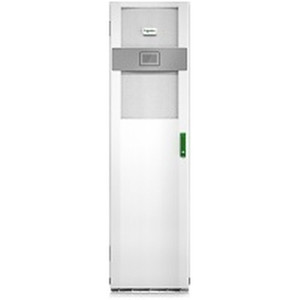
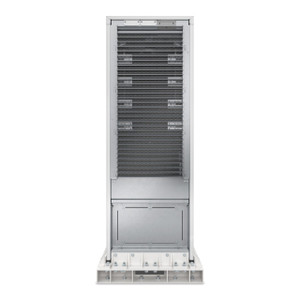
APC by Schneider Electric GVSUPS80KRGS 80kVA 480V N+1 Modular UPS
Overview
The APC by Schneider Electric GVSUPS80KRGS is a high-capacity, modular uninterruptible power supply delivering 80 kVA / 80,000 W at 480V — purpose-built for data centers, critical IT infrastructure, and industrial environments where a single power interruption carries real operational and financial consequences. The N+1 power module architecture means one module can fail or be serviced without dropping load, making this a natural fit for facilities that cannot tolerate unplanned downtime. Explore the full APC by Schneider Electric power protection catalog for the broader Galaxy VS family.
This unit ships as a special-order configuration, so engage your project team early — lead times on large modular UPS systems vary and this is not a same-day stock item. If you are evaluating it alongside the UPS category, note that the 480V input/output configuration is specific to North American high-voltage distribution and targets larger IT rooms, colocation pods, and industrial control rooms rather than typical office or small server room deployments.
Key Features
- 80 kVA / 80,000 W Capacity: At full 80kW, this unit can carry a dense rack environment — think a pod of blade servers, high-density storage, or an entire HPC cluster segment. Sizing at 80kW gives you headroom above a typical 60–70% load target without stepping up to a larger frame.
- N+1 Power Module Architecture: The N+1 configuration adds one redundant power module beyond what the load requires. If any single module faults, the remaining modules absorb the load transparently. This is the difference between a scheduled maintenance window and an emergency call at 2 a.m.
- Pure Sine Wave Output: Sensitive electronics — servers, storage arrays, networking gear with active PFC power supplies — require a clean sine wave, not a stepped approximation. The GVSUPS80KRGS delivers true sine wave output on battery, eliminating compatibility issues with modern switched-mode power supplies that reject modified sine wave sources.
- Lithium-Ion Battery Technology: Li-Ion cells offer a longer service life and reduced maintenance cycles compared to traditional VRLA lead-acid batteries. In a facility where battery replacement involves coordinating downtime windows and disposal logistics, fewer replacements translate directly to lower total cost of ownership over the UPS lifespan.
- 480V Input/Output: Operating at 480V three-phase means lower current draw for the same power delivery — smaller wire gauges, reduced I²R losses, and compatibility with 480V PDU infrastructure already common in North American data center and industrial environments. If your distribution is 208V, this is not the right SKU.
- External Battery Support: The GVSUPS80KRGS is configured for external battery modules, allowing runtime to be extended by adding battery enclosures rather than replacing the UPS frame. This is the right architecture when your runtime requirement exceeds what internal batteries can provide — common in healthcare, financial, and colocation scenarios where extended outage coverage is contractually required.
- Startup Service (Start-up 5) Included: The product name specifies Start-up 5 commissioning, indicating a factory-coordinated startup service is bundled. For a system at this scale, professional commissioning reduces the risk of installation errors that could void warranty coverage or cause load drops during initial energization.
Integration and Compatibility
The Galaxy VS platform integrates with building management systems and data center infrastructure management (DCIM) platforms via standard communication protocols. The 480V configuration aligns with North American high-voltage distribution infrastructure and is typically paired with compatible power distribution units (PDUs) downstream. For facilities planning runtime extension, external battery enclosures from the Galaxy VS family attach directly — confirm compatibility by matching the GVSUPS80KRGS SKU against the current Schneider Electric external battery module lineup before procurement.
If your load profile is under 80kW or your facility runs 400V distribution (common in international deployments), evaluate sibling models in the Galaxy VS family — for example, the GVSUPS80KRHS targets 400V environments at the same 80kW capacity tier. Right-sizing the voltage configuration before ordering is critical; retrofit after installation is not feasible.
Frequently Asked Questions
Q: What is the difference between the GVSUPS80KRGS and the GVSUPS80KRHS?
A: Both are 80kW Galaxy VS units with N+1 power modules. The GVSUPS80KRGS is configured for 480V distribution, which is standard in North American high-voltage data center environments. The GVSUPS80KRHS targets 400V, the standard for international and European deployments. Selecting the wrong voltage variant requires a complete swap — verify your facility's input voltage before ordering.
Q: Does the GVSUPS80KRGS use internal or external batteries?
A: This configuration is designed for external batteries. Runtime is determined by the external battery modules you add, not internal cells. This architecture supports runtime extension without replacing the main UPS frame, which is an advantage in environments with long backup-time requirements.
Q: Is the GVSUPS80KRGS a stock item or special order?
A: The GVSUPS80KRGS is a special-order product. Lead times vary — plan procurement well ahead of your installation date and confirm lead time at the time of quote.
Q: What type of battery does the GVSUPS80KRGS use?
A: It uses Lithium-Ion (Li-Ion) battery technology, which generally provides a longer service life and lower maintenance requirements compared to traditional VRLA lead-acid batteries commonly found in legacy UPS installations.
Q: Does the GVSUPS80KRGS include a startup service?
A: Yes. The product configuration specifies Start-up 5, which is a factory-coordinated commissioning service. For an 80kW modular UPS, professional startup is strongly advisable to ensure correct installation, load transfer validation, and warranty integrity.
Q: What output waveform does the GVSUPS80KRGS produce?
A: The GVSUPS80KRGS delivers pure sine wave output both on utility power and on battery. This is a firm requirement for servers and storage systems with active PFC power supplies, which can malfunction or shut down when fed a modified or stepped sine wave from lesser UPS designs.
The GVSUPS80KRGS sits in a specific part of the market — 80kW at 480V with N+1 redundancy and Li-Ion batteries is not a general-purpose UPS. It is a deliberate infrastructure investment for facilities where load continuity is non-negotiable. I reach for this configuration when a client is running high-density compute, has a 480V distribution backbone already in place, and needs the ability to service a power module without scheduling a maintenance outage.
Technical Highlights:
- 80kW / 80kVA Capacity: At unity power factor, this unit delivers a full 80,000 W — no derating gap between kVA and kW ratings, which matters when you are capacity-planning against measured load rather than nameplate estimates.
- N+1 Power Module Redundancy: One module can be pulled for service or fail outright and the UPS continues carrying the load without interruption. This is the core argument for modular architecture at this scale — the alternative is parallel UPS systems with significantly more floor space and wiring complexity.
- Lithium-Ion Chemistry: Li-Ion batteries tolerate more charge/discharge cycles and typically maintain capacity longer than VRLA alternatives. In a facility running regular generator tests or operating in a utility-unstable region, cycle count adds up fast — Li-Ion absorbs that more gracefully.
Deployment Considerations:
- This is a 480V three-phase system — confirm your facility has a 480V distribution panel and compatible transfer switch infrastructure before the order is placed. Retrofitting the electrical distribution after the UPS arrives is an expensive delay.
- The external battery configuration means runtime is not defined by this SKU alone. You must spec the external battery enclosures separately and confirm they are listed as compatible with the GVSUPS80KRGS in the current Schneider Electric Galaxy VS battery compatibility guide. Mismatched battery enclosures are the most common installation error on this platform.
For a North American colocation pod, a high-density HPC deployment, or a financial trading floor running 480V distribution, the GVSUPS80KRGS delivers the right combination of capacity, redundancy model, and battery technology for a long-service-life installation. It is not the right call for a 208V server room or any environment where stock availability and short lead times are a hard requirement.